The Viking Archaeology Blog is concerned with news reports featuring Viking period archaeology. It was primarily constructed as a source for the University of Oxford Online Course in Viking Archaeology: Vikings: Raiders, Traders and Settlers. For news reports for general European archaeology, go to The Archaeology of Europe News Blog.
Sunday, 3 May 2020
From the Vikings to WWII, the Danevirke Wall Has Seen it All
All through classical history, imposing and long walls, ramparts, and fortifications played a significant role in securing the borders of nations and kingdoms from all sorts of incursions and attacks. Some of the best examples are left to us by the ancient Romans, with their majestic limes fortifications of Europe, and the Antonine and Hadrian’s Wall in Scotland. Then there is the famous inspiring Great Wall of China , the likes of which were never replicated again.
But no matter where they were, these fortified walls and ramparts were always a great achievement. They required a lot of manpower, took a long time to erect, and were costly. But all of that was worth it - for such a wall could help guard a great area of land, making for an effective and immovable border. One such system of walled fortifications is known as the Danevirke, a lesser known, but equally important historical system of earth wall ramparts built by the Danes on the southern end of the Jutland Peninsula. Join us as we explore the complex history behind this important border!
The Earliest Traces of Danevirke in the Nordic Iron Age
The Danevirke, in Old Norse known as Danavirki, and in German as Danewerk, is today located not in Denmark, but in Germany, in the state of Schleswig-Holstein. It is believed that the earliest forms of a linear walled fortification across the neck of the Jutland Peninsula began sometime prior to 500 AD, in the Nordic Iron Age.
Read the rest of this article...
Thursday, 30 April 2020
The British Museum is displaying 4 million items from its collection online
Photograph: The Lewis Chessmen. © The Trustees of the British Museum
Got some browsing time on your hands? Load up the British Museum’s website. Yesterday the museum decided to do an earlier-than-planned unveil of its revamped online collection. It’s now the biggest database of any museum in the world, with more than 4 million objects to click through.
The collection features the museum’s most famous artefacts, like the Rosetta Stone, the Parthenon Sculptures, along with every item the institution holds from Ancient Egypt.
But there are some new additions too – including 280,000 new object photographs that are being published for the first time. Among them are images of 73 portraits by Damien Hirst and a watercolour by the Pre-Raphaelite Dante Gabriel Rossetti that until recently had been thought lost. You can also look for works by Kara Walker, William Hogarth and Rembrandt in a digital archive of 75,000 art prints. If you’re more into coins, they have about 50,000 of those – medieval, Tudor, the works. Fill your boots.
Read the rest of this article...
White Hugh MacNéill and his wars with the Lough Foyle vikings
White Hugh MacNéill must have regarded the Viking gathering on his very doorstep with a mixture of anger and fear, writes Kevin Mullan.
It was 866 and the local chiefain had just completed an armed tour of the North coast destroying Viking forts and scattering their settlements but now looking east from his Grianán of Aileach the king could see they were back.
It was less than 100 years since the first Viking raids in Ireland had taken place but they had now established a substantial colony in the perfect harbour of Lough Foyle.
Of this the fearsome White Hugh - recently elevated from the Kingship of Aileach to that of Ireland - could not have hoped for a clearer view.
Read the rest of this article...
Tuesday, 28 April 2020
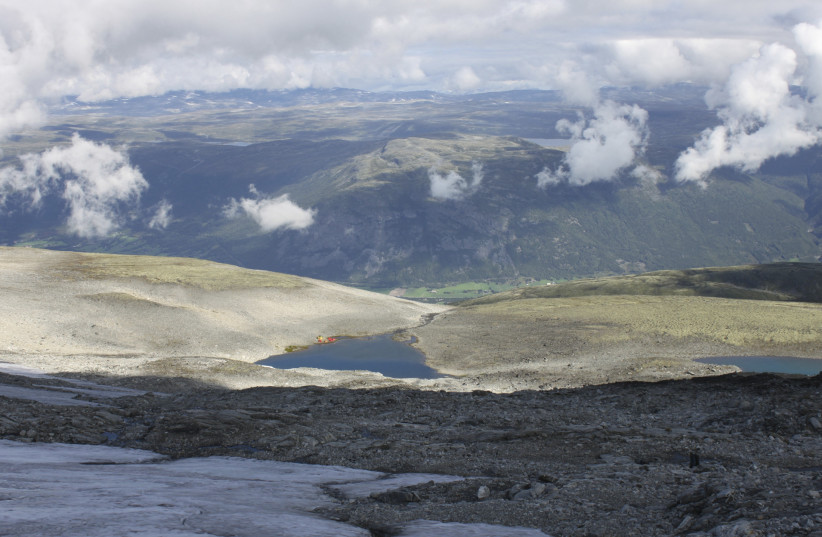
Long-forgotten Viking mountain pass found in Norway following glacier melt
General view over valley in mountains of south Norway from beside Lendbreen glacier is seen in this undated handout picture
(photo credit: REUTERS)
Due to global warming, high-elevation ice patches and glaciers have recently yielded a myriad of historical finds for archaeologists to discover.
Archaeologists have uncovered a heavily traversed glacial mountain pass in Lendbreen, Norway, utilized by travelers throughout the Viking Age, and littered with hundreds of artifacts presumed to have been used by the Vikings during that time period, according to a new study published by the Cambridge University Press on Wednesday.
Due to the warming global climate, high-elevation ice patches and glaciers have recently yielded a myriad of historical finds for archaeologists to happen upon as they finally gain access to these areas after the layers of ice once covering them have gradually melted away over time – and much faster recently.
Read the rest of this article...
Melting glaciers reveal lost mountain pass and artifacts used by Vikings
The retreat of melting glaciers has revealed a lost mountain pass in Norway -- complete with hundreds of Viking artifacts strewn along it, according to a new study.
Researchers first discovered the pass in 2011 and have been examining it, and the artifacts that have been revealed as more ice melts, ever since. Dating the objects helped them reconstruct the timeline of when this pass was used and its purpose.
The new study published this week in the journal Antiquity.
In recent years, climate change has caused mountain glaciers to melt away, revealing well-preserved markers from different periods in history beneath. This is what happened in Lendbreen, Norway.
Read the rest of this article...
Coring Arctic Lakes To Study Vikings
Vikings were here, but thousands of years earlier Stone Age people were, too. D’Andrea’s team hikes down to core a small pond next to the remnants of these people’s sea-side dwellings
[Credit: Columbia University]
Billy D'Andrea, a Lamont-Doherty Earth Observatory paleoclimatologist and Center for Climate and Life Fellow is currently doing fieldwork in Norway's Lofoten Islands. He's interested in the natural factors that may have influenced the growth of northern agriculture and rise of violent Viking chieftains during the Iron Age, ca. 500 BC to 1100 AD.
The Lofoten Islands—located above the Arctic Circle—were marginal for farming, so inhabitants were probably susceptible to small temperature swings, as well as changes in sea level (two to three meters higher in the Iron Age than today).
In this area, powerful Viking rulers and their predecessors left behind hundreds of dwellings, boathouses, and other structures. D'Andrea and his colleague, Nicholas Balascio, want to understand how the Vikings influenced the land, and vice versa, as their culture took hold, and learn why Viking chiefdoms collapsed.
Read the rest of this article...
Saturday, 25 April 2020
Who was Edward the Elder? A brief guide to the Anglo-Saxon king
Who was Edward the Elder?
He was the son of King Alfred and Ealhswith of Mercia. A man of Wessex, he was probably born in the 870s and died in 924. After his father’s death in 899, and like Alfred, he was called king of the Anglo-Saxons, reflecting his overlordship of both Wessex and Mercia. He was married three times and had an estimated 14 children. His son, Aethelstan, succeeded him. He lived in a time when the Anglo-Saxon kingdoms had not yet coalesced into England, and when Vikings held sway in East Anglia and Northumbria.
Read the rest of this article...
Monday, 20 April 2020
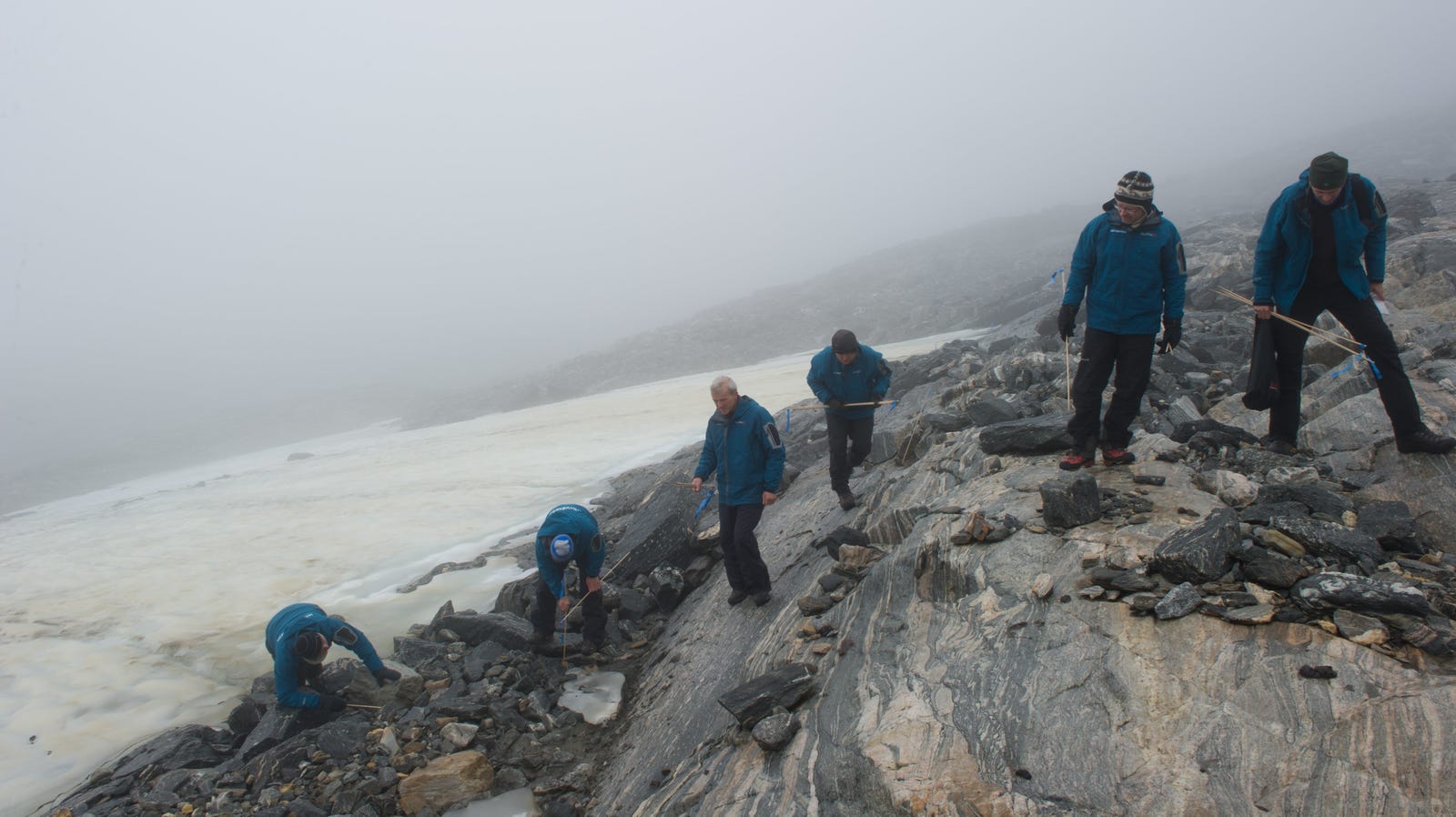
Melting Ice Exposes Mountain Pass Used by Vikings, Including Ancient Dog and Leash
Glacial archaeologists performing fieldwork at Lendbreen, Norway.
Image: L. Pilø et al., 2020/Antiquity
Archaeologists in central Norway have uncovered evidence of a heavily traveled mountain passageway that was used during the Viking Age. Hundreds of beautifully preserved items were found atop a melting glacier, in a discovery that was, sadly, made possible by global warming.
New research published today in Antiquity describes a forgotten mountain pass at Lendbreen, Norway, that was in use from the Iron Age through to the European medieval period.
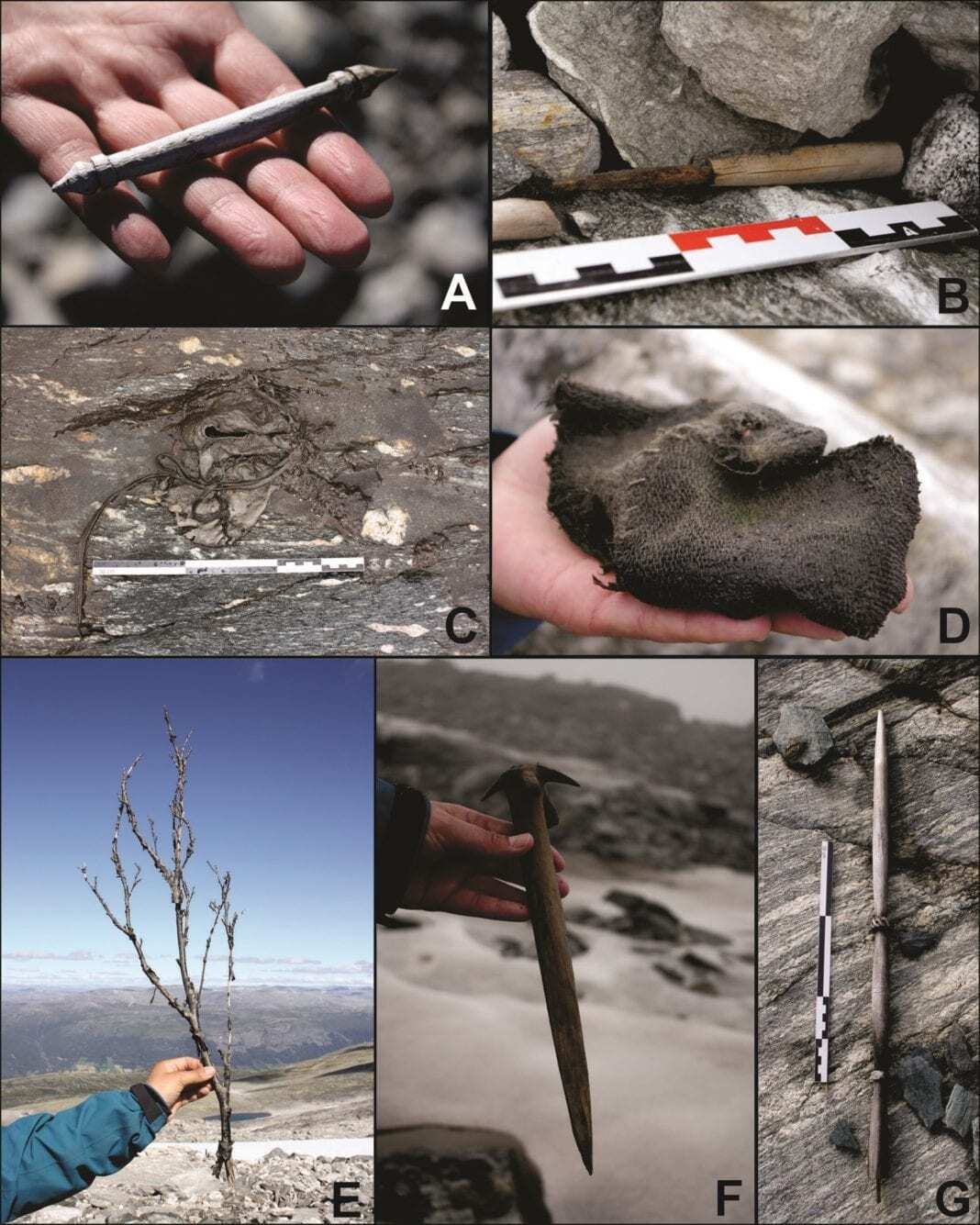
Located on Lomseggen Ridge, the passageway is absolutely littered with well-preserved artifacts, including mittens, shoes, horse snowshoes, bits of sleds, and even the remains of a dog still attached to its collar and leash. Radiocarbon dating of these artifacts is painting a picture of how and when this pivotal mountain pass was used, and its importance to both local and outside communities.
Read the rest of this article...
Thursday, 16 April 2020
Melting ice reveals lost viking artefacts on mountain pass
Image Credit : Antiquity Journal
Climate change is leading to the retreat of mountain glaciers.
In Norway, hundreds of rare archaeological finds have been revealed by melting ice in a lost mountain pass at Lendbreen in Innlandet County.
The finds tell a remarkable story of high-altitude travel in the Roman Iron Age and the Viking Age.
“A lost mountain pass melting out of the ice is a dream discovery for us glacial archaeologists,” says Lars Pilo, first author of the study and co-director for the Glacier Archaeology Program.
“In such passes, travellers lost many artefacts that became frozen in time by the ice. These incredibly well-preserved artefacts of organic materials have great historical value.”
Read the rest of this article...
The Hunt for the Lost Mountain Pass
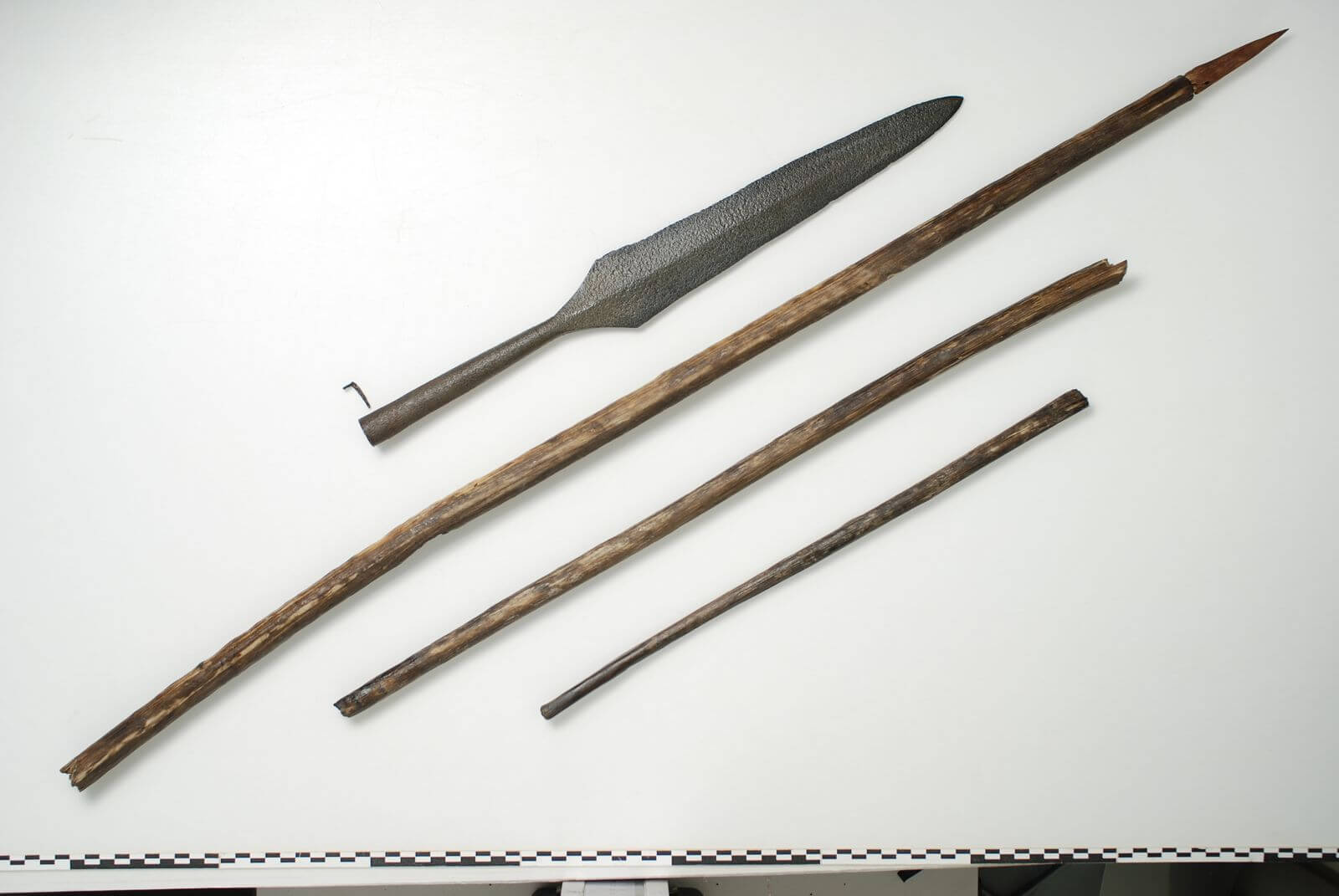
Viking Age spear, originally found in one piece in front of the Lendbreen ice patch.
Photo: Vegard Vike, Museum of Cultural History.
As glacial archaeologists, our dream discovery is a site where an ancient high mountain trail crossed non-moving ice. On such sites, past travelers left behind lots of artifacts, frozen in time by the ice. These artifacts can tell us when people travelled, when travel was at its most intense, why people travelled across the mountains and even who the travelers were. This information has great historical value.
Read the rest of this article...
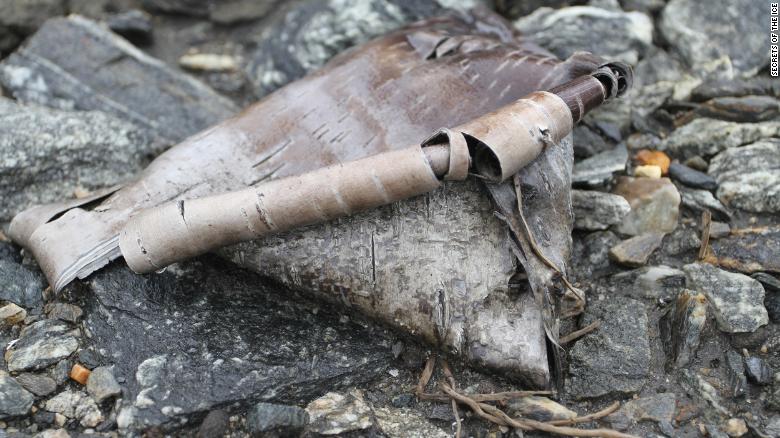
'Spectacular' artefacts found as Norway ice-patch melts
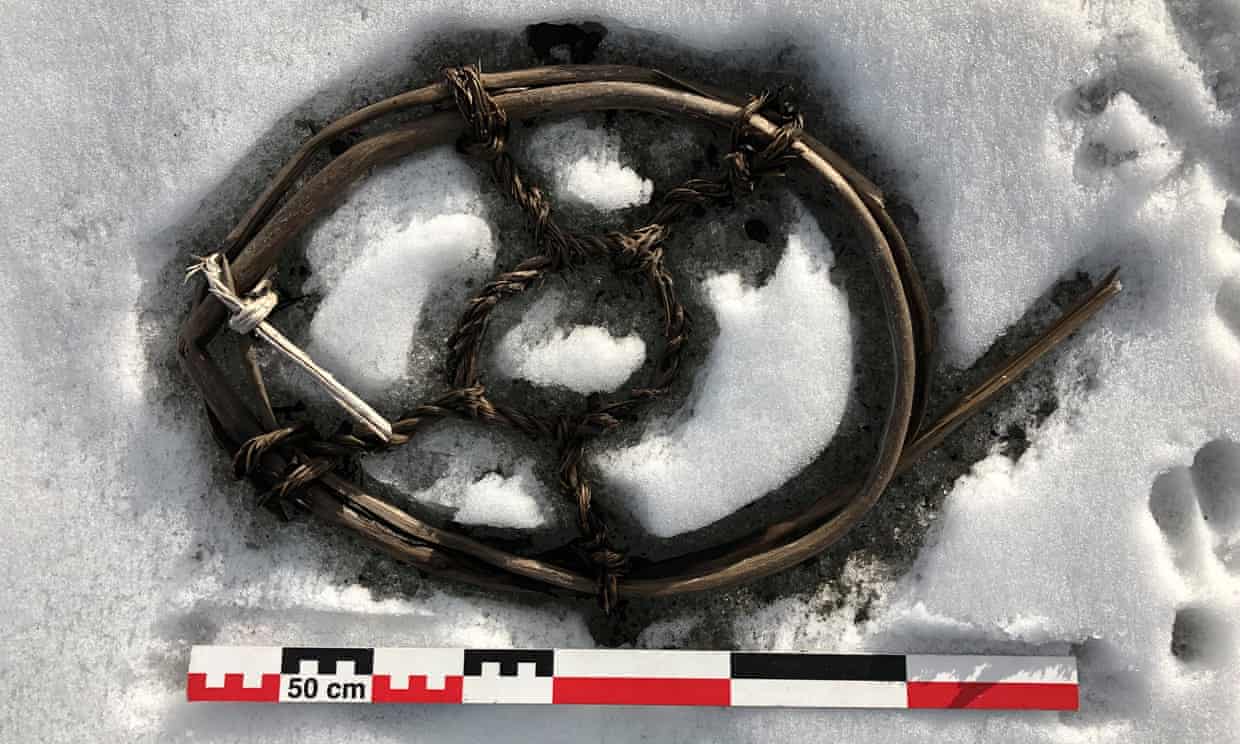
A horse snowshoe found during 2019 fieldwork at Lendbreen.
Photograph: Espen Finstad/secretsoftheice.com
Discoveries exposed by retreating ice include snowshoe for horses and bronze age ski
The retreat of a Norwegian mountain ice patch, which is melting because of climate change, has revealed a lost Viking-era mountain pass scattered with “spectacular” and perfectly preserved artefacts that had been dropped by the side of the road.
The pass, at Lendbreen in Norway’s mountainous central region, first came to the attention of local archaeologists in 2011, after a woollen tunic was discovered that was later dated to the third or fourth century AD. The ice has retreated significantly in the years since, exposing a wealth of artefacts including knitted mittens, leather shoes and arrows still with their feathers attached.
Though carbon dating of the finds reveals the pass was in use by farmers and travellers for a thousand years, from the Nordic iron age, around AD200-300, until it fell out of use after the Black Death in the 14th century, the bulk of the finds date from the period around AD1000, during the Viking era, when trade and mobility in the region were at their zenith.
Read the rest of this article...
Friday, 3 April 2020
The Fastest Viking Ship Ever Found
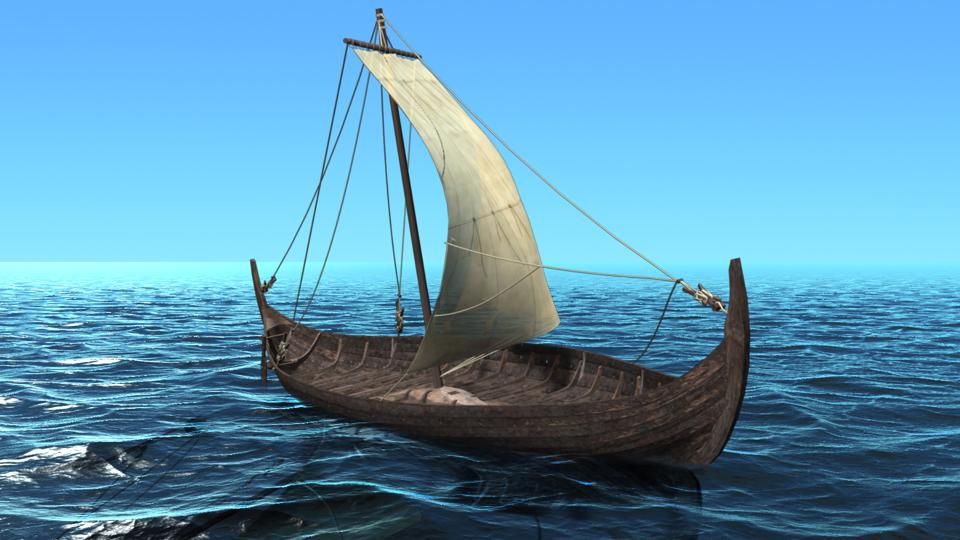
A digital reconstruction shows that the Tune Viking Ship must have been a fast sailing vessel that could also be rowed. Illustration by 7reasons for NIKU
Even though it was discovered more than 150 years ago, modern digital archaeology techniques have revealed many of the mysteries surrounding the Tune Viking ship. It now seems likely the Tune ship could cross the North Sea powered by a sail large enough to make it the fastest Viking ship ever discovered.
Modern techniques help shine a light on historic finds
Recent developments in digital archaeology, notably the use of georadar as a non-intrusive method of mapping sites of interest, have revealed several exciting Viking ship burial sites in Norway. Yet some of the digital tools and techniques can also prove useful in expanding our knowledge and understanding of existing finds.
There are only three Viking ships from burial sites in Norway that are well-preserved. All three—Gokstad, Oseberg and Tune—are on display at Oslo’s Viking Ship Museum. The Tune ship was discovered in 1867 on an island farm near Fredrikstad in south-east Norway. It has been the least understood of the three ships—until now.
Read the rest of this article...
Æthelflæd: the Lady of the Mercians
She was a queen in all but name, but Aethelflaed, the daughter of Alfred the Great, is barely mentioned in contemporary chronicles of the Anglo-Saxon era. Writer Jonny Wilkes wonders whether England owes more to her than to her famous father
When Æthelflæd was a baby her father Alfred, destined for greatness, became King of Wessex. At around 16 years old, she was married to the Lord of the Mercians and so placed next to the seat of power of a neighbouring Anglo-Saxon kingdom. In her 20s, she helped to build a string of fortifications and patronise churches; in her 30s, she took up the mantle of ruling in place of her indisposed husband and defeated the Vikings in battle; and in her 40s, on her husband’s death, Æthelflæd was chosen to lead above all male contenders.
Read the rest of this article...
Tuesday, 31 March 2020
New delay for Cork Events Centre as Danes say ancient deeds prove Vikings own site
Events Centre - Under new management?
Cork's long-delayed Events Centre has been hit by yet another hold-up as the Danish Government claims ownership of the city centre site on behalf of its former Viking owners.
The Danish culture ministry last week alerted their Government about the discovery of ancient land deeds, in the University of Copenhagen archives, which they say "prove" ownership of most of Cork City centre.
Academics at the university say the 11th Century land titles, made out to King Wulf Hardasson, clearly state that the Viking king and his rightful heirs shall lay claim to the "Great Marsh of Munster" in perpetuity.
And as the deeds were never legally dissolved after the last vikings left their settlement in Cork, the site where the long-delayed Events Centre was supposed to be built is still - legally - the property of any living descendants of the last Viking ruler of Cork.
The Danish embassy in Dublin has now lodged a formal claim with the Department of Arts, Heritage and Culture and Irish officials believe this could lead to a very lengthy legal battle with the living heirs of King Wulf Hardasson.
One Departmental official told CorkBeo; "They're saying they've traced his only living male heir, he's a plumber called Lars Sorenson who lives in Aalborg. The Danes are arguing that as the deeds were never dissolved, technically, this guy is the Viking overlord of most of Cork City."
Read the rest of this article...
Virtual Visits to Sites and Museums
Self-isolating and bored?
You can find a list of Virtual Visits to Sites and Museums at:
http://emas-archaeology.org/useful-websites/virtual-visits-to-sites-and-museums/
to help you pass the time.
Saturday, 28 March 2020
Bone analyzes tell about kitchen utensils in the Middle Ages
Clay pots? Wooden spoons? Copper pots? Silver forks? What materials has man used for making kitchen utensils throughout history? A new study now sheds light on the use of kitchen utensils made of copper.
At first thought, you would not expect hundreds of years old bones from a medieval cemetery to be able to tell you very much – let alone anything about what kinds of kitchen utensils were used to prepare food.
But when you put such a bone in the hands of Professor Kaare Lund Rasmussen, the bone begins to talk about the past.
A warehouse full of bones
- For the first time, we have succeeded in tracing the use of copper cookware in bones. Not in isolated cases, but in many bones over many years, and thus we can identify trends in historical use of copper in the household, he explains.
Read the rest of this article...
Saturday, 21 March 2020
What chemical analyzes of human bones tell us about kitchen utensils in the Middle Ages
Clay pots? Wooden spoons? Copper pots? Silver forks? What materials has man used for making kitchen utensils throughout history? A new study now sheds light on the use of kitchen utensils made of copper.
At first thought, you would not expect hundreds of years old bones from a medieval cemetery to be able to tell you very much – let alone anything about what kinds of kitchen utensils were used to prepare food.
But when you put such a bone in the hands of Professor Kaare Lund Rasmussen, University of Southern Denmark, the bone begins to talk about the past.
A warehouse full of bones
– For the first time, we have succeeded in tracing the use of copper cookware in bones. Not in isolated cases, but in many bones over many years, and thus we can identify trends in historical use of copper in the household, he explains.
The research team has analyzed bones from 553 skeletons that are between 1200 and 200 years old. They all come from nine, now abandoned cemeteries in Jutland, Denmark and Northern Germany. The skeletons are today kept at Schloss Gottorf in Schleswig, Germany and at the University of Southern Denmark.
Some of the bones examined are from Danish cities such as Ribe and Haderslev, while others are from small rural communities, such as Tirup and Nybøl.
Read the rest of this article...
Saturday, 14 March 2020
Additional Remains of Viking Settlement Discovered in Dublin
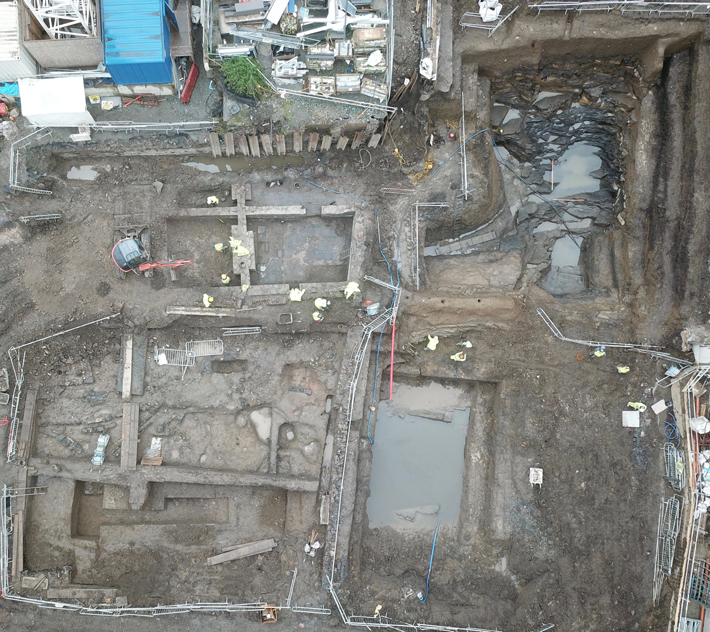
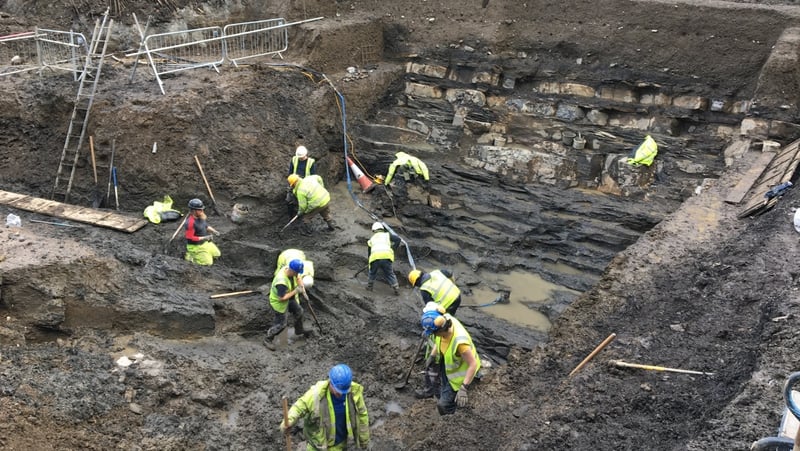
DUBLIN, IRELAND—According to an RTÉ News report, ongoing excavations on Ship Street next to Dublin Castle have revealed centuries of the city's history, including additional remains of a previously discovered early Viking settlement. Archaeologists led by Alan Hayden of Archaeological Projects Ltd. have discovered that Dubh Linn, the "Black Pool" on the River Poddle from which the city derives its name, stretched more than 1,300 feet beyond its previously known extent to the dig site. The Vikings first settled on Dubh Linn, and according to historical sources, anchored up to 200 ships there. Hayden noted that this new information also explains the reference to the pool in the name of Dublin's oldest church, St. Michael le Pole, which was founded in the sixth century A.D. and whose remains lie near the excavation area.
Read the rest of this article...
Dublin's earliest Viking settlement seen in new light
The dig is taking place beside Dublin Castle
An archaeological excavation has changed our picture of Dublin's earliest Viking settlement with the black pool or Dubh Linn now known to be a lot bigger than first thought.
The dig beside Dublin Castle has also uncovered the city's oldest police cells and a punishment burial.
The excavation is taking place on Ship St near where the remains of one of the Dublin's oldest churches - St Michael le Pole that was founded in the 6th century - are known to be.
Archaeologist Alan Hayden from University College Dublin said the work has uncovered the cells from a police station on Chancery Lane built in 1830, and beside it are walls from a medieval farm.
There are 12th Century quarries which provided the stone to build Dublin Castle and its walls.
The most important discovery yet is that Dubh Linn - the pool on the River Poddle where the Vikings first settled - was much bigger than originally thought.
Read the rest of this article...
Thursday, 12 March 2020
Scottish storms unearth 1,500-year-old Viking-era cemetery
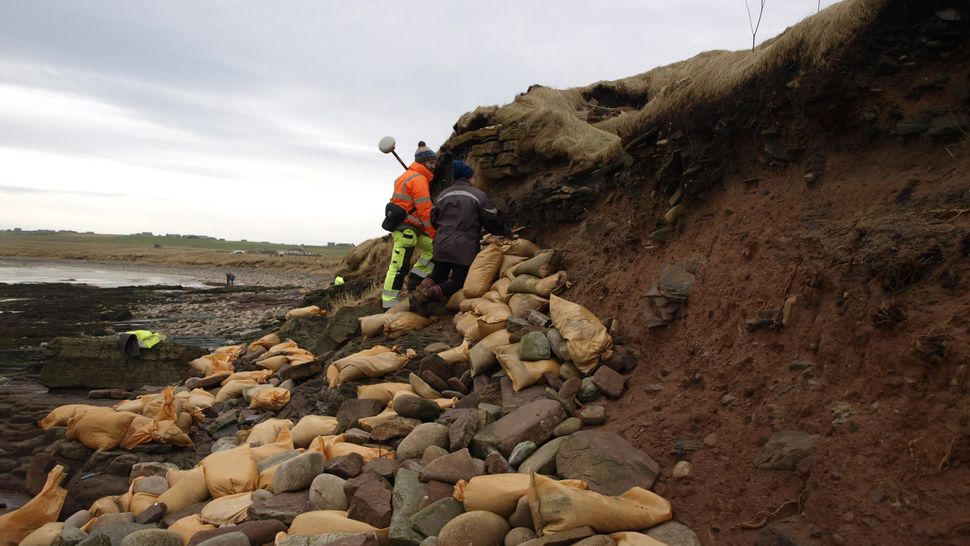
Archaeologists and volunteers are working to preserve human bones exposed by recent storms in an ancient cemetery above a beach on the Orkney Islands.
(Image: © ORCA Archaeology)
Powerful storms on the Orkney Islands in the far north of Scotland recently exposed ancient human bones in a Pictish and Viking cemetery dating to almost 1,500 years ago. Volunteers are piling sandbags and clay to protect the remains and limit the damage to the ancient Newark Bay cemetery on Orkney's largest island.
The cemetery traces its origins to the middle of the sixth century, when the Orkney Islands were inhabited by native Pictish people, akin to the Picts who inhabited most of what is now Scotland.
It was used for almost a thousand years, and many of the burials from the ninth through the 15th centuries were Norsemen or Vikings who had taken over the Orkney Islands from the Picts. But waves raised by storms are eating away at the low cliff where the ancient cemetery lies, said Peter Higgins of the Orkney Research Center for Archaeology (ORCA), part of the Archaeology Institute of the University of the Highlands and Islands.
Read the rest of this article...
Thursday, 5 March 2020
Oleg's Mound
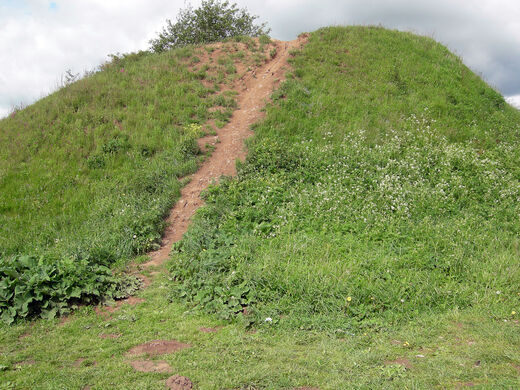
This burial mound is said to be the final resting place of Russia's first Viking ruler, Oleg of Novogrod.
The history of Russia is closely tied to the Byzantine empire and Scandinavian Vikings. One of the most important and central figures during the late 9th century was Prince Oleg of Novgorod, also known as Oleg the Prophet.
A royal from Novogrod, Oleg managed to seize power over most of Russia, then known as the Rus’, from 882 to 912. He ruled the country from his newly established capital in Kiev (Kyiv). Oleg greatly increased the wealth of his kingdom, primarily from a trade deal that he stuck with Constantinople, the capital of the Byzantine empire. Although, this came after Oleg led a military campaign against the city.
Read the rest of this article...
Thursday, 20 February 2020
The Stunning Viking Runestones Of Scandinavia
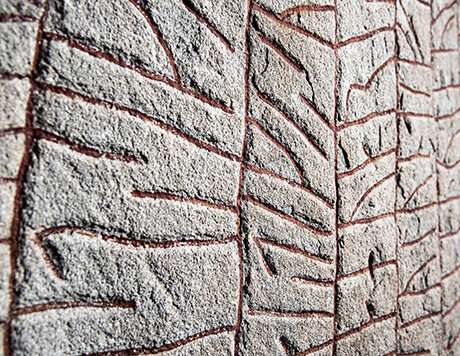
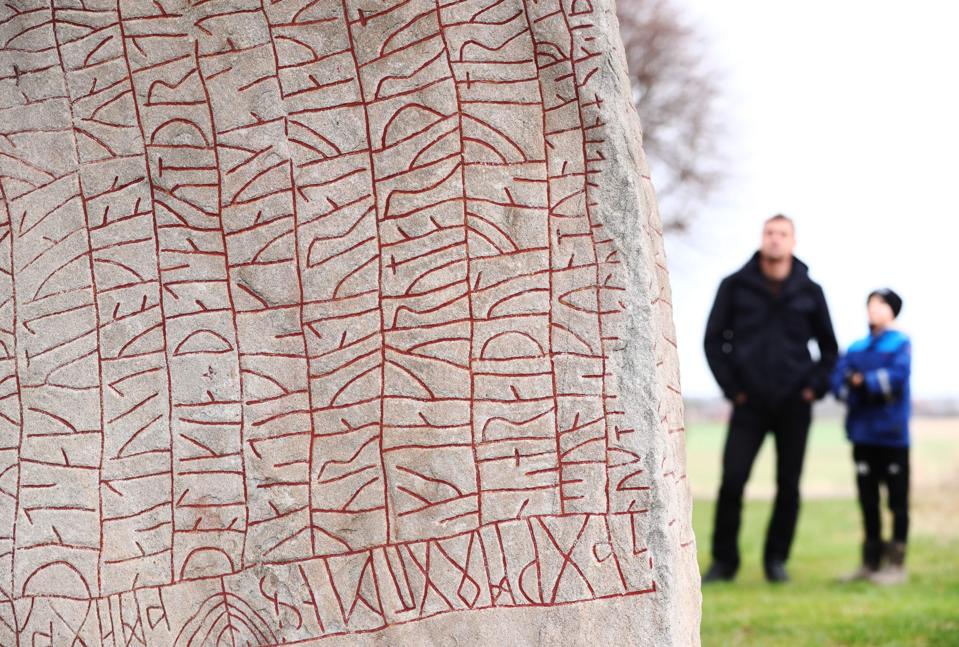
This incredibly detailed Viking-era Rök runestone stands near Lake Vattern in Östergotland, Sweden. ... [+] TT News Agency/AFP via Getty Images
The recent discovery of several Viking ship graves in Norway has lifted interest in Viking history to new heights. While there’s no doubting the fascinating discoveries being made, some truly remarkable Viking artifacts exist in plain sight throughout Scandinavia: runestones.
The region’s tradition of carving inscriptions into raised stones as a memorial began as early as the 4th century, but the vast majority of runestones still standing date from the 9th and 10th centuries, the latter years of the Viking Age. Scholars have attempted to translate many of the runic inscriptions, with varying degrees of success.
Rök, Sweden
The runestone of Rök, Sweden, is one of the most popular attractions on Scandinavia's burgeoning Viking tourist trail. Yet its origin story continues to mystify.
Read the rest of this article...
Tuesday, 18 February 2020
There are still a very few places available on the EMAS study tour to Orkney
EMAS Study Tour to Orkney
14 – 23 April 2020
Guide: David Beard MA, FSA, FSA Scot
The 2020 EMAS spring study tour will be to Orkney. We will travel by coach from Baker Street, London stopping overnight at Middlesbrough and Inverness and visiting archaeological sites on the way.
We will be based in Kirkwall, and will visit sites on Orkney Mainland and the islands of Egilsay, Rousay and Wyre. The sites that we will visit include Maes Howe, Skara Brae, Midhowe Broch, the Brough of Birsay, Cubbie Roo’s Castle, the Earl’s Palace at Birsay and Kirkwall Cathedral.
Further information...
Monday, 10 February 2020
Ancient Viking Glass Artifact Was A Game Piece Of The Elites
A tiny glass crown is being heralded as a rare archaeological artifact from the first wave of Viking raids in England.
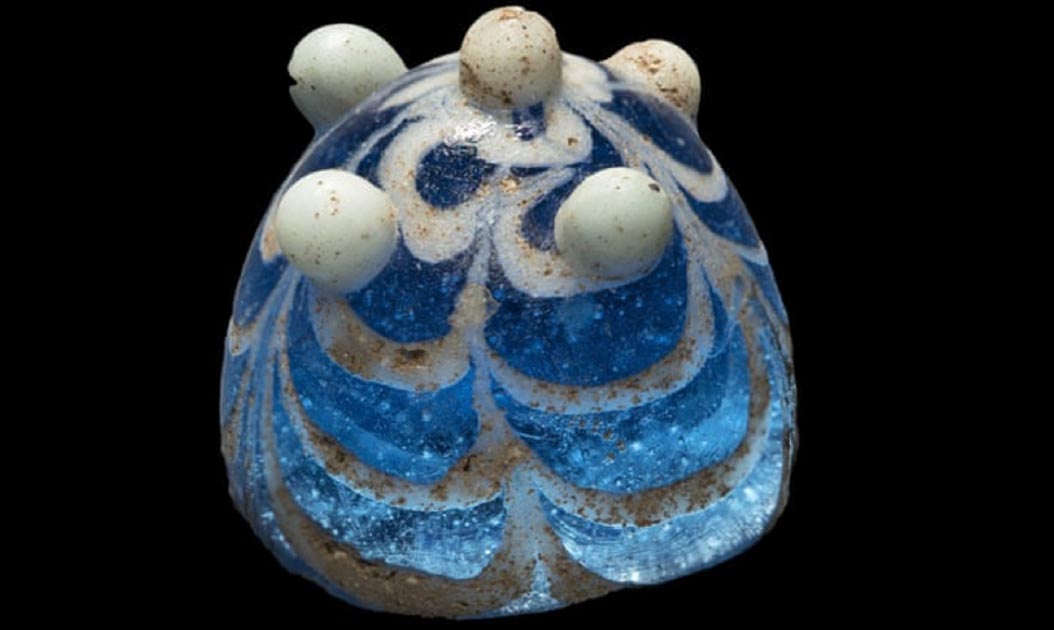
The small worked glass artifact was unearthed at an excavation site on the Holy Island of Lindisfarne , a tidal island situated off the northeast coast of England in Northumberland. Crafted from swirling blue and white glass with white glass bobbles, a report in The Times says archaeologists believe the crown was a gaming piece from the strategy board game hnefatafl (king’s table) played in Britain, Ireland, and Scandinavia before the arrival of chess in the 12th century.
A Glass Artifact With Elite Origins
The relic, which is no bigger than a grape, is described as being “of exquisite workmanship” showing influence from across the North Sea and if it is indeed a hnefatafl gaming piece it is a rare archaeological treasure linking the English island with the Vikings at the beginning of a turbulent period in English and Scandinavian history.
Read the rest of this article...
Thursday, 6 February 2020
Board-game piece from period of first Viking raid found on Lindisfarne
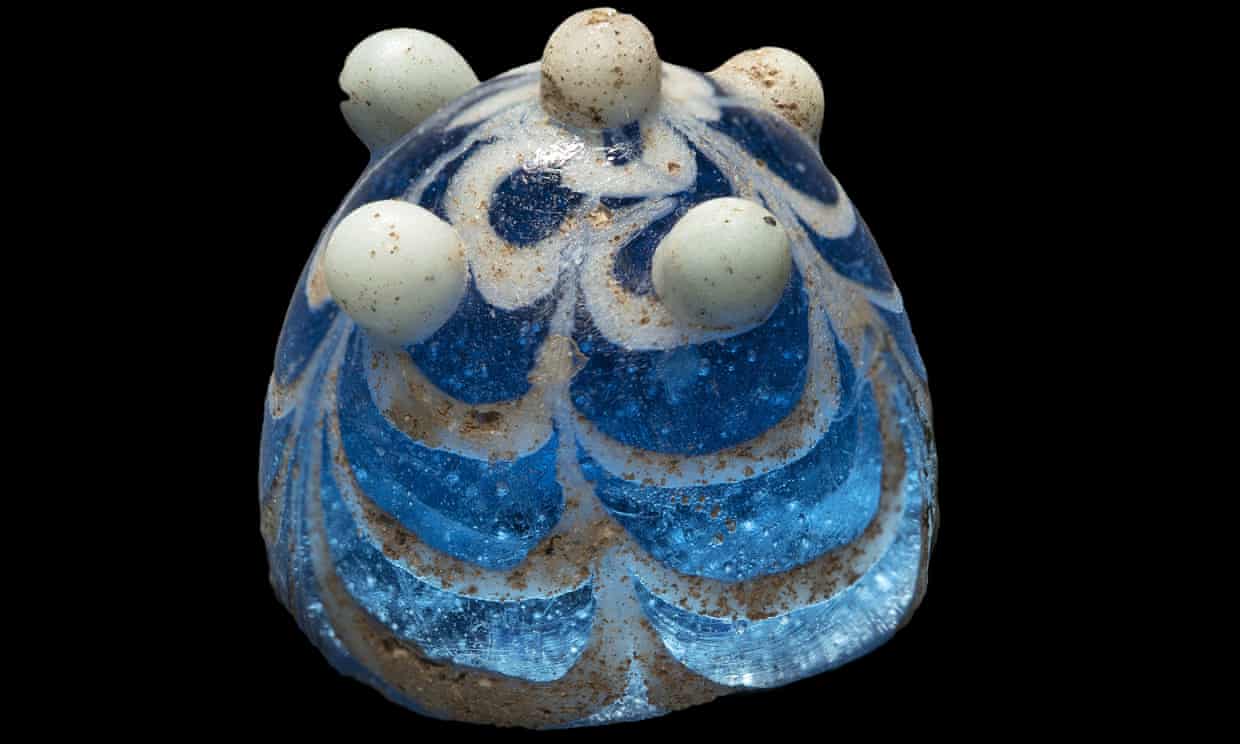
The piece of worked glass unearthed during an excavation on Lindisfarne.
Photograph: Jeff Veitch
Small glass ‘crown’ thought to be rare archaeological link to first Norse raiders
It is not large – the shape and size of a chocolate sweet – and might easily have been discarded as a pebble by a less careful hand.
But a tiny piece of worked glass unearthed during an excavation on Lindisfarne has been revealed to be a rare archaeological treasure linking the Northumbrian island with the Vikings, from the very beginning of one of the most turbulent periods in English history.
Archaeologists believe the object, made from swirling blue and white glass with a small “crown” of white glass droplets, is a gaming piece from the Viking board game Hnefatafl, or a local version of the game.
Whether dropped on the island by a Norse raider or owned by a high-status local imitating their customs, the gaming piece offers a rare tangible link between Lindisfarne’s Anglo-Saxon monastery and the culture that eventually overwhelmed it.
Read the rest of this article...
Friday, 24 January 2020
Four Warriors Buried in 11th Century Tombs in Pomerania Came From Scandinavia, say Scientists
The four warriors buried with rich grave offerings in the central part of the cemetery in Ciepłe (Pomerania) came from Scandinavia, expert analyses show. This is proof that people of foreign origin were members of the Piast state elites, scientists suggest.
Archaeologists investigating a cemetery dating from the first Piast monarchy of Bolesław I the Brave have published their latest findings.
The discovery in the small village of Ciepłe near Gniew in Eastern Pomerania, has so far revealed over 60 graves, but the archaeologists believe there may be more.
Dr. Sławomir Wadyl from the Archaeological Museum in Gdańsk said: “In the central part of the cemetery there were four very richly equipped chamber graves. Men, probably warriors, were buried in them, as evidenced by the weapons and equestrian equipment deposited with the bodies.”
Read the rest of this article...
Tuesday, 21 January 2020
How to hike the world's northernmost pilgrimage trail
The St Olavsleden trail takes you across Sweden and into Norway.
Photo: Tim Marringa
St Olavsleden is a hiking trail that runs from Sundsvall in the east of Sweden to Trondheim in the west of Norway. The historic pilgrim route has a long history that goes back to the time of the Vikings. The Local's contributor Tim Marringa gives you his best insider tips for hiking this fantastic trail.
In 2013 the old pilgrim route was restored to its former glory. The entire 580-kilometre trail was marked with distinctive red-brown signs and various stamping posts were placed along the way. The course of the trail is very diverse and lets you experience the best of Scandinavia as a hiker.
Where to start?
If you are coming from the Swedish capital, take the train to Sundsvall and buy a pilgrim passport at the local tourist office on the central square. In this passport you can receive a stamp in every special place. These are often churches or tourist offices along the way. The passport serves as proof to receive the certificate at the end and is a nice reminder of your journey.
Read the rest of this article...
Rot hastens Viking ship’s excavation
Preliminary excavation work at the Viking ship site at Gjellestad was carried out late last summer. Now experts recommend a full-scale dig of the entire area.
PHOTO: Riksantikvaren/Lene Buskoven
Archaeologists and Norway’s director of cultural heritage are calling for rapid excavation of a Viking ship found buried in a field at Gjellestad near Halden in the fall of 2018. They’ve won initial support from government officials, setting the stage for what could be the first full-scale Viking ship excavation in Norway for 114 years.
“A Viking ship is so important for Norwegian history, and we have an international responsibility here,” said Ola Elvestuen, government minister in charge of culture and the environment, just after test results from the site were presented on Friday. They were extracted during careful and preliminary digging around the vessel in August and September of last year.
Samples from the so-called “Gjellestad-ship’s” keel found last year have revealed signs of mildew or dry rot, indicating that the vessel could rapidly deteriorate if left in the ground. The overall condition of the ship was described as poor.
Read the rest of this article...
Archaeologists in Poland were stunned to discover the skeletal remains of four Scandinavian warriors many hundreds of miles from their homeland.
Two of the graves containing the remains of Scandinavian warriors
[Credit: Z. Ratajczyk, PAP]
Archaeologists in Poland were stunned to discover the skeletal remains of four Scandinavian warriors many hundreds of miles from their homeland.
The 11th-century remains were discovered at a peculiar burial site dubbed by the archaeologists a death house. A chemical and genetic analysis of the remains found the four men were from Scandinavia, most likely from Denmark.
According to Dr Sławomir Wadyl of the Gdańsk Archeological Museum, the warriors were buried alongside a plethora of trinkets and armaments.
The archaeologist told the Polish Press Agency (PAP): “In the central part of the cemetery, there were four very well-equipped chamber graves.
Read the rest of this article...
Archaeologists in Poland were stunned to discover the skeletal remains of four Scandinavian warriors many hundreds of miles from their homeland.
Two of the graves containing the remains of Scandinavian warriors
[Credit: Z. Ratajczyk, PAP]
Archaeologists in Poland were stunned to discover the skeletal remains of four Scandinavian warriors many hundreds of miles from their homeland.
The 11th-century remains were discovered at a peculiar burial site dubbed by the archaeologists a death house. A chemical and genetic analysis of the remains found the four men were from Scandinavia, most likely from Denmark.
According to Dr Sławomir Wadyl of the Gdańsk Archeological Museum, the warriors were buried alongside a plethora of trinkets and armaments.
The archaeologist told the Polish Press Agency (PAP): “In the central part of the cemetery, there were four very well-equipped chamber graves.
Read the rest of this article...
Saturday, 18 January 2020
The real Vikings: the early medieval world behind the hit drama
The exploits of Norse warrior Ragnar Lothbrok and his kin in hit TV drama Vikings has brought fresh interest to the myths and figures of the early medieval world. As the final series continues, Professor Howard Williams explores how the show’s sweeping ambition has tackled historical issues of the Viking era while creating an immersive world – one with more reality than you might think…
From 2013 to the sixth and final series, now airing, History Channel’s Vikings has brought a hit multi-season historical drama about the early Viking world to international audiences. Following the adventures of the legendary figure Ragnar Lothbrok (or Loðbrók) and his sons including Bjorn, Ubba and Ivar, writer Michael Hirst portrays a 9th-century world of seaborne conflict, far-flung connections and family feuding on an unprecedented scale. Despite numerous films over the years, occasional documentaries and an ongoing rival BBC drama series The Last Kingdom, nothing can compare in scale and duration to Vikings in bringing the early medieval world to global television viewers.
Read the rest of this article...
Confirmed: Norway’s Gjellestad Ship Is From The Viking Age
The Gjellestad ship grave was discovered by georadar survey in 2018.
Norwegian Institute for Cultural Heritage Research
Archaeologists from Norway’s Museum of Cultural History have confirmed that the Gjellestad Viking ship grave discovery in southeast Norway is almost certainly from the early days of the Viking age.
The 2018 discovery by the Norwegian Institute for Cultural Heritage Research (NIKU) made headlines around the world. Several longhouses and at least one ship burial were discovered by new ground-penetrating radar (GPR) technology. While the site was known to be of importance during the Viking era, the dating of the ship had been an educated guess, until now.
Dating a Viking ship grave
“The investigations happily confirm our hypothesis from 2018, when we found the ship by ground-penetrating radar (GPR),” said Knut Paasche, head of Digital Archaeology at NIKU.
Read the rest of this article...
Saturday, 11 January 2020
Viking Colonies Collapsed Through Over Hunting Walruses
The mysterious disappearance of Greenland's Norse colonies sometime in the 15th century may have been down to the overexploitation of walrus populations for their tusks, according to a study of medieval artifacts from across Europe.
Founded by Erik the Red around 985 AD after his exile from Iceland (or so the Sagas tell us), Norse communities in Greenland thrived for centuries - even gaining a bishop - before vanishing in the 1400s, leaving only ruins.
An Economy Built on Walrus Ivory
Latest research from the universities of Cambridge, Oslo, and Trondheim has found that, for hundreds of years, almost all ivory traded across Europe came from walruses hunted in seas only accessible via Norse settlements in south-western Greenland.
Walrus ivory was a valuable medieval commodity, used to carve luxury items such as ornate crucifixes or pieces for games like chess and Viking favorite hnefatafl. The famous Lewis chessmen are made of walrus tusk.
Read the rest of this article...
Viking runestone linked to fears of climate change: study
Credit: University of Gothenburg
One of the world's most famous runestones is now believed to have been erected by Vikings fearing a repeat of a previous cold climate crisis in Scandinavia, a new study said Wednesday.
The Rok stone, raised in the ninth century near the lake Vattern in south central Sweden, bears the longest runic inscription in the world with more than 700 runes covering its five sides.
It is believed to have been erected as a memorial to a dead son, but the exact meaning of the text has remained elusive, as parts are missing and it contains different writing forms.
The stone refers to the heroic acts of "Theodoric," which some scholars believe refers to Theodoric the Great, a sixth century ruler of the Ostrogoths in what is now Italy.
Researchers at three Swedish universities now suspect the inscriptions are more of an allusion to an impending period of extreme winter, as the person who erected the stone tried to put their child's death into a larger perspective.
Read the rest of this article...
The Vikings erected runestone out of fear of climate catastrophe
Credit: University of Gothenburg
Several passages on the Rok stone – the world’s most famous Viking Age runic monument – suggest that the inscription is about battles and for over a hundred years, researchers have been trying to connect the inscription with heroic deeds in war. Now, thanks to an interdisciplinary research project, a new interpretation of the inscription is being presented. The study shows that the inscription deals with an entirely different kind of battle: the conflict between light and darkness, warmth and cold, life and death.
The Rok runestone, erected in Ostergotland around 800 CE, is the world's most famous runestone from the Viking Age, but has also proven to be one of the most difficult to interpret. This new interpretation is based on a collaboration between researchers from several disciplines and universities.
“The key to unlocking the inscription was the interdisciplinary approach. Without these collaborations between textual analysis, archaeology, history of religions and runology, it would have been impossible to solve the riddles of the Rok runestone,” says Per Holmberg, professor in Swedish at the University of Gothenburg, who led the study.
Read the rest of this article...
Wednesday, 11 December 2019
Burial site ties major Viking swords find to warriors from Rävala
An archeological dig in Tõnismäe. Source: Siim Lõvi/ERR
Last year, Estonia's largest Viking sword fragments find was unearthed on the country's northern coast. Burial artefacts found in the same area this year suggest that the swords were used by local warriors from the ancient county of Rävala.
Archeologist and keeper of the numismatic collection of the Tallinn University Archeological Research Collection Mauri Kiudsoo told BNS that the burial site discovered this year lied just a few dozen meters from last year's find and that both the grave and the sword find date back to the 10th century. "These finds are linked," Kiudsoo said. "The brooch we found confirms the hypothesis that the swords were used by local warriors from the ancient county of Rävala."
Archeologists discovered an in-ground burial site on the north Estonian coast, once the territory of the ancient county of Rävala, earlier this year. While the grave had been plowed over, archeologists came across fragments of spearheads, bridles, scythes and single-edged combat knives. The site also revealed a crossbow-shaped brooch with heads modeled after a poppy capsule that had been disfigured in a fire and a pair of spring scissors.
Read the rest of this article...
Monday, 9 December 2019
Archaeological Study Tour to Orkney
EMAS Study Tour to Orkney
14 – 23 April 2020
There are still a few places left on the EMAS Archaeological Society Study Tour to Orkney.However, hotel places are very limited, so an early reply is advised.
You can find further details on the EMAS website.
Further details...
Friday, 29 November 2019
It Cleans Up Nicely: Scottish Viking Hoard Reveals New Secrets
Around the time the Irish were stamping out the Viking presence in their country, local lore says the Scots and Vikings also fought a battle near Galloway, Scotland. In 2014, a metal detectorist took that legend, swept the area, and discovered a hoard of more than 100 “strange and wonderful objects” that are at least 1,000 years old. Now those Viking hoard relics have been cleaned up and experts say “the richest collection of rare and unique Viking-age objects ever found in Britain or Ireland” is providing new and valuable information.
Extensive Conservation work on the Viking Hoard
Dr. Martin Goldberg, principal curator of archaeology and history at the National Museum of Scotland in Edinburgh, told The Scotsman that conservation work has “completely transformed” the appearance of some of the artifacts. It is also providing researchers with “a better understanding now of the international range of hoard.” He says:
“There were always clues about the origins of some of the material and the amazing trajectories that brought them across Europe and Asia to be buried in Galloway. But we are learning more about the specifics about where things have come from and how old various things might be and for how long the hoard may have been accumulated for. We’re sticking to AD 900 for the burial but some objects are looking like they are several centuries older.”
Read the rest of this article...
Wednesday, 27 November 2019
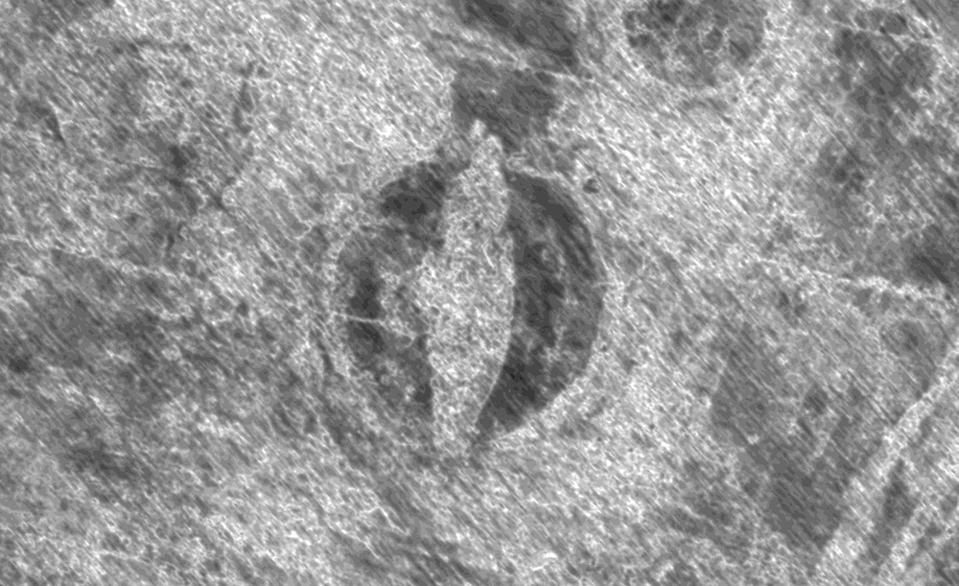
Ancient Viking ship discovered buried next to church using breakthrough georadar technology
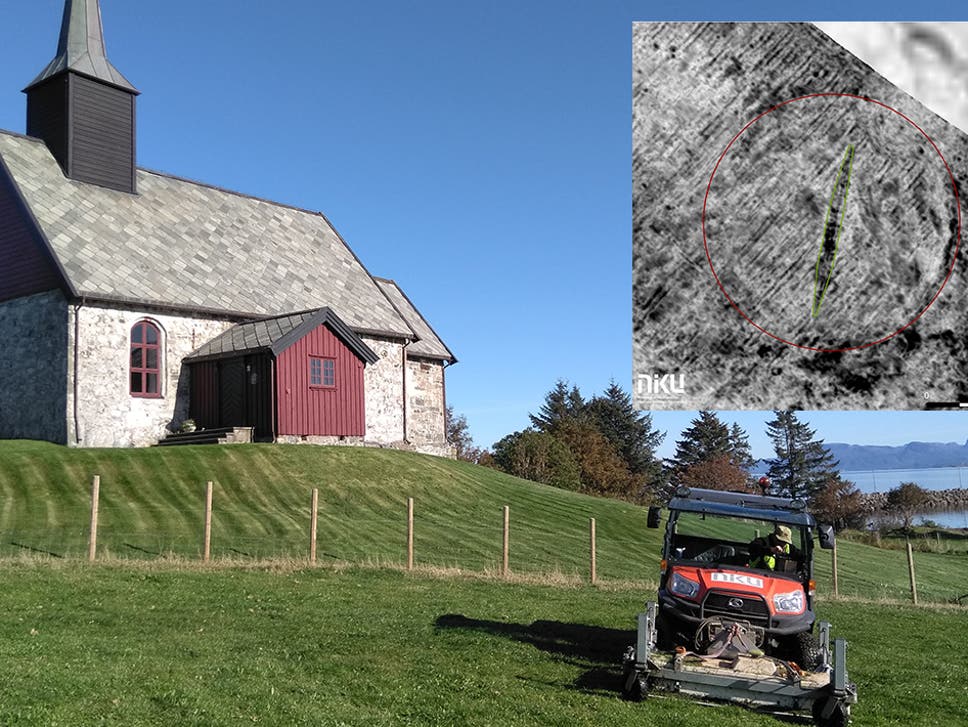
The Edøy ship was found next to a church on Edøya island in western Norway
( Manuel Gabler, NIKU )
A Viking ship believed to be over 1,000 years old has been discovered buried next to a church in Norway.
Archaeologists from the Norwegian Institute for Cultural Heritage Research (NIKU) announced they had found the ship, believed to have been used in a traditional ship burial, using “breakthrough” large-scale high-resolution georadar technology.
The remains of the 17m vessel are buried just below the top-soil, at Edøy church on Edøya island in western Norway.
Archaeologists have suggested parts of the structure may have been damaged by ploughing.
Read the rest of this article...
Unusual Viking Grave Includes Nested Boats Buried 100 Years Apart
Artist's illustration of the 8th-century Viking man's burial (Arkikon)
Archaeologists don’t know why the two vessels were buried on top of one another, but the practice may be linked with property rights
Last month, archaeologists excavating the Skeiet Viking farm in Vinjeøra, Norway, unearthed an unexpected burial: namely, a boat containing the remains of a woman nested inside of a second boat occupied by the body of a man laid to rest some 100 years earlier.
As researchers from the Norwegian University of Science and Technology (NTNU) reported in a recent announcement detailing the find, the Viking woman died during the latter half of the 9th century A.D. Her remains were buried in a 23- to 26-foot-long boat filled with grave goods including the head of a cow, two pairs of scissors, weaving tools and a pearl necklace. Two large shell-shaped brooches and a crucifix-shaped brooch made from a decorative Irish harness fitting were pinned on the woman’s dress.
Rare box-shaped Viking brooch found in Northeastern Estonia
Archaeological site. Photo is illustrative. Source: Siim Lõvi/ERR
A fully preserved early Viking-era brooch found in Northeastern Estonia this spring is one of two such items that have been discovered in Estonia. It is believed to have belonged to a woman born on the island of Gotland who moved to present-day Estonian territory later on in her life.
The bronze box-shaped brooch was found in the Ida-Viru County village of Varja.
Mauri Kiudsoo, archaeologist and keeper of the archaeological research collection at Tallinn University (TLÜ), told BNS that the brooch found at Varja was cast as a single piece.
The decorative item has been wholly preserved, with only slight damage to the surface, likely as a result of the cultivation of land, Kiudsoo said. The pin, which was apparently made of steel, is also missing.
Read the rest of this article...
Subscribe to:
Posts (Atom)