The Viking Archaeology Blog is concerned with news reports featuring Viking period archaeology. It was primarily constructed as a source for the University of Oxford Online Course in Viking Archaeology: Vikings: Raiders, Traders and Settlers. For news reports for general European archaeology, go to The Archaeology of Europe News Blog.
Monday, 28 January 2013
Sealing Norse Greenlanders’ fate?
The mystery of what happened to Greenland’s Norse population is one step closer to being solved, as new evidence suggests that the colony did not die out because its inhabitants were unable to adapt to their new environment.
The first Viking settlers arrived in c.AD 1000, and over time their population swelled to around 3,000 people. By the 15th century, however, they had vanished, with no explanation provided by contemporary written sources. This disappearance has long been debated by archaeologists, with some suggesting that the farming communities were defeated by climate change, which made it difficult to cultivate cereal crops for bread and beer, and limited wild plant resources.
Research published in the Journal of the North Atlantic suggests that the Norse colonists simply adapted their diet to cope with their new circumstances, developing a taste for seals.
A team of Danish and Canadian archaeologists have examined 80 skeletons excavated from Norse settlement sites in western and south-western Greenland. Isotope analysis revealed that the population adopted an increasingly marine-based diet, with 50%-80% of their food consisting of seal meat by the 14th century.
Read the rest of this article...
Sunday, 27 January 2013
Living conditions and indoor air quality in a reconstructed Viking house
Jannie Marie Christensen & Morten Ryhl-Svendsen
How harmful to a person’s health were the indoor conditions in Danish Viking Age houses?
We do not have much direct evidence describing that. But we know that currently exposure to smoke from the solid fuel used for cooking and heating in open fireplaces in Third World homes is in harmful levels. It is among the top ten global risks for mortality and lost years of healthy life. Fuel smoke accounts for about 3 % of the global burden of diseases, mainly for women and young children, e.g.; lower respiratory infections, pulmonary diseases, and lung cancer
Read the rest of this article...
Where were the Viking brew houses?
Graham Dineley, craft brewer & Merryn Dineley, independent researcher
We have been studying traditional malting and beer brewing techniques for 15 years.
Graham is a craft brewer with 30 years’ experience of making beer from the grain.
Merryn is an archaeologist, completing her M.Phil ‘Barley Malt & Ale in the Neolithic’ at
the University of Manchester in 1999 and continuing research independently since then.
The brewing of ale is a skilled craft that has hardly changed over the millennia. For the
last few years we have been looking into the potential archaeological evidence for the
brewing of ale at Viking sites.
Read the rest of this article...
Wednesday, 16 January 2013
Report: Vikings ‘abandoned Greenland due to loneliness and limited foods’
Researchers have a new theory on why the Vikings ultimately decided to abandon Greenland after five centuries. The news comes via a report recently published in the Journal of the North Atlantic, in which scientists claim that the infamous group of explorers may have simply got tired of the isolation of Greenland and having to survive almost exclusively on seal meat.
The theory is the result of a new Danish-Canadian project, for which scientists carried out isotope analysis on the bone remnants of Vikings and the animals that were living beside them.
Longstanding theories as to why the Vikings chose to leave the icy landmass suggested that starvation amid a mini ice age and ongoing battles with the local Inuit population were the central causes of the uprooting.
Research leader Niels Lynnerup, an anthropologist from the University of Copenhagen, told the media that he believes they may have had a wealth of food, but added, “perhaps they were just sick and tired of living at the ends of the earth and having almost nothing but seals to eat,” The Daily Mail reports.
Read the rest of this article...
Monday, 14 January 2013
Death, Narrative and Understanding the Viking Mind
We think we understand the Vikings and their ways as a culture of warriors and pirates. The Vikings plagued the coast of early medieval Britain, robbing from monastic and secular sites until they finally set up permanent residence in the Danelaw.
In reality, however, the Vikings inhabited a nebulous dichotomy between violent warrior and peaceful merchant.Yet these views of the Norsemen originate from sources outside Viking culture, they originate from the victims, such as the monasteries that were attacked. As a result, our view of the Viking world is rarely from the perspective of people who were part of it. In a series of lectures to Cornell University, delivered in September 2012, Professor Neil Price of Aberdeen University attempts to bridge this gap and get inside the Viking mind.
Professor Price puts forward the argument that stories are at the heart of the Viking consciousness and that the Vikings perceived the world as a series of interconnected stories passed orally and lived out day to day. What modern scholars interpret as “Norse myths”, i.e. tales of the gods collected in what we call the Prose and Poetic Edda, were not only stories to entertain on the long Scandinavian nights, they were also a very real part of the nature of the world.
Read the rest of this article...
Sunday, 13 January 2013
Dig will root out secrets of Viking past
A two-mile stretch of land between Arrochar and Tarbet could hold vital clues to the Vikings' occupation of Scotland.
The fierce Norsemen are said to have dragged their boats across the isthmus - now the route of the busy A83 - to raid the rich Lomond settlements before encountering defeat at the Battle of Largs in 1263.
Now an appeal has gone out for volunteers to come forward and help archaeologists in their quest for Viking clues.
Read the rest of this article...
Friday, 11 January 2013
Archaeologists Find Clues to Viking Mystery
Until now, many experts had assumed that the cooling of the climate and
the resulting crop failures and famines had ushered in the end of the
Scandinavian colony. But now a Danish-Canadian team of scientists
believes that it can refute this theory of decline.
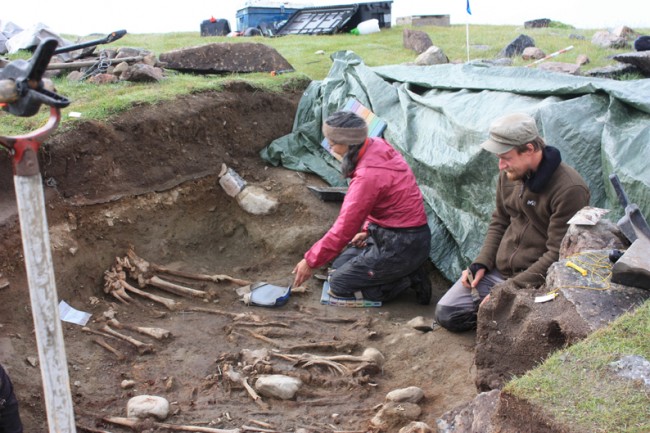
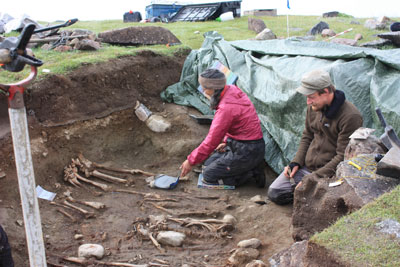
Here, archaeologists
dig up skeletons in Greenland.
On Sept. 14, 1408, Thorstein Olafsson and Sigrid Björnsdottir were married. The ceremony took place in a church on Hvalsey Fjord in Greenland that was only five meters (about 16 feet) tall.
It must have been difficult for the bride and groom to recognize each other in the dim light of the church. The milky light of late summer could only enter the turf-roofed church through an arched window on the east side and a few openings resembling arrow slits. After the ceremony, the guests fortified themselves with seal meat.
Read the rest of this article...
Don’t underestimate Viking women
The viking women were powerful. (Drawing: Erik Werenskiold)
The status of Viking women may be underestimated due to the way we interpret burial findings.
“To assume that Viking men were ranked above women is to impose modern values on the past, which would be misleading,” cautions Marianne Moen. She has been studying how women’s status and power is expressed through Viking burial findings. Her master’s thesis The Gendered Landscape argues that viking gender roles may have been more complex than we assume.Exploring new perspectives of Viking society is a theme which also will be the focus of the forthcoming Viking Worlds conference in March 2013, where Moen is a member of the organising committee.
Skewed interpretation
Our assumptions of gender roles in viking society could skew the way we interpret burial findings, Moen points out. She uses the 1904 excavation of the Oseberg long boat to illustrate the point. Rather than the skeleton of a powerful king or chieftain, the ship surprisingly contained two female skeletons.Read the rest of this article...
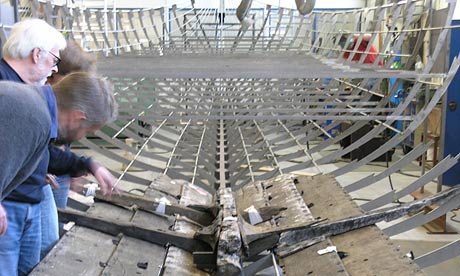
Rebirth of the Viking warship that may have helped Canute conquer the seas
Timbers of Roskilde 6 Viking warship being fitted into the steel frame for display in Copenhagen
and at the British Museum.
Now the ship's timbers are slowly drying out in giant steel tanks at the Danish national museum's conservation centre at Brede outside Copenhagen, and will soon again head across the North Sea – to be a star attraction at an exhibition in the British Museum.
The largest Viking warship ever found, it was discovered by chance in 1996 at Roskilde. It is estimated that building it would have taken up to 30,000 hours of skilled work, plus the labour of felling trees and hauling materials. At just over 36 metres, it was four metres longer than Henry VIII's flagship Mary Rose built 500 years later, and six metres longer than the Viking ship spectacularly recreated as Sea Stallion, which sailed from Scandinavia around Scotland to Dublin in 2007.
Read the rest of this article...
Tuesday, 18 December 2012
Greenland’s Viking settlers gorged on seals
The findings challenge the prevailing view of the Norse as farmers that would have stubbornly stuck to agriculture until they lost the battle with Greenland’s environment. These new results shake-up the traditional view of the Norse as farmers and have given archaeologists reason to rethink those theories.
“The Norse thought of themselves as farmers that cultivated the land and kept animals. But the archaeological evidence shows that they kept fewer and fewer animals, such as goats and sheep. So the farming identity was actually more a mental self-image, held in place by an over-class that maintained power through agriculture and land ownership, than it was a reality for ordinary people that were hardly picky eaters,” Jette Arneborg, archaeologist and curator at the National Museum of Denmark, says.
The first Norse settlers brought agriculture and livestock such as cattle, sheep, goats and pigs from Iceland. While they thought of themselves as farmers, they were not unfamiliar with hunting.
Read the rest of this article...
Norwegian Vikings grew hemp
Remnants of the Iron Age Sosteli farm in Vest-Agder County, Norway's
southernmost. Hemp was cultivated here even before the Viking Age.
(Photo: Morten Teinum/Visit Sørlandet)
The Sosteli farmsted, in Norway's southermmost Vest-Agder County, offers strong evidence that Vikings farmers actively cultivated cannabis, a recent analysis shows. The cannabis remains from the farmsted date from 650 AD to 800 AD.
This is not the first sign of hemp cultivation in Norway this far back in time, but the find is much more extensive than previous discoveries.
“The other instances were just individual finds of pollen grains. Much more has been found here,” says Frans-Arne Stylegar, an archaeologist and the county's curator.
Rope and textiles
Sosteli is also further away from current-day settlements than other sites where cannabis finds have been made.Hemp is the same plant as cannabis, or marijuana. But nothing indicates that the Vikings cultivated the plant to get people high.
Most likely it was grown for making textiles and rope.
Read the rest of this article...
Sunday, 16 December 2012
University of Oxford Online Courses in Archaeology
Now is the time to enrol for
Hilary term online courses in Archaeology.
Each courses lasts for 10
weeks, with the expectation of c. 10 hours study a week. Students submit two short assignments.
Successful completion of the courses carries
a credit of 10 CATS Points.
CATS Points from these
courses can now be used as part of the requirement for the new Certificate in Higher Education offered by the University of Oxford.
The following courses are
available: (click on the title for further information)
You can find general information about University of Oxford courses here...
The last battle of the Vikings
The Battle of Largs was the last time a Norwegian military force attacked Scotland
It was the battle which
led to the end of Viking influence over Scotland, when a terrifying
armada from Norway bore down on the Ayrshire town of Largs 750 years
ago.
The mainland was Scottish but the islands of Bute and Cumbrae just across from Largs were Norse.
In fact, the whole of the Hebrides - a region known as Innse Gall - gave its allegiance to the Vikings from western Norway.
"It was a war just waiting to happen," says underwater archaeologist Dr Jon Henderson.
Read the rest of this article...
Monday, 3 December 2012
Helmets, Viking gold and Royal boars: Portable Antiquities Scheme releases 2011 report
Nearly 100,000 archaeological discoveries – ranging from Roman helmets to Viking gold – were made during 2011, according to the annual report by the Portable Antiquities Scheme.
In a typically eventful year of soil digging, including primetime exposure for the Scheme’s greatest breakthroughs on the ITV series Secret Treasures, the official figures show an eight percent rise in finds, with a total of 970 Treasure cases.
Huge online interest also saw the accompanying website, finds.org.uk, honoured as the best research and online collection at the Best of the Web awards, with more than 463,000 people looking at 820,000 finds on the database of discoveries.
“It is a scheme which is envied the world over,” said Neil MacGregor, the Director of the British Museum, praising the Department for Culture Media and Sport and Treasure Hunting magazine, the appropriately-named periodical which published the report.
Read the rest of this article...
Saturday, 24 November 2012
Ottawa researcher’s firing derails Viking project
This should be the best of times for Pat Sutherland. November’s issue of National Geographic magazine and a documentary airing Thursday night on CBC’s The Nature of Things both highlight research the Ottawa archeologist has been doing in the Canadian Arctic for the past dozen years that could fundamentally alter our understanding of our early history.
If Sutherland is right, Norse seafarers — popularly known as Vikings — built an outpost on Baffin Island, now called Nanook, centuries before Columbus blundered on to North America. Moreover, there’s evidence they traded with the Dorset, the Arctic’s ancient, now-vanished inhabitants, for as many as 400 years.
”That’s incredible,” says Andrew Gregg, who wrote, directed and produced The Norse: An Arctic Mystery, the CBC documentary that recounts Sutherland’s findings. “That rewrites all the history books.”
But Sutherland’s pleasure at the recognition her discoveries are receiving has been sharply tempered by a harsh reality. Last April, even as the documentary about her work was being filmed, the 63-year-old, then curator of Arctic archeology at the Canadian Museum of Civilization, was abruptly dismissed from her job.
At the same time, museum officials also stripped her husband, Robert McGhee — himself a legendary Arctic archeologist described as “one of the most eminent scholars that Canada has produced” — of the emeritus status it had granted him after his retirement from the Gatineau museum in 2008.
Read the rest of this article...
Tuesday, 20 November 2012
How Vikings killed time
The Vikings played ball, lifted stones and wrestled. Often the games turned violent and bloody, occasionally resulting in death.
When Viking men played their games, the women watched - except in drinking games. This is a scene from at saga play in Steigen, Norway. (Photo: Mari Pedersen)
Life in the Viking Age was tough and hard, and physical work filled much of their days, but their lives were not without leisure.In a new study, Leszek Gardela uses archaeological findings and careful reading of Viking sagas to describe how Vikings killed time when they were in mood for entertainment.
The archaeologist paints a vivid picture of Viking life, but the familiarity of many of the activities suggests that while Vikings had shorter lives and arguably vented their frustrations in more violent ways than what most people do today, leisure time in the Viking Age was not too different from leisure time in 2012.
Read the rest of this article...
Greenland's viking settlers gorged on seals
Archaeologists dig up skeletons of Norse settlers in 2010 at the Norse farm Ø64,
Igaliku Fjord, Østerbygden, Greenland. Photo: Jette Arneborg
UNSOLVED MYSTERY
Greenland's viking settlers, the Norse, disappeared suddenly and mysteriously from Greenland about 500 years ago. Natural disasters, climate change and the inability to adapt have all been proposed as theories to explain their disappearance. But now a Danish-Canadian research team has demonstrated the Norse society did not die out due to an inability to adapt to the Greenlandic diet: an isotopic analysis of their bones shows they ate plenty of seals.“Our analysis shows that the Norse in Greenland ate lots of food from the sea, especially seals,” says Jan Heinemeier, Institute of Physics and Astronomy, Aarhus University.
“Even though the Norse are traditionally thought of as farmers, they adapted quickly to the Arctic environment and the unique hunting opportunities. During the period they were in Greenland, the Norse ate gradually more seals. By the 14th century, seals made up between 50 and 80 per cent of their diet.”
Read the rest of this article...
Sunday, 18 November 2012
Summer Courses in Archaeology
Oxford Experience Archaeology Courses
The Oxford Experience Summer
School offers weekly introductory courses in the Sciences and Humanities. Participants stay in Christ Church, the
largest and one of the most beautiful Oxford Colleges.
Thursday, 8 November 2012
Should we keep the Vikings’ stolen goods?
Made in Scotland or Ireland toward the end of the eighth century, the
original purpose of Ranvaik’s chest had been to house the bones of a
Christian saint.
(Photo: National Museum of Denmark)
Ranvaik’s golden chest was made in Ireland or Scotland toward the end of the eighth century and originates from a church or a monastery.
"Ranvaik owns this shrine" the inscription on the bottom reads, as a strong indication that it later came to belong to a noble Viking lady named Ranvaik.
Archaeologists believe that the shrine, which can be admired at the Danish National Museum, is stolen property from the Viking Age.
”Viking Age objects that come from churches and monasteries can best be explained as loot from the raids which made the Vikings notorious in the Christian world,” explains Maria Panum Baastrup, an archaeologist at the National Museum’s Prehistoric Collection.
Read the rest of this article...
Friday, 26 October 2012
Viking skeleton found in Wales
A skeleton of a Viking has been discovered by archaeologists at Llanbedrgoch, Anglesey. Scientists from Amgueddfa Cymru – National Museum Wales, who made the discovery believe it will shed new light on the interaction between Celtic, Anglo-Saxon and Viking-age worlds operating around the Irish Sea.
The skeleton find is an unexpected addition to a group of five (two adolescents, two adult males and one woman) discovered in 1998-99. Originally thought to be victims of Viking raiding, which began in the 850s, this interpretation is now being revised. Tests by Dr Katie Hemer of Sheffield University indicates that the males were not local to Anglesey, but may have spent their early years (at least up to the age of seven) in North West Scotland or Scandinavia.
The Llanbedrgoch site was discovered in 1994 after a number of metal detector finds had been brought to the museum for identification. These included an Anglo-Saxon penny of Cynethryth (struck AD 787-792), a penny of Wulfred of Canterbury (struck about AD 810), and three lead weights of Viking type.
Read the rest of this article...
Monday, 22 October 2012
Evidence of Viking Outpost Found in Canada
Archaeologist Patricia Sutherland (orange jacket) excavates a potential Viking site on
Baffin Island.
For the past 50 years—since the discovery of a thousand-year-old Viking way station in Newfoundland—archaeologists and amateur historians have combed North America's east coast searching for traces of Viking visitors.
It has been a long, fruitless quest, littered with bizarre claims and embarrassing failures. But at a conference in Canada earlier this month, archaeologist Patricia Sutherland announced new evidence that points strongly to the discovery of the second Viking outpost ever discovered in the Americas.
(Read the new National Geographic magazine feature "Vikings and Native Americans: Face-to-Face.")
While digging in the ruins of a centuries-old building on Baffin Island (map), far above the Arctic Circle, a team led by Sutherland, adjunct professor of archaeology at Memorial University in Newfoundland and a research fellow at the University of Aberdeen in Scotland, found some very intriguing whetstones. Wear grooves in the blade-sharpening tools bear traces of copper alloys such as bronze—materials known to have been made by Viking metalsmiths but unknown among the Arctic's native inhabitants.
Read the rest of this article...
Monday, 15 October 2012
Wanted! Limerick men with Viking blood for tests
Limerick: known to have been a vital Viking trading centre
IF you ever wondered whether you are you descended from the Vikings or the Normans, now is the time to find out.
A network of academics led by Dr Catherine Swift of Mary Immaculate College, and Dr Turi King of the Department of Genetics, University of Leicester are using scientific techniques and the traditional tools of the historian in an attempt to identify what percentage of the Irish population are descended from Vikings.
Volunteers with certain surnames - including English, Stokes and Noonan, amongst many others - will be tested at Fennessey’s pub, New Street, Sunday, October 21, at 12 noon.
“Limerick is a very interesting location for our project as it is known to be a vital Viking trading centre,” said Dr Swift.
Read the rest of this article...
Letter from Iceland: Surviving the Little Ice Age
Excavations at the ancient farm of Hjalmarvik are
providing detailed insights into the ways Icelanders
adapted to changing climatic conditions. (Zach Zorich)
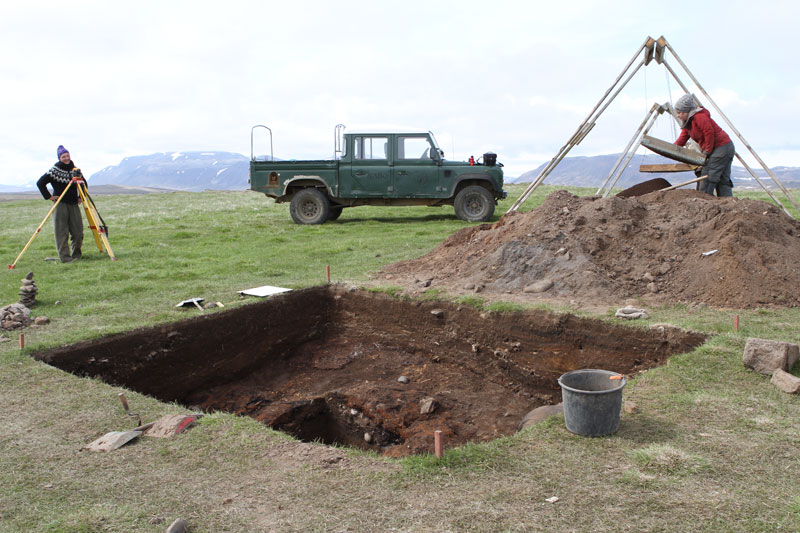
Stefán Ólafsson of the Icelandic Archaeological Institute and Céline Dupont Hébert of Laval University, Quebec City, are the crew chiefs of a team of archaeologists with the unglamorous job of excavating a garbage dump at Hjalmarvik, an ancient farm on the northeastern coast of Iceland. Their approximately 9-by-12-foot excavation trench sits just outside what was a sod-walled farmhouse that may date back to the years shortly after 871, when Iceland was first settled by groups of Vikings from Norway. Today, the remains of the house are no more than a flat spot on the ground overlooking a small bay a few hundred yards to the west. The excavation of the garbage dump, or midden, is revealing a detailed record of life at the farm and provides clues to how its residents handled the severe challenges the island faced during an extended period of climatic disruption.
The walls of the trench are striped with orange peat ash, probably discarded when the hearth inside the house was cleaned. Although the crew has uncovered interesting whalebone carvings—some decorated with images and others that were used as gaming pieces—the most common items found in the trench are the discarded bones of the animals eaten by Hjalmarvik’s residents. Laboratory analysis of the bones has not yet begun, but at first glance it looks like most of the food they were eating came from the surrounding ocean.
Read the rest of this article...
Thursday, 11 October 2012
Archaeology Summer Courses in Oxford
The Oxford Experience,
Christ Church, Oxford
The Oxford Experience summer
school offers one-week introductory classes in the humanities and sciences,
including a number of archaeology courses.
You can find details of the
Oxford Experience summer school here...
You may be particularly interested in this course: The World of the Vikings
Thursday, 4 October 2012
Vikings Project Curator
Job Description:
The British Museum
Prehistory and Europe Department
Project Curator: Vikings
Full-time
Fixed-term for 18 months
£22,907 per annum pro rata
Ref: 1283403
Read the rest of this advert...
Prehistory and Europe Department
Project Curator: Vikings
Full-time
Fixed-term for 18 months
£22,907 per annum pro rata
Ref: 1283403
Read the rest of this advert...
Oxford Experience on Facebook
The Oxford Experience - an Oxford University summer school that offers many courses in archaeology and history - now has a Facebook site.
You can find the site at: www.facebook.com/OxfordExperience
You can find out more about the Oxford Experience here...
Monday, 1 October 2012
Stinging nettles reveal Bronze Age trade routes
A piece of nettle cloth retrieved from Denmark's richest known Bronze Age burial mound Lusehøj may actually derive from Austria, new findings suggest. The cloth thus tells a surprising story about long-distance Bronze Age trade connections around 800 BC.
2,800 years ago, one of Denmark's richest and most powerful men died. His body was burned. And the bereaved wrapped his bones in a cloth made from stinging nettle and put them in a stately bronze container, which also functioned as urn.
Now new findings suggest that the man's voyage to his final resting place may have been longer than such voyages usually were during the Bronze Age: the nettle cloth, which was wrapped around the deceased's bones, was not made in Denmark, and the evidence points to present-day Austria as the place of origin.
Read the rest of this article...
Thursday, 27 September 2012
Mystery endures over millennium-year-old graves
The excavation at Bodzia: photo - Institute of Archaeology and Ethnology of the Polish Academy of Sciences [Credit: PAN]
Archaeologists remain mystified and spellbound by a thousand-year-old cemetery with Viking traits discovered near the village of Bodzia in central Poland.
“Nothing similar has ever been found before,” said Professor Andrzej Buko of the Polish Academy of Sciences on Monday, in an interview with Polish Radio.
The excavations at the site took place between 2007-2009, in conjunction with the laying of the A1 motorway.
Some 57 graves were found, yet the funeral rites betray an unexpected mixture of traits, taking in Scandinavian, Slavic, Moravian and Byzantine traditions.
Particularly intriguing was the grave of a young warrior of about 25 years of age.
He was buried in a foetal position, north to south, clutching an ornate silver sword, echoing Viking traditions.
Yet objects found by the man suggest a provenance from Kievan Rus, a state that disintegrated in the 13th century.
Was the man a Viking warrior, hired by the one of the rulers of Kievan Rus?
Read the rest of this article...
Thursday, 20 September 2012
The English inspired Vikings to build cities
St. Jørgensbjerg Church in Roskilde was built in 1080 – by English builders? (Photo: Ib Rasmussen)
The first cities and churches in medieval Denmark were probably inspired by the English, sources show. A historian sheds light on how the English influenced the Vikings, culturally as well as politically.
When Danish Vikings sailed across the North Sea and conquered England, they left their mark on the English language and place names. That’s common knowledge, at least to historians.What’s perhaps less known is that the influence cut both ways. Although England was under Danish rule in the Viking Age, the English were culturally and politically more sophisticated than their neighbours to the east.
Historian Marie Bønløkke Spejlborg was one of the more than 300 Norse mythology researchers who attended the 15th International Saga Conference held recently in Aarhus, Denmark.
Read the rest of this article...
Tuesday, 11 September 2012
'Eggs, legs and Grimsby' - Viking words we still use
The influence of the Vikings who came to Britain can still be heard more than 1,000 years later in the English language.
They didn't just loot and leave, at the end of the 9th
Century there were large settlements of Scandinavians throughout the
country.
Dr Richard Dance, of Cambridge University, tells Neil Oliver
the words and places whose origins can be traced back to the Vikings.
Monday, 10 September 2012
Vikings were “first to begin criminal profiling”, historian says
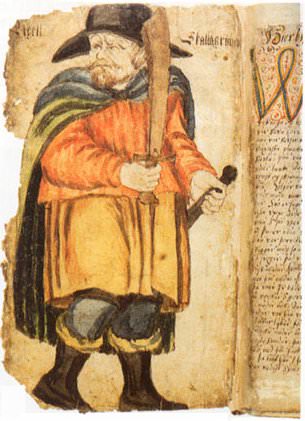
The Saga of Egil Skallagrimsson tells the story of a
tenth-century Viking warrior who took part in raids in Europe and often
fought with his own neighbours in Iceland. When his life’s story was
written in the thirteenth-century, was the author using him as an
example of the type of man that society had to worry about?
Tarrin Wills, a researcher from the University of Aberdeen, believes
that Viking societies themselves were deeply concerned about these
violent and unpredictable individuals – so much so that they took on the
role of early criminal profilers – drafting descriptions of the most
likely trouble-makers.
Wills presented his research yesterday to the British Science
Festival, one of Europe’s largest science festivals. It is being held
this year in Aberdeen and is expecting to attract over 50,000 people for
its talks, discussions and workshops.
After examining the Icelandic sagas, Wills believes that its authors
pinpointed physical characteristics of high testosterone levels – known
to cause violent behaviour – creating some of the earliest ‘criminal
mugshots’.
Forget Crimewatch – the Vikings were there first
A researcher from the University of Aberdeen, who presented today at
the British Science Festival, suggested this is a problem Viking
societies themselves were deeply concerned about – so much so that they
took on the role of early criminal profilers – drafting descriptions of
the most likely trouble-makers.
Dr Tarrin Wills, from the Centre for Scandinavian Studies, has
examined early Icelandic literature and discovered that its authors
pinpointed physical characteristics of high testosterone levels – known
to cause violent behaviour – creating some of the earliest ‘criminal
mugshots’.
Dr Wills, whose work is published in Viking and Medieval Scandinavia
began investigating the link between Viking behaviour and levels of
testosterone after reading an article about hormones and city traders.
Sunday, 19 August 2012
Bornais finds shed light on Iron Age and Viking life
Animal bones used in games and potentially in rituals to predict the future were found at Bornais
Powerful figures from the late Iron
Age through to the end of the Vikings were drawn to a sandy plain on South Uist,
according to archaeologists.
The area has produced large numbers of finds, including what have been described as exotic items from abroad.
Green marble from Greece, ivory from Greenland and bronze pins from Ireland have been among the finds.
A piece of bone marked with an ogham inscription, an ancient text that arrived in Scotland from Ireland, was also found.
Archaeologists said the items provided a detailed picture of life in the first millennium AD.
Read the rest of this article...
Saturday, 18 August 2012
MACABRE FINDS IN THE BOG AT ALKEN ENGE
This is the first skull from the 2012 dig with a mortal wound caused by a spear or an arrow. Credit: Curator Ejvind Hertz, Skanderborg Museum
A FRACTURED SKULL AND A THIGH BONE HACKED IN HALF — FINDS OF DAMAGED HUMAN BONES ALONG WITH AXES, SPEARS, CLUBS AND SHIELDS CONFIRM THAT THE BOG AT ALKEN ENGE WAS THE SITE OF VIOLENT CONFLICT.
For almost two months now, Dr Holst and a team of fifteen archaeologists and geologists have been working to excavate the remains of a large army that was sacrificed at the site around the time of the birth of Christ. The skeletal remains of hundreds of warriors lie buried in the Alken Enge wetlands near Lake Mossø in East Jutland, Denmark.‘It’s clear that this must have been a quite far-reaching and dramatic event that must have had profound effect on the society of the time,’ explains Project Manager Mads Kähler Holst, professor of archaeology at Aarhus University.
Read the rest of this article...
Friday, 10 August 2012
Lost Viking Military Town Unearthed in Germany?
A battle-scarred, eighth-century town unearthed in northern Germany may
be the earliest Viking settlement in the historical record,
archaeologists announced recently.
Ongoing excavations at Füsing (map), near the Danish border, link the site to the "lost" Viking town of Sliasthorp—first recorded in A.D. 804 by royal scribes of the powerful Frankish ruler Charlemagne. Used as a military base by the earliest Scandinavian kings, Sliasthorp's location was unknown until now, said dig leader Andres Dobat, of Aarhus University in Denmark.
Whether it proves to be the historic town or not, the site offers valuable insights into military organization and town planning in the early Viking era, according to the study team. Some 30 buildings have been uncovered since excavations began in 2010.
Ongoing excavations at Füsing (map), near the Danish border, link the site to the "lost" Viking town of Sliasthorp—first recorded in A.D. 804 by royal scribes of the powerful Frankish ruler Charlemagne. Used as a military base by the earliest Scandinavian kings, Sliasthorp's location was unknown until now, said dig leader Andres Dobat, of Aarhus University in Denmark.
Whether it proves to be the historic town or not, the site offers valuable insights into military organization and town planning in the early Viking era, according to the study team. Some 30 buildings have been uncovered since excavations began in 2010.
Sunday, 5 August 2012
Medieval silver treasure found on Gotland
A silver treasure from the 12th century has been found on the Baltic island Gotland, where over 600 pieces of silver coins have been unearthed, according to reports in local media.
"This is an amazing find. It’s unbelievable that treasures of this
scale exist here on Gotland,” Marie Louise Hellquist of Gotland’s County
Administrative Board (Länsstyrelsen) told local newspaper Hela Gotland.
The medieval treasure was uncovered last Monday, as the landowner was moving soil. Some 500 pieces of coin were discovered in the field, and following further searches conducted once archaeologists arrived on Wednesday, that figure has swollen considerably.
“In total we’ve reached 650 pieces, so far,” Hellquist said.
Silver coins were not the only items discovered, as both jewellery and a raw silver artefact, which archaeologists believe to be part of an ancient axe, have been found at the site.
The medieval treasure was uncovered last Monday, as the landowner was moving soil. Some 500 pieces of coin were discovered in the field, and following further searches conducted once archaeologists arrived on Wednesday, that figure has swollen considerably.
“In total we’ve reached 650 pieces, so far,” Hellquist said.
Silver coins were not the only items discovered, as both jewellery and a raw silver artefact, which archaeologists believe to be part of an ancient axe, have been found at the site.
Wednesday, 1 August 2012
Denmark’s past viewed from above
This field once housed a large Viking settlement. The centre of the
picture shows vestiges of a Viking Age house with long curved walls.
Other remnant houses are also visible in the cornfield, along with
vestiges of pit houses.
There’s a lot to learn about the past by studying the land from high above. See a series of stunning aerial archaeology photos here.
Since 2009 archaeologists have been using small aircraft to map nine
areas in Denmark that are of particular interest to archaeologists and
historians.
The project is called 'The past as viewed from the sky – air archaeology in Denmark' and will initially run until 2013.
But what can aerial photos possibly tell us about the past?
Subscribe to:
Posts (Atom)