The Viking Archaeology Blog is concerned with news reports featuring Viking period archaeology. It was primarily constructed as a source for the University of Oxford Online Course in Viking Archaeology: Vikings: Raiders, Traders and Settlers. For news reports for general European archaeology, go to The Archaeology of Europe News Blog.
Sunday, 20 March 2016
1,100 year-old Denmark crucifix ‘may change history’
A cross discovered by an amateur Danish archaeologist may "change history" according to an expert, who believes the cross may date from before Christianity is thought to have reached Denmark.
An amateur archaeologist on the island of Funen made a startling discovery last week – a necklace resembling Jesus on the cross. But after posting a picture of the discovery on Facebook, Dennis Fabricius Holm quickly found that the item may have a lot more significance than he had initially thought.
“I finished work early last Friday, so I decided to spend a couple of hours searching with my metal detector,” Holm told national broadcaster DR.
“Suddenly I hit upon something,” continued Holm. “Ever since I turned over the clump of earth and saw the cross, I’ve been unable to think of anything else.”
Read the rest of this article...
British Buckle Found in Danish Viking Grave
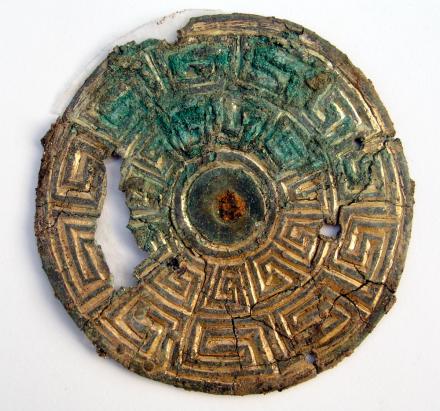
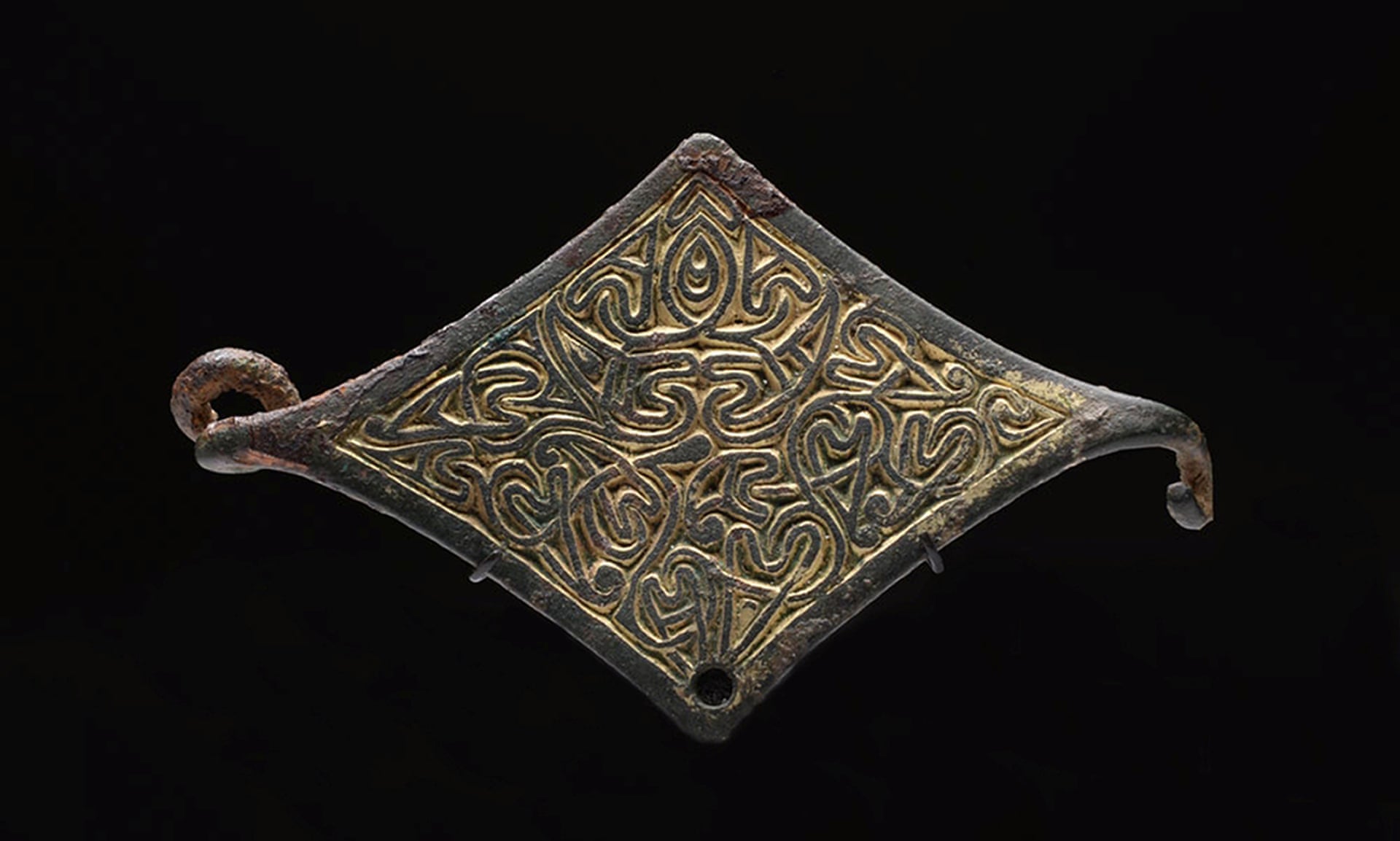
A gilt bronze buckle dating to more than 1,000 years ago has been found buried with a woman in a Viking grave in west Denmark. Determining the origin of the 2.4-inch-wide buckle has been a major challenge, according to archaeologist Ernst Stidsing of the Museum of East Jutland. Stidsing sent photos of the buckle to a colleague who was stumped and who sent them on to other experts. They agreed that it was from the British Isles, but were divided on exactly which part—some said Ireland, others the south of Scotland. They agreed, however, that the disc was originally a decoration on a religious box and was only used as a buckle after it was stolen.
Read the rest of this article...
Friday, 4 March 2016
Was Viking ruler Rollo Danish or Norwegian?
Norwegian researches opened a tomb containing the remains of descendants of Viking leader Rollo in Normandy, France on Monday with the aim of putting an end to a centuries-long debate: was Rollo Danish or Norwegian?
Norwegian researchers opened a tomb containing the remains of
descendants of Viking leader Rollo in Normandy, France on Monday with
the aim of putting an end to a centuries-long debate: was Rollo Danish
or Norwegian?
“We have worked on investigating this for about seven years, so to
finally obtain material that we can test for DNA is huge,” historian
Sturla Ellingvåg told NTB.
Read the rest of this article...
Anglo-Saxon 'island' settlement discovered
The remains of an Anglo-Saxon island have been uncovered in one of the most important archaeological finds in decades.
Anglo-Saxon
'island' settlement discovered Liason officer Adam Daubney and metal
detectorist Graham Vickers have discovered a 'significant'
archaeological site [Credit: University of Sheffield]
The island which was home to a Middle Saxon settlement was found at Little Carlton near Louth, Lincolnshire by archaeologists from the University of Sheffield.
It is thought the site is a previously unknown monastic or trading centre but researchers believe their work has only revealed an enticing glimpse of the settlement so far.
Read the rest of this article...
Sunday, 28 February 2016
No Wool, No Vikings
Fosen
Folk High School students sailing a square-sail-rigged boat in the
Trondheim Fjord. Square sails were the norm in Viking days. Photo by
Claire Eamer
Gray clouds hang low over the Trondheim Fjord, a huge, convoluted indentation in the central Norwegian coast. A gusting wind blows the tops off the waves, tosses rain in my face, and fills Braute’s great square sail. It heels over, water splashing over its leeward gunwale and through the oar-ports, soaking everyone on that side of the long, open, Viking-style wooden boat.
Braute is sailing out from Fosen Folk High School, located in Rissa, on the north shore of the fjord. I’m sharing a hard wooden bench with some of the school’s students—mostly young Norwegians, with a sprinkling of foreigners. They’ve just spent nine months studying traditional skills that date back to the Viking Age, from boatbuilding and sailing to traditional farming and wool working.
On this, the last trip of the school year, we’re heading for Utsetøya, a little island near the mouth of the fjord. That’s where the school’s small flock of sheep, which provides both meat and wool, runs wild for most of the year, hemmed in only by the sea. Most of Fosen’s student body is crammed aboard Braute and two other Viking-style boats, along with staff, food, mounds of camping gear, and one shivering Canadian journalist. The plan is to camp on the island for several nights, check on the flock, and collect next year’s supply of raw wool.
Read the rest of this article...
Did the Vikings use crystal 'sunstones' to discover America?
Vikings may have used the interaction of sunlight with particular types of crystal to create a navigational aid that may even have worked in overcast conditions.
Ancient records tell us that the intrepid Viking seafarers who discovered Iceland, Greenland and eventually North America navigated using landmarks, birds and whales, and little else. There’s little doubt that Viking sailors would also have used the positions of stars at night and the sun during the daytime, and archaeologists have discovered what appears to be a kind of Viking navigational sundial. But without magnetic compasses, like all ancient sailors they would have struggled to find their way once the clouds came over.
However, there are also several reports in Nordic sagas and other sources of a sólarsteinn “sunstone”. The literature doesn’t say what this was used for but it has sparked decades of research examining if this might be a reference to a more intriguing form of navigational tool.
The idea is that the Vikings may have used the interaction of sunlight with particular types of crystal to create a navigational aid that may even have worked in overcast conditions. This would mean the Vikings had discovered the basic principles of measuring polarised light centuries before they were explained scientifically and which are today used to identify and measure different chemicals. Scientists are now getting closer to establishing if this form of navigation would have been possible, or if it is just a fanciful theory.
Read the rest of this article...
Monday, 15 February 2016
Lost in Translation? Ibn Fadlan and the Great Unwashed
14–15 March 2016
MBI Al Jaber Building, Corpus Christi College, Oxford
Our two-day interdisciplinary conference will draw on historians, numismatists, textual scholars and archaeologists and will attempt to set Ibn Fadlan’s account within the broader context of tenth-century Europe, the Islamic world and the Eurasian steppes.
Further details...
Friday, 5 February 2016
From genes to latrines: Vikings and their worms provide clues to emphysema
In a paper published today in Nature: Scientific Reports
a group of researchers led by LSTM have found that the key to an
inherited deficiency, predisposing people to emphysema and other lung
conditions, could lie in their Viking roots.
Chronic obstructive pulmonary disease (COPD) and emphysema affect over 300 million people, or nearly 5% of the global population. The only inherited risk factor is alpha-1-antitrypsin (A1AT) deficiency, and this risk is compounded if individuals smoke tobacco.
Read the rest of this article...
Viking 'sunstones' put to the test
Ancient records tell us that the intrepid Viking seafarers who discovered Iceland, Greenland and eventually North America navigated using landmarks, birds and whales, and little else. There's little doubt that Viking sailors would also have used the positions of stars at night and the sun during the daytime, and archaeologists have discovered what appears to be a kind of Viking navigational sundial. But without magnetic compasses, like all ancient sailors they would have struggled to find their way once the clouds came over.
Viking 'sunstones' put to the test Leif Erikson discovers America
[Credit: Christian Krogh/WikiCommons]
However, there are also several reports in Nordic sagas and other sources of a sólarsteinn "sunstone". The literature doesn't say what this was used for but it has sparked decades of research examining if this might be a reference to a more intriguing form of navigational tool.
Read the rest of this article...
Thursday, 4 February 2016
Bärenkult und Schamanenzauber
Bärenkult und Schamanenzauber: Rituale Früher Jäger
5.12.2015 - 28.3.2016
Archäologische Museum Frankfurt
Warum hat man Bären feierlich bestattet?
Weshalb tanzten Schamanen mit einem Hirschgeweih auf dem Kopf?
In welchen Zauberwelten weilten sie bei ihren Séancen?
Und wozu dienten Äxte und Stäbe, die wie Köpfe von Elchkühen gestaltet waren?
Bärenzeremoniell, Hirschtanz sowie Ren- und Elchkult waren religiös-schamanische Rituale zahlreicher indigener Jägervölker im Norden Skandinaviens und Sibiriens. Mit Faszination und Abscheu begegneten Geistliche und Reisende des 17. und 18. Jahrhunderts diesen Praktiken. Sie verdammten sie als „erschröcklichen Abgötterej vnnd verehrung der Teuffel". Dahinter stand jedoch eine urtümliche Vorstellungswelt und Religiosität, die in der Lebensform archaischer Jäger-Fischer-Sammler-Kulturen wurzelte.
Staunen erweckt jedoch nicht nur die weite Verbreitung dieser Kulte über die gesamte zirkumpolare Zone, sondern noch mehr ihr unergründliches Alter. Denn die Verehrung von Bären und Geweihträgern, verbunden mit schamanischen Ritualen, ist schon für die Altsteinzeit überliefert, dem Auftreten des modernen Menschen in Europa vor etwa 40 000 Jahren und noch darüber hinaus. In den religiösen Phänomenen neuzeitlicher Ethnien der nördlichen Hemisphäre werden somit Züge einer menschlichen „Urreligion" sichtbar.
Read the rest of this article...
Bärenkult und Schamanenzauber
Bärenkult und Schamanenzauber: Rituale Früher Jäger
5.12.2015 - 28.3.2016
Archäologische Museum Frankfurt
Warum hat man Bären feierlich bestattet?
Weshalb tanzten Schamanen mit einem Hirschgeweih auf dem Kopf?
In welchen Zauberwelten weilten sie bei ihren Séancen?
Und wozu dienten Äxte und Stäbe, die wie Köpfe von Elchkühen gestaltet waren?
Bärenzeremoniell, Hirschtanz sowie Ren- und Elchkult waren religiös-schamanische Rituale zahlreicher indigener Jägervölker im Norden Skandinaviens und Sibiriens. Mit Faszination und Abscheu begegneten Geistliche und Reisende des 17. und 18. Jahrhunderts diesen Praktiken. Sie verdammten sie als „erschröcklichen Abgötterej vnnd verehrung der Teuffel". Dahinter stand jedoch eine urtümliche Vorstellungswelt und Religiosität, die in der Lebensform archaischer Jäger-Fischer-Sammler-Kulturen wurzelte.
Staunen erweckt jedoch nicht nur die weite Verbreitung dieser Kulte über die gesamte zirkumpolare Zone, sondern noch mehr ihr unergründliches Alter. Denn die Verehrung von Bären und Geweihträgern, verbunden mit schamanischen Ritualen, ist schon für die Altsteinzeit überliefert, dem Auftreten des modernen Menschen in Europa vor etwa 40 000 Jahren und noch darüber hinaus. In den religiösen Phänomenen neuzeitlicher Ethnien der nördlichen Hemisphäre werden somit Züge einer menschlichen „Urreligion" sichtbar.
Read the rest of this article...
Tuesday, 19 January 2016
English DNA 'one-third' Anglo-Saxon
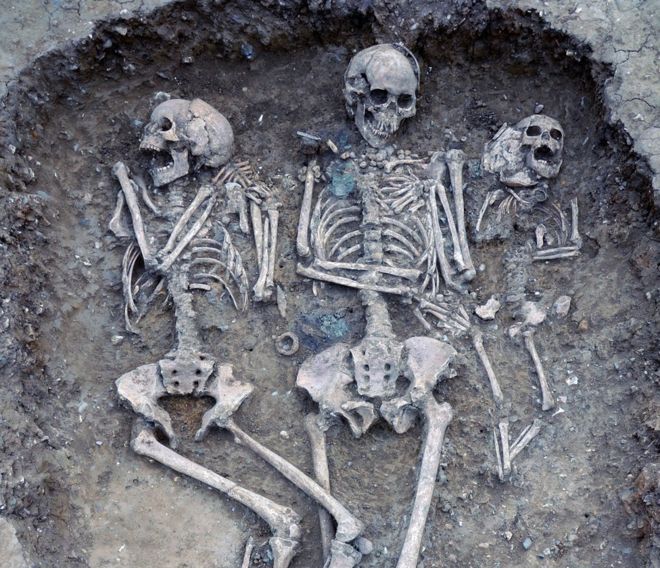
This triple burial from Oakington, Cambridgeshire, includes metal and amber grave goods
The present-day English owe about a third of their ancestry to the Anglo-Saxons, according to a new study.
Scientists sequenced genomes from 10 skeletons unearthed in eastern England and dating from the Iron Age through to the Anglo-Saxon period.
Many of the Anglo-Saxon samples appeared closer to modern Dutch and Danish people than the Iron Age Britons did.
The results appear in Nature Communications journal.
According to historical accounts and archaeology, the Anglo-Saxons migrated to Britain from continental Europe from the 5th Century AD. They brought with them a new culture, social structure and language.
Read the rest of this article...
Monday, 18 January 2016
EMAS Archaeology Study Tour: Landscape of the Bayeux Tapestry
Landscape of the Bayeux Tapestry
21 - 28 May 2016
2016 will be the 950th anniversary of the Battle of Hastings. The famous Bayeux Tapestry that depicts this battle also presents a map of the events that led up to Hastings.
This study tour will follow the route of this map, starting at Westminster and following Harold’s progression through Normandy, and then on to the arrival of William’s forces at Pevensey and finally to Battle, where we will look at the evidence for the suggested new location for the Battle of Hastings.
Full details of this study tour can be found here...
N.B. In order to be certain of a place you need to apply by 1 February 2016 at the latest.
Saturday, 9 January 2016
Scientists find 1,500-year-old pre-Viking settlement beneath new airport site
When Norway announced plans to expand its Ørland Airport this year, archaeologists got excited. They knew that pre-construction excavation was likely to reveal ancient artifacts from the Iron Age, centuries before the Vikings ruled. But they got far more than they had hoped.
Ørland Airport is located in a region of Norway that changed dramatically after the last ice age ended. The area was once completely covered by a thick, heavy layer of ice whose weight caused the Earth's crust to sink below sea level. When the glaciers melted, much of this region remained underwater, creating a secluded bay where today there is nothing but dry land. At the fringes of this vanished bay, archaeologists with the Norwegian University of Science and Technology Museum found the remains of what appears to have been a large, wealthy farming community.
Surveying an area of roughly 91,000 square meters, the researchers uncovered post holes for three large "longhouses" arranged in a U-shape, where villagers would have gathered, honored their chieftain, and possibly stored food. Over the next year, the team plans to unearth more of the village layout—with help from the Norwegian government, which funds scientific excavations at sites set for development.
Read the rest of this article...
Kinder, Gentler Vikings? Not According to Their Slaves
New clues suggest slaves were vital to the Viking way of life—and argue against attempts to soften the raiders’ brutish reputation.
A bare-chested Viking offers a slave girl to a Persian merchant in an artist’s rendering of a scene from Bulgar, a trading town on the Volga River.
ILLUSTRATION BY TOM LOVELL, NATIONAL GEOGRAPHIC CREATIVE
The ancient reputation of Vikings as bloodthirsty raiders on cold northern seas has undergone a radical change in recent decades. A kinder, gentler, and more fashionable Viking emerged. (See “Did Vikings Get a Bum Rap?”)
But our view of the Norse may be about to alter course again as scholars turn their gaze to a segment of Viking society that has long remained in the shadows.
Archaeologists are using recent finds and analyses of previous discoveries—from iron collars in Ireland to possible plantation houses in Sweden—to illuminate the role of slavery in creating and maintaining the Viking way of life.
Friday, 18 December 2015
Rare Viking hoard found by detectorist in Oxfordshire
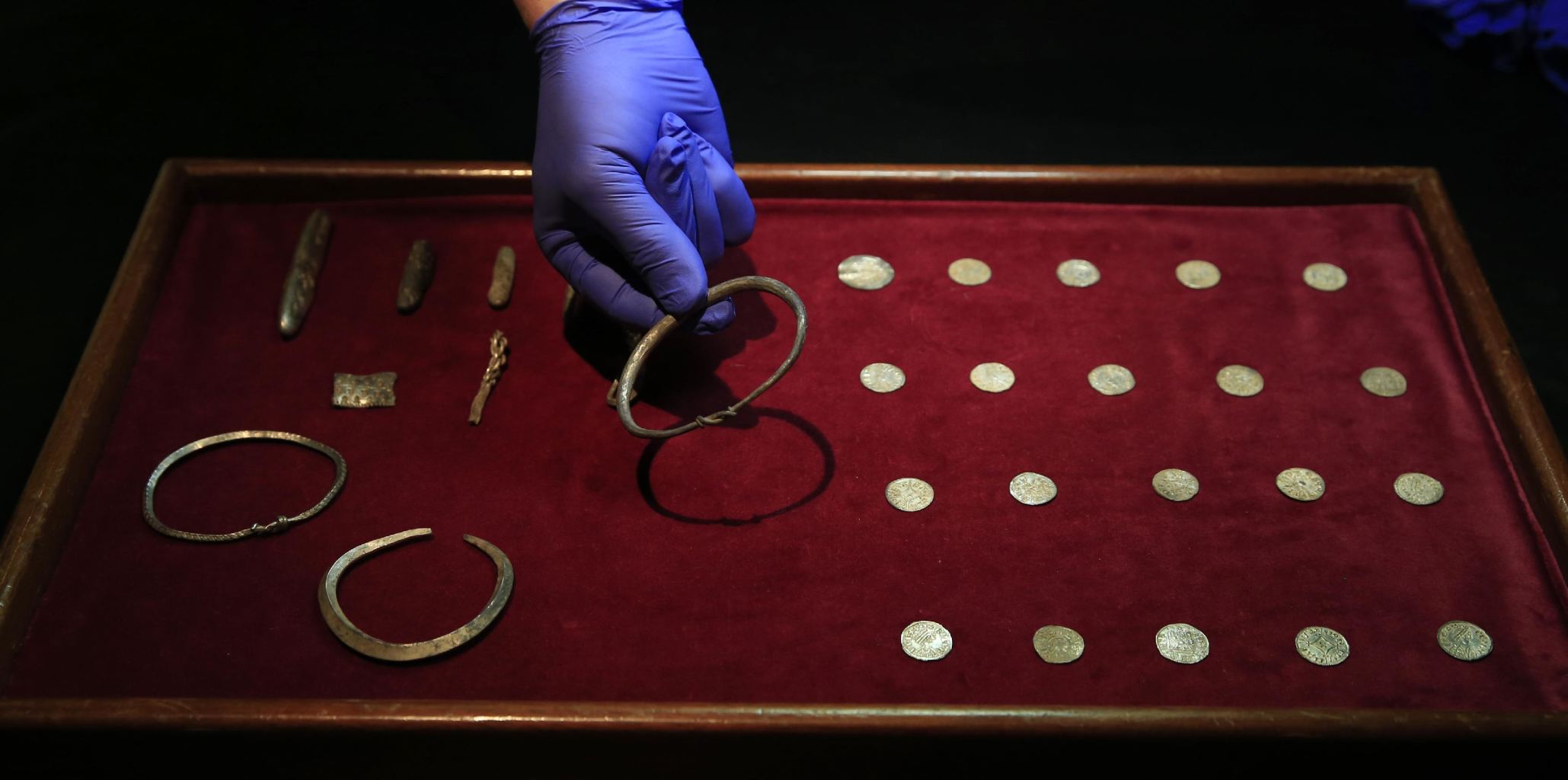
A rare Viking hoard of arm rings, coins and silver ingots has been unearthed in Oxfordshire. The hoard was buried near Watlington around the end of the 870s, in the time of the "Last Kingdom".
The hoard includes rare coins, jewellery and silver ingots
[Credit: Trustees of the British Museum]
[Credit: Trustees of the British Museum]
This was when the Anglo-Saxon kingdoms of Mercia and Wessex were fighting for their survival from the threat of the Vikings, which was to lead to the unification of England.
Archaeologists have called the hoard a "nationally significant find". The hoard was discovered by 60-year-old metal detectorist James Mather.
He said: "I hope these amazing artefacts can be displayed by a local museum to be enjoyed by generations to come."
The find in October was lifted in a block of soil and brought to the British Museum, where it was excavated and studied by experts from the British Museum in London and the Ashmolean Museum in Oxford.
Read the rest of this article...
The Viking Phenomena
Neil Price, Professor at the Institution for Archaeology at the University in Uppsala has been granted 50 mill SEK (5.4 mill EUR/5,9 Mill USD) to study “Vikingafenomenet” – The Viking Phenomena.
“The Viking Phenomena” is an umbrella programme that shelters several sub-strands, with a principle focus on the polities of eastern Scandinavia in the mid-eighth century.
A primary objective is the final, full publication of the Vallsgärde cemetery – Uppsala’s most prominent archaeological excavation over the years – to be undertaken by a team coordinated under the direction of Neil Price. This will be supported by an international collaborative arm with an Estonian team, conducting detailed post-excavation research on the extraordinary twin boat graves discovered at Salme on Saaremaa, which seem to represent the casualties of a raid on Estonia launched from Swedish Uppland, perhaps even by the Valsgärde people themselves.
Monday, 14 December 2015
Viking hoard found in field sheds light on England's origins
A trove of Viking jewelry and Saxon coins unearthed by an amateur treasure-hunter in a farmer's field may help rescue an English king from obscurity.
The Watlington Hoard, a collection of silver bands, ingots and 186 coins unveiled at the British Museum Thursday, dates from a tumultuous period. The coins were minted during the reign of Alfred the Great, ruler of the Anglo-Saxon kingdom of Wessex, who battled a "great heathen army" of Viking invaders during the 9th century.
By coincidence, discovery of the hoard coincides with the broadcast of "The Last Kingdom," a big-budget BBC drama series that has boosted popular interest in the conflict between Alfred and the Vikings.
Alfred is renowned as the ruler whose victories helped create a unified England, but some of the coins in the hoard also bear the name of the far more obscure King Ceolwulf II of Mercia, a neighboring kingdom to Wessex.
"Poor Ceolwulf gets a very bad press in Anglo Saxon history," said museum coins curator Gareth Williams. What little is known of him was written at Alfred's court and paints Ceolwulf as "a puppet of the Vikings."
Read the rest of this article...
Viking hoard discovery reveals little-known king 'airbrushed from history'
A hoard of Viking coins could change our understanding of English history, after showing how Alfred the Great 'airbrushed' out a rival king
A rare coin showing King Alfred ‘the Great’ of Wessex (r.871-99) and King Ceolwulf II of Mercia (874-79)
A Viking hoard discovered by an amateur metal detectorist could prompt the re-writing of English history, after experts claimed it shows how Alfred the Great “airbrushed” a rival king from history.
Ceolwulf II of Mercia is barely mentioned in contemporary records and largely forgotten by history, only briefly described in the Anglo-Saxon Chronicle as an “unwise King’s thane”.
But as of today, his reputation might be rescued after a haul of coins dug up after more than 1,000 years suggested he in fact had a powerful alliance with Alfred, ruling their kingdoms as equals.
Sunday, 15 November 2015
Viking link to the North East of Scotland
Their exploits are more linked to the Northern Isles and the west coast of Scotland, with monastries raided, islanders murdered and gold and silver plundered. But new research - and a clutch of archaeological finds - has now suggested that the North East may not have escaped the fury of the Norsemen afterall.
Vikings in Scotland have been more associated with the Northern Isles and the west coast, but research suggests they may have had a foothold in the north east too [Credit: The Scotsman]
Academics at Aberdeen University have been working to fill the “blank space” of Viking activity in Aberdeenshire and Moray, with written history barely touching on the area so far. Using finds recorded through the Treasure Trove system and the input a team of metal detectors in the North East, a picture of possible Viking activity in the old Pictish Kingdom of Fortriu during the 8th, 9th and 10th centuries is now emerging.
Dr Karen Milek, senior lecturer in archaeology at the University of Aberdeen, said: “We tend to think of Viking activity in Scotland as linked to the Northern Isles or the raids on monasteries such as Iona. We have such a good understanding of Norse culture from the Atlantic coast but no one has been talking about the North East.”
Read the rest of this article...
Thursday, 12 November 2015
Explore 4,500 British Museum artifacts with Google's help
The British Museum in London holds an array of beautiful and historically significant artifacts including the Rosetta Stone, which helped historians to understand the ancient hieroglyphics used in Egypt. Today, the organisation is teaming up with Google to bring its various collections online as part of the Google Cultural Institute. The search giant has been developing this resource for years by continually visiting and archiving exhibits around the world. With the British Museum, an extra 4,500 objects and artworks are being added to its collection, complete with detailed photos and descriptions.
The most important addition is arguably the Admonitions Scroll, a Chinese text which dates back to the 6th-century. The piece is incredibly fragile, so it's only visible in the museum for a few months each year. Through the Cultural Institute, you can take a peek whenever you like -- and because it's been captured at "gigapixel" resolution you can zoom in to see some extraordinary details. All of the objects are searchable on Google's site, along with a couple of curated collections about ancient Egypt and Celtic life in the British Iron Age.
Read the rest of this article...
Wednesday, 11 November 2015
Detectorist finds hoard of 5,000 Anglo-Saxon coins
A hoard of more than Anglo Saxon 5,000 coins have been unearthed, including what may be a unique penny. The discovery, near Lenborough, Buckinghamshire is said to be the biggest hoard of coins in modern times.
A hoard of more than Anglo Saxon 5,000 coins have been unearthed, including what may be a unique coin. The 5,248 coins were found by Paul Coleman on December 21 last year [Credit: Kerry Davies/INS News Agency Ltd]
It includes a uniquely-stamped coin which may be the results of a mix-up at the mint, more than 1,000 years ago. No valuation has officially been placed on the coins, which have formerly been declared as treasure trove, but some experts believe they could be worth more than £1 million.
The 5,248 coins were found by metal detector enthusiast Paul Coleman on December 21 last year. He almost decided not to dig the site when his metal detector beeped, believing he had come across a hidden manhole cover.
Read the rest of this article...
Sunday, 8 November 2015
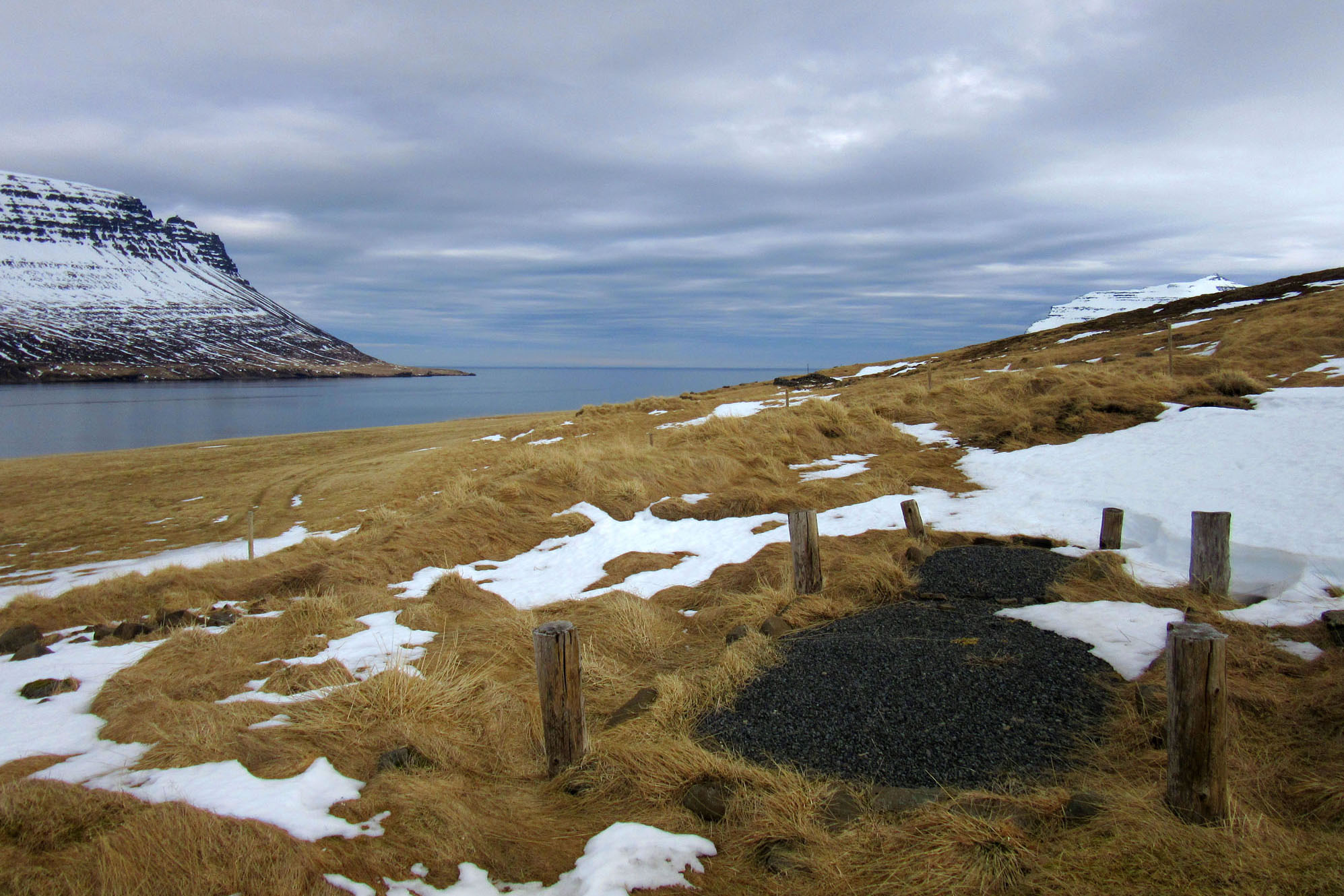
Viking longhouse discovered in East Iceland
Archeological excavations have pointed to the discovery of a Viking longhouse from the age of settlement in Iceland in Stöð, Stöðvarfjörður in East Iceland.
On the local website, Fjarðarbyggð, it says that clues about extremely important archeological findings had appeared. An archeologist at the site says that all conclusions point to the fact that the longhouse is the settlement longhouse mentioned in the ancient Landnáma, the medieval book of settlement. The farm at Stöð is thought to be the first settlement longhouse in East Iceland.
Read the rest of this article...
Thursday, 29 October 2015
Amateur archaeologist finds Viking treasure on Danish island
It’s very rare to have found so many Harald Bluetooth coins (photo: Museum Vestsjælland)
A Danish amateur archaeologist has made a stunning find on the island of Omø just off the coast of southern Zealand.
The discovery – which consists of rare silver treasure dating back to the Viking era – was made when Robert Hemming Poulsen paid a work trip to Omø to lay fibre optic cables. He brought his metal detector along and hunted for buried treasure after work.
“A treasure like this is found once every 10-15 years,” said Hugo Hvid Sørensen, a curator from Museum Vestsjælland, where the treasure is now on display. “It contains many items and is extremely well kept because it has been buried in sandy earth.”
Read the rest of this article...
Hiker stumbles upon ‘extraordinary’ 1,200-year-old Viking sword
After more than a millennium buried in the snow of Norway’s mountains, a surprisingly well-preserved sword sheds light on the Viking age
Viking sword found by a hiker in Hordaland, Norway. Photograph: Hordaland County Counci
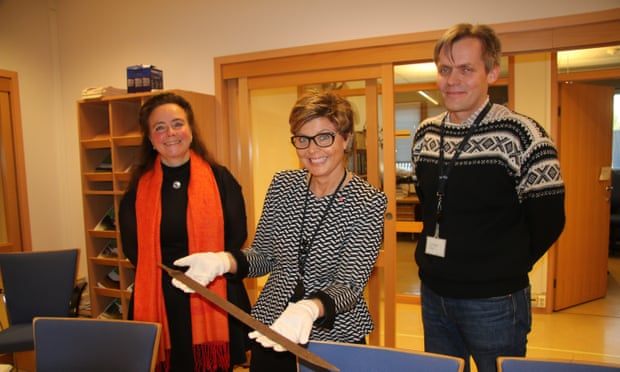
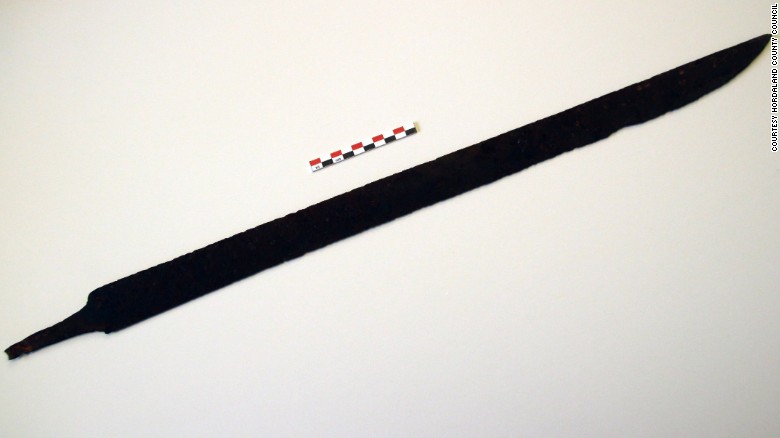
Some time near AD750, someone left a Viking sword along a mountain plateau in southern Norway. On a late October day more than 1,250 years later, a hiker named Goran Olsen picked it up.
The Hordaland County council announced this week that the hiker had discovered the sword in surprisingly pristine condition among the rocks of an old road in Haukeli, as he stopped to rest along an old road through the region’s mountains and valleys.
“It’s quite unusual to find remnants from the Viking age that are so well-preserved,” county conservator Per Morten Ekerhovd told CNN. “It might be used today if you sharpened the edge,” he added.
Read the rest of this article...
Wednesday, 28 October 2015
1,200-year-old Viking sword discovered by hiker
This sword dating from c. 750 AD was discovered by a hiker in Norway. An archaeologist said the artifact was an important example of the Viking age.
A sword is probably the last thing you'd expect to find on a hike -- especially one that's more than a millennium old.
But that's what happened to a man in Norway who recently stumbled across a 1,200-year-old Viking sword while walking an ancient route.
The find, which dates from approximately 750 A.D. and is in exceptionally good condition, was announced by Hordaland County Council.
County Conservator Per Morten Ekerhovd described the discovery as "quite extraordinary."
"It's quite unusual to find remnants from the Viking age that are so well-preserved ... it might be used today if you sharpened the edge," he told CNN.
Read the rest of this article...
UK buyer sought to keep Anglo-Saxon brooch in country
An elaborate Anglo-Saxon brooch that is more than 1,000 years old may be exported if a UK buyer is not found who will pay at least £8,000 for it.
The gilt bronze brooch, from the late 8th century, is one of just 12 such ornaments in existence, and it stands out from the rest for the skill and creativity employed in the creation of its unique complex leaf pattern, which could represent the Christian tree of life.
An illustration dating from the same period of the Virgin Mary in the Book of Kells shows her wearing a similar brooch, suggesting they were worn by high-status women.
Experts said the brooch is of outstanding significance for the study of Anglo-Saxon art and material culture, but it could be exported unless a UK buyer matches the £8,460 asking price.
Read the rest of this article...

Friday, 23 October 2015
Hiker finds 1,200-yr-old Viking sword in Norway
A hiker travelling the ancient route between western and eastern Norway found a 1,200-year-old Viking sword after sitting down to rest after a short fishing trip.
The sword is in such good condition it could be used today [Credit: Hordaland Country Council]
The sword, found at Haukeli in central southern Norway will be sent for conservation at the The University Museum of Bergen.
Jostein Aksdal, an archeologist with Hordaland County said that the sword was in such good condition that if it was given a new grip and a polish, it could be used today.
“The sword was found in very good condition. It is very special to get into a sword that is merely lacking its grip,” he said.
Early Medieval Church at Seydisfjordur in Iceland
How to envisage the conversion to Christianity in Iceland? This is the question raised by archaeologist Steinunn Kristjánsdóttir in a recent article presenting the early medieval Þórarinsstaðir church in Iceland
The early Christian church site at Þórarinsstaðir in Seyðisfjörður, East Iceland, is an example of how religious buildings and their belongings reflect both ecclesiastical and worldly contacts in early medieval Europe.
The site was excavated in 1998–1999 and revealed, for what was then the first time in Iceland, a timber-constructed church building of two phases, dated to the early and late 11th century (Kristjánsdóttir 2004, pp. 84–95). Interestingly, the church buildings at Þórarinsstaðir appeared to be of the same form of construction as that characterizing many of the earliest churches found in Viking settlement areas in Northern Europe: an early type of stave church, here called a post church, notably one built of timber with earth-dug corner posts
Monday, 12 October 2015
When archaeologists found the first Viking Age fortress in Denmark for 60 years last September, it was hailed as a fantastic archaeological discovery.
Now the time has come for the archaeologists to unearth the hidden secrets and legacy of the fortress, located near Køge just south of Copenhagen. A 20 million kroner grant from the AP Møller Fund and 4.5 million kroner from Køge Municipality has helped make that possible.
“With the grant, the Danish Castle Centre – a division of Museum Southeast Denmark and Aarhus University – has worked out a unique research project seeking to explore the secrets Borgring is hiding beneath Danish soil,” the Danish Castle Centre said.
“With the use of modern archaeological methods the scientists and archaeologists will investigate how the fortresses were used, how they were organised, how quickly they were built, their age and what environment, landscape and geography they were a part of.”
Read the rest of this article...
Saturday, 3 October 2015
Lewis chessmen might be Icelandic in origin
Carbon dating of walrus bones found in Snæfellsnes peninsula indicates that the bones are at least 2000 years old. A large number of walrus skulls and walrus tusks have been found around Garðafjara beach on the south coast Snæfellsnes. The first skull was discovered 1884. All in all the bones of 50 walruses have been found, most in the past 50 years. Biologists argue this indicates Snæfellsnes was the home of a sizable walrus colony prior to the settlement of Iceland.
The Lewis Chessmen: A ferocius berserker (rook), a stern king and a contemplative queen
[Credit: WikiCommons]
A previous theory, explaining the concentration of bone discoveries, speculated they came from the wreck of a ship which had been carrying walrus bones to Europe. However, the existence of a large walrus colony in Iceland would have meant the accumulation of walrus skeletons and skulls which would have been discovered by the Viking age settlers of Iceland.
Hilmar J. Malmquist, the chief of the Icelandic Natural History Museum points out in an interview with the local newspaper Fréttablaðið that such graveyards of walrus bones could also explain references to walruses in Icelandic place names, shedding light on the possible use of walrus ivory by the early settlers of Iceland who could have had access to domestic ivory found in such bone yards.
Monday, 14 September 2015
Viking treasure hoard unearthed in Wales
A hoard of historic Viking treasure has been unearthed near Caernarfon in Gwynedd, Wales. The haul, which includes ancient ingots and fragments of coins dating back almost a thousand years to the time of King Cnut the Great, was found by treasure hunter Walter Hanks from Llanllyfni using a metal detector in Llandwrog back in March.
Part of the hoard of Viking silver found near Caernarfon [Credit: Robin Maggs] A total of fourteen silver pennies produced at Dublin under the Hiberno-Scandinavian ruler Sihtric Anlafsson (989-1036), which archeologists say are rarely found on the British mainland, also make up part of the find. Eight of the coins date back to A.D. 995 while the other six were believed to have been produced in A.D 1018.
Experts believe that the hoard was purposely buried in the ground between 1020 and 1030 in a bid to store the silver - and could even have been used as part of a burial ritual. Earlier today, the astonishing discovery was officially declared treasure by the North West Wales coroner Dewi Pritchard-Jones during an inquest at Caernarfon.
Read the rest of this article...
Sunday, 2 August 2015
New research on the causes of the Viking Age
The Viking hit-and-run raids on monastic communities such as Lindisfarne and Iona were the most infamous result of burgeoning Scandinavian maritime prowess in the closing years of the Eighth Century.
The Vale of York Cup - a Christian vessel from northern mainland Europe that was probably held by Scandinavians for some time after its capture, before finishing its life as the receptacle for a large silver hoard buried in Yorkshire [Credit : York Museums Trust]
These skirmishes led to more expansive military campaigns, settlement, and ultimately conquest of large swathes of the British Isles. But Dr Steve Ashby, of the Department of Archaeology at the University of York, wanted to explore the social justifications for this spike in aggressive activity.
Previous research has considered environmental, demographic, technological and political drivers, as well as the palpable lure of silver and slave and why these forms of wealth became important at this stage.
Read the rest of this article...
Tuesday, 28 July 2015
New research on the causes of the Viking Age
The Viking hit-and-run raids on monastic communities such as Lindisfarne and Iona were the most infamous result of burgeoning Scandinavian maritime prowess in the closing years of the Eighth Century.
These skirmishes led to more expansive military campaigns, settlement, and ultimately conquest of large swathes of the British Isles. But Dr Steve Ashby, of the Department of Archaeology at the University of York, wanted to explore the social justifications for this spike in aggressive activity.
Previous research has considered environmental, demographic, technological and political drivers, as well as the palpable lure of silver and slave and why these forms of wealth became important at this stage.
Read the rest of this article...
Sunday, 19 July 2015
The last Viking and his 'magical' sword?
Have you held the sword? Have you felt its weight? Have you felt how sharp and strong the blade is?
Langeidsverdet helfigur
[Credit: Ellen C. Holthe, Museum of Cultural History, University of Oslo]
A deadly weapon and symbol of power -- jewellery for a man, with magical properties. The sword gave power to the warrior, but the warrior's strength could also be transferred to the sword. That is how they were bound together: man and weapon, warrior and sword.
This sword was found in Langeid in Bygland in Setesdal in 2011. It is a truly unique sword from the late Viking Age, embellished with gold, inscriptions and other ornamentation. The discovery of the sword has not been published until now, when it is being displayed for the first time in the exhibition 'Take It Personally' at the Historical Museum in Oslo.
The sword must have belonged to a wealthy man in the late Viking Age. But who was he and what magic inscriptions are set into the decoration -- in gold? Was the owner of the sword in the Danish King Canute's army when it attacked England in 1014-15?
Read the rest of this article...
Sunday, 12 July 2015
Viking-age hut found in Reykjavik
Archaeologists digging on Lækjargata in central Reykjavik were looking for traces of a farm cottage built in 1799 – and found a Viking longhouse from some 900 years earlier.
The longhouse is at least 20 m long at 5.5m wide at it widest point. The ‘long fire’ in the centre of the hut is one of the largest ever found in Iceland, which visible traces suggesting it was over 5.2 m long.
“This find came as a great surprise for everybody,” says Þorsteinn Bergsson, Managing Director of Minjavernd, an independent association working for the preservation of old buildings in Iceland. “This rewrites the history of Reykjavik.”
Read the rest of this article...
Wednesday, 8 July 2015
You(r) Archaeology – portraying the past
“You(r) Archaeology – portraying the past” - A European competition to express your view.
What is archaeology? An adventure? A pain in the neck? The appeal of the past, the magic of marvellous sites, the boredom of a dusty museum? Probably all of these together, and still more.
Up until July 31st 2015, all European citizens can answer the question and tell us about their idea of archaeology by entering a drawing, painting, photo or video in the European competition “You(r) Archaeology”.
Further details...
Monday, 29 June 2015
Rare Viking relic discovered at Perthshire dig
ARCHAEOLOGISTS delving into Scottish history believe they have discovered a rare object at a Viking-age longhouse in Perthshire
The small circular stone, with a central hole - thought to be a spindle whorl - was found by Diana McIntyre, who was on a dig with Glenshee Archaelogy Project at Lair in Glenshee.
A spindle whorl, was a weight fitted to a spindle while hand spinning textiles to increase and maintain the speed of the spin.
The stone, which is only around 5cm in diameter, has been carefully shaped to be symmetrical, but what has interested the team are the symbols and designs carved onto one surface.
Read the rest of this article...
Subscribe to:
Posts (Atom)