Sunday, 16 February 2014

Mysterious code in Viking runes is cracked


A runic code called jötunvillur has finally been decrypted. It just might help solve the mystery of the Vikings’ secret codes.

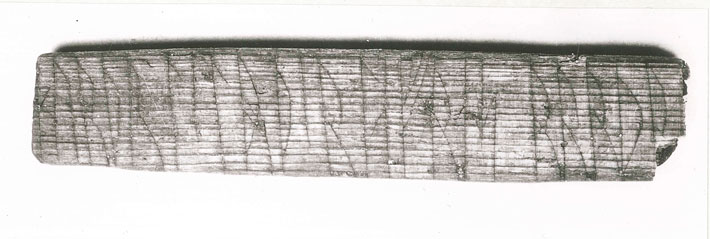
Two men, Sigurd and Lavrans, carved their names both in code and in standard runes on this stick, dated from the 13th century and found at the Bergen Wharf. This helped researcher Jonas Nordby crack the jötunvillur code. (Photo: Aslak Liestøl/Museum of Cultural History, University of Oslo)

Why did Vikings sometimes use codes when they wrote in runes? Were the messages secret, or did they have other reasons for encrypting their runic texts? Researchers still don’t know for sure.

But Runologist K. Jonas Nordby thinks he has made progress toward an answer. He has managed to crack a code called jötunvillur, which has baffled linguists and historians for years.

His discovery can help researchers understand the purpose behind the mystery codes.

Read the rest of this article...

Ancient Viking code deciphered for the first time


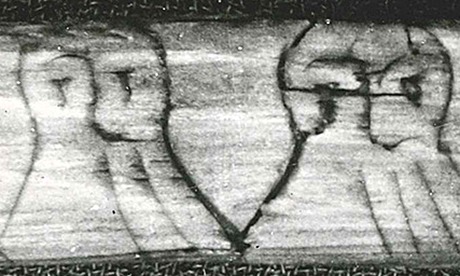
Mystery nosed out ... Fragment of wooden stick with runic inscription on one side found at the old wharf in Bergen. The text is written using a code where the number of 'hairs' in the beards of each face indicate the position of the character in the runic alphabet. Museum of cultural history, University of Oslo. Aslak Liestol Photograph: Aslak Liestol/Museum of Cultural History, University of Oslo
An ancient Norse code which has been puzzling experts for years has been cracked by a Norwegian runologist - to discover the Viking equivalent of playful text messages.
The mysterious jötunvillur code, which dates to 12th or 13th-century Scandinavia, has been unravelled by K Jonas Nordby from the University of Oslo, after he studied a 13th-century stick on which two men, Sigurd and Lavrans, had carved their name in both code and in standard runes. The jötunvillur code is found on only nine inscriptions, from different parts of Scandinavia, and has never been interpreted before.
Read the rest of this article...

Viking Code Cracked

OSLO, NORWAY—Runologist K. Jonas Nordby of the University of Oslo has deciphered the ancient Norse jötunvillur code, found on nine known inscriptions. Nordby used a thirteenth-century stick on which two men had carved their names, Sigurd and Lavrans, in standard runes and in the code. The confusing system requires that the reader have a good working knowledge of the runes in order to swap them out with others for sounds in their names. “What if codes were used like a game, playing with a system? With jötunvillur, you had to learn the names of runes, so I think codes were used in teaching, in learning to write and read runes,” he told The Guardian.

Read the rest of this article...

Thursday, 6 February 2014

CULTURAL IDENTITY – CELTIC AND ANGLO-NORMAN REALMS


Jutting out from the edge of the Lake District and home to a proud industrial heritage, the Furness Peninsula seems to weld together many of our contrasting ideas about what Englishness means. To the north lies some of the country’s most outstanding areas of natural beauty; at the southern tip sits a shipyard where nuclear submarines for the Royal Navy are built. The area is defined by working-class values, post-industrial decline and 21st-century regeneration.
By uniting these elements, Furness appears to epitomise many of the complex ideas behind a notion of England that is both very modern, and very old.

Raises questions

But this, it turns out, is far from the complete picture. In a recent project, historians have begun to scratch the surface of a much earlier period in Furness’ past – one that not only changes what we know about its history, but also raises questions about these very ideas of Englishness itself.

Read the rest of this article...

Monday, 3 February 2014

Was Charlemagne a Mass Murderer?


When he heard of this, the Lord King Charles rushed to the place with all the Franks he could gather on short notice and advanced to where the Aller flows into the Weser. Then all the Saxons came together again, submitted to the authority of the Lord King, and surrendered the evildoers who were chiefly responsible for this revolt to be put to death – four thousand five hundred of them. The sentence was carried out.

This entry for the year 782 in the Royal Frankish Annals is one of the most debated topics of Charlemagne’s reign. Did the ‘Massacre of Verden’ actually happen with 4500 people being killed in a single day? Was the Carolingian ruler (and later Holy Roman Emperor) justified in his actions? Or was this a brutal act of ethnic-cleansing that has left a terrible mark on the man who is credited with re-establishing Western Europe after the fall of the Roman Empire?

Read the rest of this article...

Sunday, 2 February 2014

Summer Courses in Archaeology


The Oxford Experience Summer School


Courses in Archaeology


The Oxford Experience Summer School is held at Christ Church, Oxford

The Oxford Experience Summer School offers a number of one-week courses in archaeology as part of its programme.

Participants live in Christ Church - the largest of the Oxford Colleges - and take their meals in the Great Hall, which is the hall that inspired the Hogwarts Hall in the Harry Potter films.

Courses are limited to a maximum of twelve participants and tend to fill up rather quickly, so early application is advised.


Youcan find out more about the Oxford Experience here...

Training Digs for 2014


Now is the time to start thinking about training digs for the summer.

If you are planning to go on a training dig, take a look at our list here...

If you would like to submit details of a training dig (or any other archaeological event), please use the contact form here...

Friday, 31 January 2014

The Vikings are coming…

Iron axe-head found in the Thames at Hammersmith, Viking, 10th-11th century (1909,0626.8)

Tom Williams, Project Curator: Vikings, British Museum
Several years ago I worked at the Tower of London. Spending long periods of time within a building of such age, I would often start to wonder about how the area would have looked before the castle was built. Every morning I would pass the remains of Roman walls at Tower Bridge station, walls that were repaired and refortified by King Alfred the Great in response to the very real threat of Viking raids from the river. Blotting out the great hulk of HMS Belfast, Tower Bridge and the modern office blocks that now crowd the banks, I would try to imagine the awe and the terror that a Londoner would have felt a thousand years ago, standing on the city walls, watching the carved and gilded prows of dragon ships silently gliding up the Thames. Viking fleets and armies raided and besieged the city on numerous occasions, and the river has given up dozens of weapons that might have ended up there as a result of those conflicts.
Read the rest of this article...

Tuesday, 28 January 2014

Govan Stones: The Viking-Age treasures

The sarcophagus dates back to about AD 900

A unique collection of Viking-age monuments, which lay unloved in a Govan churchyard for 1,000 years, has attracted the attention of the British Museum. Its curator said the Govan Stones was one of the best collections of early medieval sculpture anywhere in the British isles.
Govan is well-known as an industrial powerhouse which, over the past 150 years, has built an incredible number of the world's largest ships.
However the town, now part of the city of Glasgow, has a long and largely-forgotten history as one of the earliest seats of Christianity in Scotland and the main church of the Kingdom of Strathclyde, the lost kingdom of the northern Britons.
In AD 870, Vikings, who had been based in Dublin, destroyed Dumbarton at the mouth of the Clyde, which had been a major power centre in the centuries after the Romans departed from Britain.
Read the rest of this article...

Swedish divers unearth Stone Age settlement


"One-of-a-kind" Stone Age artefacts left by Swedish nomads 11,000 years ago have been discovered by divers in the Baltic Sea, prompting some to claim that Sweden's Atlantis had been found.

A diver exams an 11,000-year old tree trunk [Credit: Arne Sjostrom]

 "What we have here is maybe one of the oldest settlements from the first more permanent sites in Scania and in Sweden full stop," project leader and archaeology professor at Sodertorn University Bjorn Nilsson told The Local. 

Nilsson's team has been diving in Hano, a sandy bay off the coast of Skane County, and has been given the resources by the Swedish National Heritage Board (Riksantikvarieambetet) needed for a three-year excavation of an area 16 metres below the water's surface.

Read the rest of this article...

Old Norse people drank wine 3,000 years ago

Researchers have found traces of wine in jars, dating back to 1100 BC. The finds suggest that wine was imported long before previously thought.


The discovery of traces of wine in an Old Norse jar reveals that Nordic people drank wine as early as 1100 BC. The archaeologists behind the discovery believe that Nordic people may have received the wine through trading with central and southern Europeans. (Illustration: Robert Brown)

Having recently studied three jars from ancient Denmark and one cup from southern Sweden, researchers found traces of wine in one of the jars, which may originate as far back as 1100 BC.
The new study indicates that Old Norse people traded wine with central and southern Europeans long before the Iron Age, when most of the earliest traces of wine in the North started to appear.
Read the rest of this article...

Thursday, 23 January 2014

British Museum launches The BP Exhibition Vikings: life and legend


In March 2014 the British Museum will open the Sainsbury Exhibitions Gallery with a major exhibition on the Vikings, supported by BP.

The exhibition has been developed with the National Museum of Denmark and the Staatliche Museen zu Berlin (National Museums in Berlin) and focuses on the core period of the Viking Age from the late 8th century to the early 11th century.
The extraordinary Viking expansion from the Scandinavian homelands during this era created a cultural network with contacts from the Caspian Sea to the North Atlantic, and from the Arctic Circle to the Mediterranean. The Vikings will be viewed in a global context that will highlight the multi-faceted influences arising from extensive cultural contacts. The exhibition will capitalise on new research and thousands of recent discoveries by both archaeologists and metal-detectorists, to set the developments of the Viking Age in context.
Read the rest of this article...

WELL PRESERVED IRON AGE VILLAGE UNCOVERED IN DENMARK


During evaluation of land prior to the construction of a new hospital in Aalborg, Northern Denmark, archaeologists uncovered an Iron Age village dating back around 2000 years. The settlement differs from other sites of this period because of its well preserved condition, including a number of houses complete with fireplaces, chalk floors and cobbled paving.

The village covers an area of ​​approximately 4 ha., and excavation has so far located about 40 houses. However, this number is expected to increase greatly during full excavation, but initial reports show they are not all contemporary, and represent repeated reconstruction and rebuild over hundreds of years.
Usually, only traces of the postholes are left to understand the layout of a house, but the village had been covered over with a thick layer of soil, that had protected it after abandonment. Several of the houses had floors created out of chalk for the living area, while other parts of the buildings appeared to be used as stabling for animals. Preliminary studies show bones found were mainly from the butchering of cattle, pigs, sheep and goats, but the inhabitants supplemented their diet with fish from the nearby fjord.

Read the rest of this article...

Sunday, 19 January 2014

Hilary Term Online Courses in Archaeology


Hillary Term begins tomorrow at Oxford, but there is still time to enrol for one of the online courses in archaeology.

Cave paintings, castles and pyramids, Neanderthals, Romans and Vikings - archaeology is about the excitement of discovery, finding out about our ancestors, exploring landscape through time, piecing together puzzles of the past from material remains.

These courses enable you to experience all this through online archaeological resources based on primary evidence from excavations and artefacts and from complex scientific processes and current thinking. Together with guided reading, discussion and activities you can experience how archaeologists work today to increase our knowledge of people and societies from the past.

The following courses are available:

Researchers claim to have found King Alfred's pelvis


Researchers said Friday they may have discovered remains of King Alfred the Great, the 9th-century royal remembered for protecting England from the Vikings and educating a largely illiterate nation. 

The portion of a pelvic bone said to belong either to Alfred, the only English king to have the moniker "Great", or his son King Edward the Elder was identified in remains dug up at a medieval abbey in Winchester, southwest England, the capital of Alfred's kingdom [Credit: University of Winchester] 

The University of Winchester said in a statement that a pelvis found in a box of bones in the city's museum is likely to be either from the legendary leader or his son, King Edward the Elder.

Read the rest of this article...

Bone fragment 'could be King Alfred or son Edward'

The fragment of pelvis dates back to the period in history when King Alfred died

A fragment of pelvis bone unearthed in Winchester in 1999 may belong to King Alfred the Great or his son Edward the Elder, academics have said.
It was found at a previous dig at Hyde Abbey and has been dated to 895-1017 - the era the king died.
Experts were originally testing remains exhumed last year from an unmarked grave at St Bartholomew's Church, where it was thought he was buried.
But they were found to be from the 1300s, not 899, when the king died.
The fragment of pelvis had been among remains stored in two boxes at Winchester's City Museum and was tested by academics at Winchester University after their study into the exhumed remains proved fruitless.
Read the rest of this article...

Saturday, 18 January 2014

King Alfred the Great bones believed to be in box found in museum


The first remains of King Alfred the Great may have been found at last after tests on a pelvic bone unearthed in Winchester revealed it belonged to either the Anglo-Saxon King or his son Edward.
But after a high-profile excavation of an unmarked grave where the Anglo-Saxon King was believed to be buried, the location of the bone was much more mundane - a storage box in the bowels of a local museum.
Archaeologists from the University of Winchester had initially analysed six skeletons excavated from a grave at St Bartholomew's Church, the historic site of Hyde Abbey, last March.
Read the rest of this article...

Thursday, 16 January 2014

Treasure hunters found nearly 1,000 items in 2012

It is thought these coins, minted in the name of Edmund, King of East Anglia, were buried when Vikings attacked Britain in 865#

Amateur archaeologists with metal detectors found 990 items classified as treasure during 2012, according to figures from the British Museum.
All of the rare coins, rings and brooches contain gold or silver, and many date back more than 1,200 years.
The public reported more than 74,000 other historical items to the Portable Antiquities Scheme, which experts say has "revolutionised archaeology".
More than 900,000 objects have been reported since it started in 1997.
The verification process takes several months, which is why the items submitted in 2012 are only being detailed now.
Read the rest of this article...

Friday, 10 January 2014

New Iron Age Sites Discovered in Finland

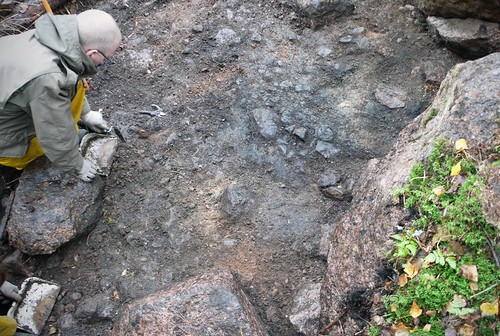
A National Board of Antiquities archaeologist excavates at the Ahvenkoski harbor forge. The furnace was located between two stones, and in the ground one can see dark gray iron slag pieces. 
Image courtesy Jouni Jäppinen.

It was in the autumn of 2010 when local amateur archaeologists discovered evidence of harbor facilities thought to date from around 1000–1200 AD near Ahvenkoski village at the mouth of the western branch of the Kymi River in southeastern Finland. The findings included a smithy, an iron smelting furnace, and forceps, as well as hundreds of iron objects such as boat rivets similar to those found at Viking settlements in different parts of the Baltic, Scandinavia, Scotland and Iceland. Then, in 2011, a possible 2 x 3-meter-wide cremation grave was uncovered, confirmed later through rescue excavations by archaeologists from the Finnish National Board of Antiquities and through osteological analysis at the University of Helsinki. Artifacts included a battle axe, a knife, and a bronze buckle, all associated with burned human bones, initially thought to be dated to around 1000 - 1200 CE before analysis. Similar objects have been discovered in the Baltic Sea area and in Ladoga Karelia. Identical cape buckles have also been found in Gotland. 

Read the rest of this article...

Network theory and the heroes of Icelandic sagas

Egill Skallagrímsson from a 17th-century manuscript [Credit: WikiCommons] 

The Icelandic sagas of the Norse people are thousand-year-old chronicles of brave deeds and timeless romances, but how true to Viking life were they? Writing in Significance, Pádraig Mac Carron and Ralph Kenna use a statistical network of associations between characters to find out. 

While the stories involve a cast of thousands, recurring characters have emerged as the stories passed into historical legend. A set of recurring characters living within the same fictional world is not restricted to ancient stories, such as the Norse or Greek myths, but remains a popular device in modern comic and film franchises. 

By exploring the number of ‘too-good-to-be-true’ interactions between protagonists, the researchers built a network of recurring characters which in turn could help reveal if the stories are invented or if they are based on a real society.

Read the rest of this article...

Karl der Große: Macht, Kunst, Schätze


Karl der Große: Macht, Kunst, Schätze - three major exhibitions which will run in Aachen from 20 June to 21 September 2014 to mark the 1200th anniversary of the death of Charlemagne.

The three exhibitions are listed as:

Places of Power
The exhibition in the town hall’s coronation hall, the former kings’ hall of the palace, focuses on Charlemagne’s imperial palaces.

Charles’s Art
At the Centre Charlemagne, a new exhibition housed in the heart of the imperial palace, the golden age of culture during the Carolingian period is presented with top-class works of art.

Lost Treasures
In the cathedral’s treasure chamber next to Carolingian Marienkirche, precious church treasures from the Carolingian period and the Middle Ages return to their original site once again.

This should prove to be the most important Carolingian exhibition since the 'Karl der Große und Pabst Leo III. in Paderborn' exhibition held in 1999.

Go to the exhibition website...

Looted Viking treasure is discovered in British Museum store

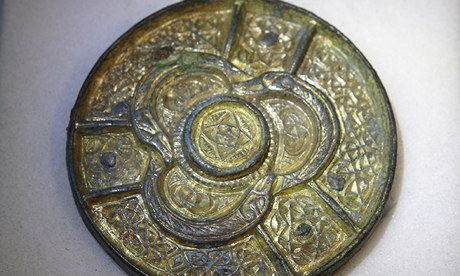
The Celtic brooch looted by the Vikings and discovered in the museum's collection. Photograph: Andy Hall for the Observer
A Celtic treasure looted by the Vikings more than 1,000 years ago has been discovered in the British Museum's storerooms. An ornate, gilded disc brooch dating from the eighth or ninth century was found by chance and is being described as a "staggering find". No-one knew of its existence until now.
It had been concealed in a lump of organic material excavated from a Viking burial site at Lilleberge in Norway by a British archaeologist in the 1880s and acquired by the British Museum in 1891.
Curator Barry Ager, a Vikings specialist, was poring over artefacts before a visit from a Norwegian researching the Viking site when his eye was caught by some metal sticking out of the side of the organic lump.
Read the rest of this article...

1,000-year-old loot found in British Museum store

The Celtic brooch looted from the Vikings and discovered in the museum's collection 
[Credit: Andy Hall for the Observer] 

A Celtic treasure looted by the Vikings more than 1,000 years ago has been discovered in the British Museum's storerooms. An ornate, gilded disc brooch dating from the eighth or ninth century was found by chance and is being described as a "staggering find". No-one knew of its existence until now. 

It had been concealed in a lump of organic material excavated from a Viking burial site at Lilleberge in Norway by a British archaeologist in the 1880s and acquired by the British Museum in 1891. 

Read the rest of this article...

RAISING A HORN TO NORDIC DRINKING HERITAGE


Anew book describes the fascinating history of drinking horns and their importance within Scandinavian culture where their roots stretch back into at least the Iron Age as several graves have been found to contain examples from this period.

A long history

During Classical Antiquity, it was the Thracians and Scythians who were known for their custom of drinking from actual horns but in Bronze Age Mycenaean Greece, although they had retained their shape the materials used were clay or metal. Their spread across Central Europe and into Scandanavia by the 5th century BC can be traced by their fittings found in various graves.
The Gallehus horns, discovered north of Møgeltønder in Southern Jutland, Denmark, were created from sheet gold. Designed to look like auroch horns, they were found in 1639 and in 1734 respectively at locations only 20 metres apart and date to the early 5th century BC. Sadly the originals were stolen and melted down in 1802.

Read the rest of this article...

Sweyn Forkbeard: England's forgotten Viking king

Sweyn Forkbeard (shown left), England's shortest reigning king, remains in the shadows of both his son Canute the Great, and father Harold Bluetooth

On Christmas Day 1013, Danish ruler Sweyn Forkbeard was declared King of all England and the town of Gainsborough its capital. But why is so little known of the man who would be England's shortest-reigning king and the role he played in shaping the early history of the nation?
For 20 years, Sweyn, a "murderous character" who deposed his father Harold Bluetooth, waged war on England.
And exactly 1,000 years ago, with his son Canute by his side, a large-scale invasion finally proved decisive.
Read the rest of this article...
Sunday, 22 December 2013

Vikings Online Course


Vikings: Raiders, Traders and Settlers 

22 January to 5 April 2014


Vikings: Raiders, Traders and Settlers is an online archaeology course run by the University of Oxford's Department of Continuing Education.
The course runs for ten weeks and successful completion carries an award of ten CATS points. Students write two short assignments as part of the course.
Online forums for each unit enable students to discuss the topic being studied, and help from the online tutor is always available
You can find more details here...
You can find details of other online archaeology courses here...

Thursday, 12 December 2013

Double graves with headless slaves


In the Viking era, a number of slaves were beheaded and then buried together with their masters. New methods of skeleton analysis reveal more about the life of the poor more than a thousand years ago.

In 1975, three intact skeletons from the Iron Age were found on the Tommeide farm in Tomma. Naumann interprets this as a family grave. - Despite possible kinship between them, probably as members of the same household, the child nevertheless had a diet that was different from that of the two adults during the last years of their lives. (Photo: Anne Stalsberg, NTNU Vitenskapsmuseet)

How was life for common people in Norway during the period 400–1050 AD? Can we learn more? Yes, according to Elise Naumann, research scholar in archaeology. By using isotope analysis to examine ancient skeletons, she has made several remarkable discoveries. The research results from the analysis of skeletons found at Flakstad in Lofoten have also been reported in the American newspaper USA Today.

Read the rest of this article..

Tuesday, 10 December 2013

Isotope analysis reveals diet of beheaded Viking slaves


In the Viking era, a number of slaves were beheaded and then buried together with their masters. New methods of skeleton analysis reveal more about the life of the poor more than a thousand years ago.

Isotope analysis reveals diet of beheaded Viking slaves
In 1975, three intact skeletons from the Iron Age were found on the Tommeide farm in Tomma. Naumann interprets this as a family grave. - Despite possible kinship between them, probably as members of the same household, the child nevertheless had a diet that was different from that of the two adults during the last years of their lives [Credit: Anne Stalsberg, NTNU Vitenskapsmuseet]
How was life for common people in Norway during the period 400–1050 AD? Can we learn more? Yes, according to Elise Naumann, research scholar in archaeology. By using isotope analysis to examine ancient skeletons, she has made several remarkable discoveries. The research results from the analysis of skeletons found at Flakstad in Lofoten have also been reported in the American newspaper USA Today.

Read the rest of this article...

Thursday, 5 December 2013

Building is underway at The new Wessex Gallery of Archaeology, The Salisbury Museum

Anglo-Saxon satchel mount c.700 AD. Gold and Silver foils with repoussé decoration. 
Found with the burial of an Anglo-Saxon ‘princess’ at Swallowcliffe, Salisbury.
Amesbury Archer Gold Hair Tresses - 2,300 BC. The oldest gold objects found in Britain, 
Copyright Ken Geiger/National Geographic.
Polished macehead made from gneiss found with a cremation burial at Stonehenge,  3,000 – 2,500 BC.

Building is underway at The new Wessex Gallery of Archaeology, 
The Salisbury Museum

Building has begun on the new Wessex Gallery at the Salisbury Museum, which will make it clear for the first time exactly why Salisbury and it’s nearby World Heritage Sites hold a unique place in British history.

The new gallery will be of international importance, telling the story of Salisbury and the surrounding area from prehistoric times to the Norman Conquest. Realm Projects, the Nottinghamshire based builders who worked on the Hepworth Wakefield and The Jewish Museum, have been contracted to complete the works.

“By Christmas this year the major construction work will be complete,” said museum director Adrian Green with a gleam in his eye. “In roughly seven months, the new Wessex Gallery will be ready.”

Read the rest of this article...

Sunday, 1 December 2013

Treasure trove reveals Iron Age town


Västra Vång in Blekinge is now a sleepy rural community on Sweden’s southern Baltic coast. It has never been mentioned in ancient or medieval writings. So why are gold figurines and bronze busts turning up there?

Perhaps the locals should have had suspected there was a wealth of history in the soil beneath them. Several discoveries in the past and more recently show that long ago, this spot was out of the ordinary. 
Burial mounds from the Viking Age abound here. In the 1860s residents dug up a six kg Viking treasure consisting of jewellery and over 4,000 silver coins. But archaeologists are now making discoveries that suggest this place was a significant, but unmapped centre.
Read the rest of this article...
Monday, 18 November 2013

VIKING RUNESTONE FOUND ON MEDIEVAL SCHOLAR’S FARMLAND

The runestone found at Naversdale, Orphir. (Picture:www.theorcadianphotos.co.uk)

In what has been described as an “amazing coincidence”, a viking runestone with a religious inscription has been discovered on a farm owned by archaeologist Dr Sarah Jane Gibbon, an expert on Norse church history.
Found by Dr Gibbon’s father, Donnie Grieve, a retired teacher from Harray, the runes on the broken stone are a 19-character Latin passage of part the Lord’s Prayer — “who art in heaven hallowed”.
Measuring approximately 8cm by 24cm, it was discovered by Mr Grieve at Naversdale farm in Orphir while he was gathering building stone from a field on September 26.
He said: “I recognised it right away as being runes. It’s very recognisable and very clear.
“It’s unusual, because it’s a Latin inscription — part of the Lord’s Prayer. I don’t think there’s any record of any inscription like that in Orkney or Shetland, so it’s unusual.
Read the rest of this article...

Saturday, 16 November 2013

Thousand-year old swordsman rises from the earth


Archaeology hobbyists were stunned when they unearthed a remarkable historical find from a field in Janakkala, southern Finland. The ancient grave site appeared to be that of an early crusader buried with two swords from different eras.

The well-preserved grave contained an uncharacteristically large 12th-century sword as well as what appeared to be a Viking-age blade that may have been part of a cremation ceremony.
The amateur historians were using a metal detector in a field in Hyvikkälä, Janakkala, which had showed signs of pre-historic settlement. After uncovering a few minor objects, the metal detector picked up a spear tip and an axe blade. After some digging, the group discovered a broken sword. At this point, the hobbyists broke off their work to alert the National Board of Antiquities (NBA).
Read the rest of this article...

Thursday, 7 November 2013

UNRAVELLING THE SOCIAL HIERARCHY WITHIN VIKING SOCIETY


Six Late Iron Age (AD 550–1030) graves were discovered in the northern Norwegian island of Flakstad and partially excavated in the period 1980–1983. There were ten individuals making up three single burials, two double and one triple and unusually for this region the bones were in a good state of preservation.
Although much of the contextual information had been lost due to farming activity, the double and triple burials contained one intact individual in each, along with the post-cranial bones of the other occupants. This situation has been interpreted as decapitated slaves buried with his/her master and the theory is supported by a number of double burials found within Norse societies indicating this practice.
Elise Naumann from the University of Oslo led a study to investigate stable isotope and ancient mitochondrial DNA fragments in order to better understand the social status, geographical and/or familial links within the Flakstad group.
Read the rest of this article...

Monday, 4 November 2013

Viking Graves Yield Grisly Find: Sacrificed Slaves


Viking graves in Norway contain a grisly tribute: slaves who were beheaded and buried along with their masters, new research suggests.

In Flakstad, Norway, remains from 10 ancient people were buried in multiple graves, with two to three bodies in some graves and some bodies decapitated. Now, an analysis reveals the beheaded victims ate a very different diet from the people with whom they were buried.

"We propose that the people buried in double and triple burials might have come from very different strata of society, and that slaves could have been offered as grave gifts in these burials," study co-author Elise Naumann, an archaeologist at the University of Oslo in Norway, wrote in an email.

Read the rest of this article...

PERSIAN SILK IN VIKING BURIALS

Detail of the silk textiles from the Persian region that were found in the Oseberg ship. 
Photo: KHM-UiO

The silk trade was far more comprehensive than we have hitherto assumed and recent research may change our perceptions of the history of the Norwegian Vikings.

After four years of in-depth investigation of the silk trade of the Viking Age, Marianne Vedeler, Associate Professor at the Museum of Cultural History, University of Oslo has found that the Norwegian Vikings maintained trade connections with Persia and the Byzantine Empire through a network of traders from a variety of places and cultures who brought the silk to the Nordic countries.

One hundred small silk fragments

In the Oseberg ship, which was excavated nearly a hundred years ago, more than one hundred small silk fragments were found. This is the oldest find of Viking Age silk in Norway. At the time when the Oseberg silk was discovered, nobody conceived that it could have been imported from Persia. It was generally believed that most of it had been looted from churches and monasteries in England and Ireland.
Read the rest of this article...

Norwegian Vikings purchased silk from Persia


The Vikings did not only go West to pillage and plunder. Most of the silk found in the Oseberg ship may have been purchased by honest means from Persia.

Norwegian Vikings purchased silk from Persia
Silk textiles from the Persian region were found in the Oseberg ship. Among the motifs, we can see parts of special birds associated with Persian mythology, combined with clover-leaf axes, a Zoroastrian symbol taken from the Zodiac. The textiles have been cut into thin strips and used for adornment on clothing. Similar strips have also been found in other Viking Age burial sites [Credit: KHM- UiO]
The Norwegian Vikings were more oriented towards the East than we have previously assumed, says Marianne Vedeler, Associate Professor at the Museum of Cultural History, University of Oslo in Norway. After four years of in-depth investigation of the silk trade of the Viking Age, she may change our perceptions of the history of the Norwegian Vikings. The silk trade was far more comprehensive than we have hitherto assumed.

The Norwegian Vikings maintained trade connections with Persia and the Byzantine Empire. A network of traders from a variety of places and cultures brought the silk to the Nordic countries. Her details are presented in the book “Silk for the Vikings”, to be published by Oxbow publishers this winter, but in this article you can glimpse some of her key findings.


Read the rest of this article...

Sunday, 20 October 2013

Pre-Viking Age Monuments Unearthed Near Burial Ground In Sweden


Archaeologists in Sweden said Thursday they have unearthed the remains of unusually large wooden monuments near a pre-Viking Age burial ground.
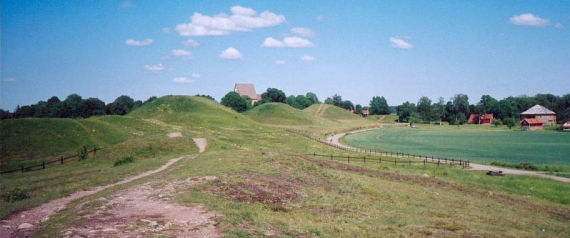
As archaeologists dug in preparation for a new railway line, they found traces of two rows of wooden pillars in Old Uppsala, an ancient pagan religious center. One stretched about 1,000 yards (1 kilometer) and the other was half as long.
Archaeologist Lena Beronius-Jorpeland said the colonnades were likely from the 5th century but their purpose is unclear. She called it Sweden's largest Iron Age construction and said the geometrical structure is unique.
"It is a completely straight line and they have dug postholes every 20 feet (6 meters)," she said. "They have had an idea of exactly where this line is going and where to build it. It is a fairly modern way of thinking and we don't have many traces of these sorts of constructions from that time."
Read the rest of this article...

Saturday, 19 October 2013

Uppsala unearths pagan road of old kings


Archaeologists digging in old Uppsala have discovered what appears to be a remarkable display of power of a fifth century Swedish chieftain. Massive posts marked the ancient road in perfect alignment for more than a kilometre. 

"It's exciting because we’ve never seen anything like it in these parts before," Robin Lucas, archaeologist at Uppland Museum, told The Local.

The archaeologists, who were excavating the area in preparation for a new railroad line, discovered 144 post-holes two metres wide and a metre deep in a perfectly straight line spanning a kilometre in Old Uppsala. The post holes are placed precisely six metres from each other.

"It appears to be a processional road leading to Old Uppsala, which was the seat of the early Swedish kings," Lucas said. 


Read the rest of this article...