The Viking Archaeology Blog is concerned with news reports featuring Viking period archaeology. It was primarily constructed as a source for the University of Oxford Online Course in Viking Archaeology: Vikings: Raiders, Traders and Settlers. For news reports for general European archaeology, go to The Archaeology of Europe News Blog.
Saturday, 23 March 2013
Online Viking Course
Vikings: Raiders, Traders and Settlers
University of Oxford Online and Distance Learning
8 May to 21 July 2013
Ravagers, despoilers, pagans, heathens - the Vikings are usually regarded as bloodthirsty seafaring pirates, whose impact on Europe was one of fear and terror. As they plundered the British Isles and the north Atlantic, these pagan invaders were seen by their Christian victims as a visitation from God.
Yet the Vikings were also traders, settlers and farmers with a highly developed artistic culture and legal system. Their network of trade routes stretching from Greenland to Byzantium and their settlements, resulted in the creation of the Duchy of Normandy in France, the foundation of the Kingdom of Russia in Kiev and Novgorod as well as the development of Irish towns including Cork, Dublin and Limerick.
This course will use recent findings from archaeology together with documentary records, to examine these varied aspects of the Viking world and to give a detailed and balanced view of this fascinating period.
A wide variety of online resources including Google Maps and Google Earth as well as specific Viking web pages, are used in conjunction with text books and specially designed online interactive media to create an exciting insight into the world of the Vikings.
Further details...
Pre-Viking tunic found by glacier as warming aids archaeology
A pre-Viking woollen tunic found beside a thawing glacier in south Norway shows how global warming is proving something of a boon for archaeology, scientists said on Thursday.
The greenish-brown, loose-fitting outer clothing - suitable for a person up to about 176 cms (5 ft 9 inches) tall - was found 2,000 metres (6,560 ft) above sea level on what may have been a Roman-era trade route in south Norway.
Carbon dating showed it was made around 300 AD.
"It's worrying that glaciers are melting but it's exciting for us archaeologists," Lars Piloe, a Danish archaeologist who works on Norway's glaciers, said at the first public showing of the tunic, which has been studied since it was found in 2011.
A Viking mitten dating from 800 AD and an ornate walking stick, a Bronze age leather shoe, ancient bows, and arrow heads used to hunt reindeer are also among 1,600 finds in Norway's southern mountains since thaws accelerated in 2006.
Read the rest of this article...
Stone Ships Show Signs of Maritime Network in Baltic Sea Region 3,000 Years Ago
In the middle of the Bronze Age, around 1000 BC, the amount of metal objects increased dramatically in the Baltic Sea region. Around the same time, a new type of stone monument, arranged in the form of ships, started to appear along the coasts. New research from the University of Gothenburg, Sweden shows that the stone ships were built by maritime groups.
The maritime groups were part of a network that extended across large parts of northern Europe. The network was maintained largely because of the strong dependence on bronze.
Archaeologists have long assumed that bronze was imported to Scandinavia from the south, and recent analyses have been able to confirm this notion. The distribution of bronze objects has been discussed frequently, with most analyses focusing on the links in the networks. The people behind the networks, however, are only rarely addressed, not to mention their meeting places.
Read the rest of this article...
Friday, 8 March 2013
First evidence of Viking-like 'sunstone' pulled from shipwreck
Researchers say this crystal found at the Alderney shipwreck near the Channel Islands could prove that fabled Viking sunstones really did exist.
Ancient lore has suggested that the Vikings used special crystals to find their way under less-than-sunny skies. Though none of these so-called "sunstones" has ever been found at Viking archaeological sites, a crystal uncovered in a British shipwreck could help prove they did indeed exist.
The crystal was found in the wreckage of the Alderney, an Elizabethan warship that sank near the Channel Islands in 1592. The stone was discovered less than 3 feet (1 meter) from a pair of navigation dividers, suggesting it may have been kept with the ship's other navigational tools, according to the research team headed by scientists at the University of Rennes in France.
A chemical analysis confirmed that the stone was Icelandic Spar, or calcite crystal, believed to be the Vikings' mineral of choice for theirfabled sunstones, mentioned in the 13th-century Viking saga of Saint Olaf.
Read the rest of this article...
Thursday, 7 March 2013
'Viking sunstone' found in shipwreck
A clear view of the Sun was not necessary for Vikings to navigate, scientists believe
A crystal found in a shipwreck could be similar to a sunstone - a mythical navigational aid said to have been used by Viking mariners, scientists believe.
The team from France say the transparent crystal may have been used to locate the Sun even on cloudy days.
This could help to explain how the Vikings were able to navigate across large tracts of the sea - well before the invention of the magnetic compass.
However, a number of academics treat the sunstone theory with scepticism.
Read the rest of this article...
ScienceShot: Sunstone Unearthed From Shipwreck
In 1592, a British ship sank near the island of Alderney in the English Channel carrying an odd piece of cargo: a small, angular crystal. Though cloudy and scuffed up from 4 centuries at the bottom of the sea, its precise geometry and proximity to the ship's navigation equipment caught the eye of a diver exploring the wreckage. Once it was brought back to land, a few European scientists began to suspect the mysterious object might be a calcite crystal, which they believe Vikings and other European seafarers used to navigate before the introduction of the magnetic compass.
A previous study showed that calcite crystals reveal the patterns of polarized light around the sun and, therefore, could have been used to determine its position in the sky even on cloudy days. That led researchers to believe these crystals, which are commonly found in Iceland and other parts of Scandinavia, might have been the powerful "sunstones" referred to in Norse legends, but they had no archaeological evidence to support their hypothesis—until now.
Read the rest of this article...
Some DNA ancestry services akin to 'genetic astrology'
Some customers want to find Viking ancestry, but almost every Briton has some, say researchers
Scientists have described some services provided by companies tracing ancestry using DNA as akin to astrology.
Some test findings tell people that they have links to groups such as Vikings, to particular migrations of people and sometimes to famous figures such as Napoleon or Cleopatra
But researchers working with a campaign group say DNA tests cannot provide accurate information about ancestry.
Ancestry companies insist they are able to provide a valuable service.
Read the rest of this article...
Monday, 4 March 2013
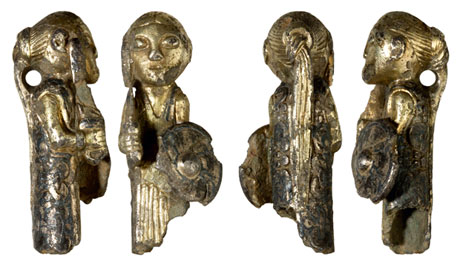
Flight of the valkyrie: the Viking figurine that's heading for Britain
Four views of the valkyrie, the only 3D depiction from the Viking era known to exist
Photograph: Asger Kjærgaard/Odense Bys Museer
Thumb-sized figurine discovered in Denmark by amateur archaeologist is the only 3D representation of a valkyrie ever found – and will arrive at British Museum in 2014
A little face peering up from a clod of frozen mud in Denmark has proved to be a unique find: the only known 3D Viking representation of a valkyrie.
The figurine, believed to date from about AD800, was found in December and has gone straight from conservation to display in the National Museum in Copenhagen. It will then be included in the exhibition on the Viking age that opens there in June and at the British Museum in 2014.
The legends of the valkyries – the ominous companions of the god Odin who descend on battlefields to choose which warriors will die – have been among the most enduring in Scandinavian folklore and literature. Later images, often inspired by Wagner's music, tend to be romantic creatures with flowing locks and voluptuous bodies.
Read the rest of this article...
Sunday, 3 March 2013
‘Vikings’ Sheds Light On Dark Ages
This Image Released By History Shows Travis Fimmel As Ragnar (Center), In A Scene From ‘Vikings’, Premiering On March 3 On History. (AP)
Series Aims To Smash Some Stereotypes
ASHFORD, Ireland, March 2, (AP): If historical fiction guru Michael Hirst has his way, a legendary Viking raider named Ragnar soon will conquer North America on behalf of the History channel. History’s ambitious Dark Ages drama “Vikings,” debuted Sunday after five months of filming in Ireland, dramatizes the myth-cloaked story of Ragnar Lothbrok, leader of a Viking people typically depicted as horn-helmeted brutes. Here’s one pointed clue that “Vikings” aims to smash a few stereotypes along with English skulls: There’s not a horned head in sight because real Vikings never actually wore them. This lavishly produced nine-parter, the biggest production ever commissioned by History with a reported budget of $40 million, seeks to get viewers rooting for the Norsemen even as they butcher defenseless Christians and loot their way through Europe. With a cast including Gabriel Byrne, the series debuted on History Sunday at 10 pm.
“It’s always been in the background of my mind to do a Viking project,” said Hirst, whose reputation as a master of history-based drama has grown from his days as screenwriter of 1998’s film “Elizabeth” to his creation of the 2007-10 Showtime series “The Tudors” about the life, times and ill-fated brides of Henry VIII.
Speaking to The Associated Press during the final weeks of shooting, in a rain-soaked ash forest in the Wicklow hills south of Dublin, Hirst said he loved poring over the history of an ill-understood person or period, then weaving it into compelling entertainment.
Hirst, the showrunner and executive producer of “Vikings” as well as its sole writer, found working with 8th-century Scandinavian warriors a liberating experience because, while there’s such rich legend in Norse culture, there’s simply no written history from the illiterate Vikings’ point of view. “By definition, not as much is known about the Dark Ages. This is particularly true of the Vikings who were pagans and didn’t write anything down,” he said as, in the distance, actors on horseback worked on a scene of Ragnar taking his son on a mission to a magical tree, one facet of Norse religious belief. “Because not a huge amount is known, that gives me some liberty. But I like working from historical material. I always start projects by reading as much research as possible.”
Read the rest of this article...
Monday, 25 February 2013
Exhibition preview: Capital of the North, Yorkshire Museum, York
© Gareth Buddo
"From the fifth century, for 1,000 years, York was the northern city,” says Natalie McCaul, the curator of archaeology at the museum doing this history justice several centuries later.
“It was the place from which the powerful ruled. Kings ruled the country from here. Archbishops led the church from here.
“Traders and merchants made fortunes. This exhibition will look at how York became so powerful, and the men and women who made it that way.”
Started with a film triggered by a coloured bookmark – one for adults, one for kids – this chronological run-through is divided into eight periods.
They include Anglian and Viking throwbacks, the House of York and the Tudor ages, symbolised by glitzy objects such as theEsrick Ring and theMiddleham Jewel, and depicting the likes of Richard III, Henry IV and William the Conqueror in cartoon form.
Read the rest of this article...
They include Anglian and Viking throwbacks, the House of York and the Tudor ages, symbolised by glitzy objects such as theEsrick Ring and theMiddleham Jewel, and depicting the likes of Richard III, Henry IV and William the Conqueror in cartoon form.
Read the rest of this article...
To claim someone has 'Viking ancestors' is no better than astrology
Last week we were told that Eddie Izzard is a Viking descendant on his mother's side and an Anglo-Saxon on his father's. Photograph: Danny Lawson/PA
Exaggerated claims from genetic ancestry testing companies undermine serious research into human genetic history
You may have missed the latest genetic discovery. As reported by The Daily Telegraph on Friday: "One million British men may be directly descended from the Roman legions". The story reappeared on Sunday, at the Who Do You Think You Are – Live event at London's Olympia, when it was repeated by Alistair Moffatt, the managing director of BritainsDNA, the company behind the claims.
Such stories are becoming increasingly common in newspapers, on television and radio. Last week on the BBC miniseries Meet the Izzards we were told that Eddie Izzard is a Viking descendant on his mother's side and an Anglo-Saxon descendant on his father's. Last year the Observer reported that Tom Conti has Saracen origins and is a relative of Napoleon Bonaparte.
Read the rest of this article...
Wednesday, 20 February 2013
GUERRILLA WARFARE IN THE NORWEGIAN IRON AGE
Bygdeborg Mur, Fylke: Østfold. Image: Kulturminnesøk
Researcher Ingrid Ystgaard from the Norwegian University of Science and Technology has studied the weapons found in graves and examined the battle techniques they would best suit during the important transition from the early to the late Iron Age in Norway around 500 AD.
A time of conflict
The Western Roman Empire was collapsing, and warfare engulfed Europe, major alliances were splintered and smaller bands of men started vying with one another. Ystgaard feels it may be significant that the battle axe became a favoured weapon during this time.
Ystgaard also studied the simple stone fortifications (Bygdeborgen ) built for protection on hilltops or other sites that were easy to defend. Relatively common, they were maintained between 400 AD to 600 AD and then, over the course of a single generation, abandoned and left to crumble.
The researcher wondered why people gave up fortifications that had been used for more than six generations and feels she has found one answer in some 100 weapon graves in mid-Norway dating to this turbulent and violent period.
Read the rest of this article...Monday, 18 February 2013
ARCHI The Archaeological Sites Index
ARCHI, the online searchable archaeological database, has added a new feature that allows users to add sites to their world-wide database.
The online form is easy to use and should prove to be an extremely useful addition to this site.
You can find the online form at:
Sunday, 17 February 2013
Archaeology Summer Courses at Oxford
The Oxford Experience is offering a number of archaeology courses this summer.
Each course lasts for one week and participants stay in the 16th century college of Christ Church.
The courses offered are:
Cathedrals of Britain by James Bond
An Introduction to Archaeology by David Beard
The Black Death by Trevor Rowley (course full)
Bishop Odo and the Bayeux Tapestry by Trevor Rowley
Colleges of Oxford by Julian Munby
The Architecture and Archaeology of Medieval Churches by David Beard (course full)
Cotswold Towns by Trevor Rowley
Treasures of the British Museum by Michael Duigan (course full)
Churches of England by Kate Tiller
Treasures of the Ashmolean Museum by Gail Bent
The Age of Stonehenge by Scott McCracken
The World of the Vikings by David Beard
Saturday, 16 February 2013
EMAS Easter Study Tour to Yorkshire
There are still a few places available on the Easter archaeological study tour to Yorkshire.
The Study Tour is organized by EMAS, the University of London Extra-Mural Archaeological Society, and is open to any one.
You can find further details here...
Friday, 15 February 2013
Secrets of York’s Viking heritage to be unveiled at festival
Vicky Harrison, collections manager at York Minster, with the Horn of Ulf, a ceremonial drinking horn
Secrets of York’s Viking heritage - including a ceremonial horn which was pivotal to the life of the city’s most famous landmark – will be unveiled over the half-term holiday.
As part of the 2013 Jorvik Viking Festival, teams at York Minster will host a series of events next week looking at why the Norse raiders were originally drawn to the city, using archaeological discoveries to shed fresh light on a key chapter in the city’s history.
The Children’s Chapel at the Minster will be the scene for Viking-themed family activities next Wednesday, Thursday and Friday between 10am and 3pm.
Read the rest of this article...
Friday, 8 February 2013
Remarkable new finds below York Minster
ARCHAEOLOGISTS have found evidence of a previously-unknown settlement below York Minster, dating back more than 1,000 years.
Experts working at the Minster say the finds – including a ninth-century coin – help to plug a gap in York’s known history, between the departure of the Romans in the fifth century and the arrivals of the Normans in 1066.
The period is referred to as the Dark Ages due to the lack of knowledge about the time, and although Viking finds have increased awareness of York history from 866 onwards, broader understanding is scarce.
Now, a team from York Archaeological Trust working in a pit below the Minster say they have made priceless finds, including evidence of a local mint.
Read the rest of this article...
York Minster finds shed light on post-Roman period
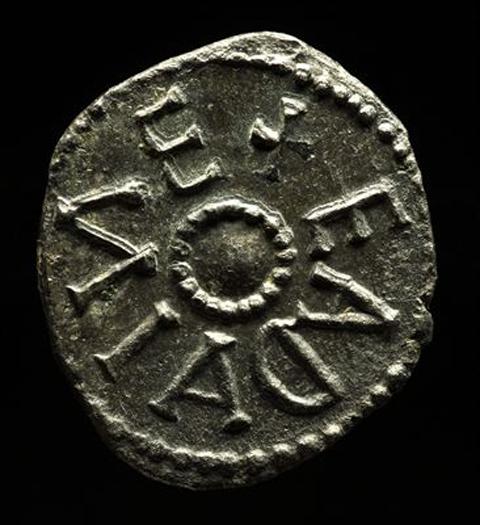
The rare Anglo-Saxon coin found at the minster shows that the city had its own mint [Credit: Maev Kennedy/Guardian]
The recent excavation of a pair of Viking feet and a tiny silver Anglo-Saxon coin may lack the glamour of the discovery of the last Plantagenet, but it has shone a light on one of the least known periods in the long history of York Minister: the centuries between the fall of Roman empire and the coming of the Vikings, in AD866.
The coin, no bigger than a 5p piece, is a sceat, minted in York. It is in such good condition that experts at the British Museum first thought it was a Victorian fake. So good is its state of repair that marks are legible identifying the maker as Eadwine, who also minted coins for the Northumbrian court. It proves that York had enough status and wealth in the early 9th century to support its own mint.
The coin is so pristine it was probably never circulated, so the archaeologists surmise that it was dropped accidentally almost as soon as it was struck, and that the mint must therefore have been very close to the site of the present enormous medieval church, which was built over layers of earlier foundations, some of them Roman.
Read the rest of this article...
Monday, 4 February 2013
FAROE ISLANDS BEFORE THE VIKINGS: NEW EVIDENCE
Kevin Edwards, Professor of Physical Geography, collecting samples for analysis on the Faroe Islands. Image: University of Aberdeen
Over the years, there has been much speculation regarding whether Irish monks may have travelled north across the sea to the Faroe Islands long before the Vikings ever arrived there.
However, despite the best efforts of scientists, researchers and archaeologists, nothing was uncovered that could prove the existence of settlers on the Faroes before the year 800 AD.
Until now!
Cereal pollen indicates early farming
Scientists from Aberdeen University in northeast Scotland have found something exciting in early Faroese pollen samples that gives them a reason to rethink Faroese prehistory: cereal pollen.
Kevin Edwards, a professor of physical geography and archaeology at Aberdeen University, tells ScienceNordic about the work:
”One of the main problems with cereal pollen is that it is produced in tiny quantities. Cereal pollen grains are also very large, and that means they don’t spread far with the wind. That’s why it’s so important to find.”
Now they have found cereal pollen in the early samples from the Islands there is just one problem: the soil where they found it is far from ideal for accurate pollen analysis, so they must try to discover more, but given the rarity it will be difficult.
Read the rest of this article...
Monday, 28 January 2013
Sealing Norse Greenlanders’ fate?
The mystery of what happened to Greenland’s Norse population is one step closer to being solved, as new evidence suggests that the colony did not die out because its inhabitants were unable to adapt to their new environment.
The first Viking settlers arrived in c.AD 1000, and over time their population swelled to around 3,000 people. By the 15th century, however, they had vanished, with no explanation provided by contemporary written sources. This disappearance has long been debated by archaeologists, with some suggesting that the farming communities were defeated by climate change, which made it difficult to cultivate cereal crops for bread and beer, and limited wild plant resources.
Research published in the Journal of the North Atlantic suggests that the Norse colonists simply adapted their diet to cope with their new circumstances, developing a taste for seals.
A team of Danish and Canadian archaeologists have examined 80 skeletons excavated from Norse settlement sites in western and south-western Greenland. Isotope analysis revealed that the population adopted an increasingly marine-based diet, with 50%-80% of their food consisting of seal meat by the 14th century.
Read the rest of this article...
Sunday, 27 January 2013
Living conditions and indoor air quality in a reconstructed Viking house
Jannie Marie Christensen & Morten Ryhl-Svendsen
How harmful to a person’s health were the indoor conditions in Danish Viking Age houses?
We do not have much direct evidence describing that. But we know that currently exposure to smoke from the solid fuel used for cooking and heating in open fireplaces in Third World homes is in harmful levels. It is among the top ten global risks for mortality and lost years of healthy life. Fuel smoke accounts for about 3 % of the global burden of diseases, mainly for women and young children, e.g.; lower respiratory infections, pulmonary diseases, and lung cancer
Read the rest of this article...
Where were the Viking brew houses?
Graham Dineley, craft brewer & Merryn Dineley, independent researcher
We have been studying traditional malting and beer brewing techniques for 15 years.
Graham is a craft brewer with 30 years’ experience of making beer from the grain.
Merryn is an archaeologist, completing her M.Phil ‘Barley Malt & Ale in the Neolithic’ at
the University of Manchester in 1999 and continuing research independently since then.
The brewing of ale is a skilled craft that has hardly changed over the millennia. For the
last few years we have been looking into the potential archaeological evidence for the
brewing of ale at Viking sites.
Read the rest of this article...
Wednesday, 16 January 2013
Report: Vikings ‘abandoned Greenland due to loneliness and limited foods’
Researchers have a new theory on why the Vikings ultimately decided to abandon Greenland after five centuries. The news comes via a report recently published in the Journal of the North Atlantic, in which scientists claim that the infamous group of explorers may have simply got tired of the isolation of Greenland and having to survive almost exclusively on seal meat.
The theory is the result of a new Danish-Canadian project, for which scientists carried out isotope analysis on the bone remnants of Vikings and the animals that were living beside them.
Longstanding theories as to why the Vikings chose to leave the icy landmass suggested that starvation amid a mini ice age and ongoing battles with the local Inuit population were the central causes of the uprooting.
Research leader Niels Lynnerup, an anthropologist from the University of Copenhagen, told the media that he believes they may have had a wealth of food, but added, “perhaps they were just sick and tired of living at the ends of the earth and having almost nothing but seals to eat,” The Daily Mail reports.
Read the rest of this article...
Monday, 14 January 2013
Death, Narrative and Understanding the Viking Mind
We think we understand the Vikings and their ways as a culture of warriors and pirates. The Vikings plagued the coast of early medieval Britain, robbing from monastic and secular sites until they finally set up permanent residence in the Danelaw.
In reality, however, the Vikings inhabited a nebulous dichotomy between violent warrior and peaceful merchant.Yet these views of the Norsemen originate from sources outside Viking culture, they originate from the victims, such as the monasteries that were attacked. As a result, our view of the Viking world is rarely from the perspective of people who were part of it. In a series of lectures to Cornell University, delivered in September 2012, Professor Neil Price of Aberdeen University attempts to bridge this gap and get inside the Viking mind.
Professor Price puts forward the argument that stories are at the heart of the Viking consciousness and that the Vikings perceived the world as a series of interconnected stories passed orally and lived out day to day. What modern scholars interpret as “Norse myths”, i.e. tales of the gods collected in what we call the Prose and Poetic Edda, were not only stories to entertain on the long Scandinavian nights, they were also a very real part of the nature of the world.
Read the rest of this article...
Sunday, 13 January 2013
Dig will root out secrets of Viking past
A two-mile stretch of land between Arrochar and Tarbet could hold vital clues to the Vikings' occupation of Scotland.
The fierce Norsemen are said to have dragged their boats across the isthmus - now the route of the busy A83 - to raid the rich Lomond settlements before encountering defeat at the Battle of Largs in 1263.
Now an appeal has gone out for volunteers to come forward and help archaeologists in their quest for Viking clues.
Read the rest of this article...
Friday, 11 January 2013
Archaeologists Find Clues to Viking Mystery
Until now, many experts had assumed that the cooling of the climate and
the resulting crop failures and famines had ushered in the end of the
Scandinavian colony. But now a Danish-Canadian team of scientists
believes that it can refute this theory of decline.
Here, archaeologists
dig up skeletons in Greenland.
On Sept. 14, 1408, Thorstein Olafsson and Sigrid Björnsdottir were married. The ceremony took place in a church on Hvalsey Fjord in Greenland that was only five meters (about 16 feet) tall.
It must have been difficult for the bride and groom to recognize each other in the dim light of the church. The milky light of late summer could only enter the turf-roofed church through an arched window on the east side and a few openings resembling arrow slits. After the ceremony, the guests fortified themselves with seal meat.
Read the rest of this article...
Don’t underestimate Viking women
The viking women were powerful. (Drawing: Erik Werenskiold)
The status of Viking women may be underestimated due to the way we interpret burial findings.
“To assume that Viking men were ranked above women is to impose modern values on the past, which would be misleading,” cautions Marianne Moen. She has been studying how women’s status and power is expressed through Viking burial findings. Her master’s thesis The Gendered Landscape argues that viking gender roles may have been more complex than we assume.Exploring new perspectives of Viking society is a theme which also will be the focus of the forthcoming Viking Worlds conference in March 2013, where Moen is a member of the organising committee.
Skewed interpretation
Our assumptions of gender roles in viking society could skew the way we interpret burial findings, Moen points out. She uses the 1904 excavation of the Oseberg long boat to illustrate the point. Rather than the skeleton of a powerful king or chieftain, the ship surprisingly contained two female skeletons.Read the rest of this article...
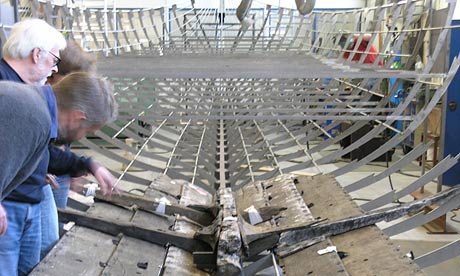
Rebirth of the Viking warship that may have helped Canute conquer the seas
Timbers of Roskilde 6 Viking warship being fitted into the steel frame for display in Copenhagen
and at the British Museum.
Now the ship's timbers are slowly drying out in giant steel tanks at the Danish national museum's conservation centre at Brede outside Copenhagen, and will soon again head across the North Sea – to be a star attraction at an exhibition in the British Museum.
The largest Viking warship ever found, it was discovered by chance in 1996 at Roskilde. It is estimated that building it would have taken up to 30,000 hours of skilled work, plus the labour of felling trees and hauling materials. At just over 36 metres, it was four metres longer than Henry VIII's flagship Mary Rose built 500 years later, and six metres longer than the Viking ship spectacularly recreated as Sea Stallion, which sailed from Scandinavia around Scotland to Dublin in 2007.
Read the rest of this article...
Tuesday, 18 December 2012
Greenland’s Viking settlers gorged on seals
The findings challenge the prevailing view of the Norse as farmers that would have stubbornly stuck to agriculture until they lost the battle with Greenland’s environment. These new results shake-up the traditional view of the Norse as farmers and have given archaeologists reason to rethink those theories.
“The Norse thought of themselves as farmers that cultivated the land and kept animals. But the archaeological evidence shows that they kept fewer and fewer animals, such as goats and sheep. So the farming identity was actually more a mental self-image, held in place by an over-class that maintained power through agriculture and land ownership, than it was a reality for ordinary people that were hardly picky eaters,” Jette Arneborg, archaeologist and curator at the National Museum of Denmark, says.
The first Norse settlers brought agriculture and livestock such as cattle, sheep, goats and pigs from Iceland. While they thought of themselves as farmers, they were not unfamiliar with hunting.
Read the rest of this article...
Norwegian Vikings grew hemp
Remnants of the Iron Age Sosteli farm in Vest-Agder County, Norway's
southernmost. Hemp was cultivated here even before the Viking Age.
(Photo: Morten Teinum/Visit Sørlandet)
The Sosteli farmsted, in Norway's southermmost Vest-Agder County, offers strong evidence that Vikings farmers actively cultivated cannabis, a recent analysis shows. The cannabis remains from the farmsted date from 650 AD to 800 AD.
This is not the first sign of hemp cultivation in Norway this far back in time, but the find is much more extensive than previous discoveries.
“The other instances were just individual finds of pollen grains. Much more has been found here,” says Frans-Arne Stylegar, an archaeologist and the county's curator.
Rope and textiles
Sosteli is also further away from current-day settlements than other sites where cannabis finds have been made.Hemp is the same plant as cannabis, or marijuana. But nothing indicates that the Vikings cultivated the plant to get people high.
Most likely it was grown for making textiles and rope.
Read the rest of this article...
Sunday, 16 December 2012
University of Oxford Online Courses in Archaeology
Now is the time to enrol for
Hilary term online courses in Archaeology.
Each courses lasts for 10
weeks, with the expectation of c. 10 hours study a week. Students submit two short assignments.
Successful completion of the courses carries
a credit of 10 CATS Points.
CATS Points from these
courses can now be used as part of the requirement for the new Certificate in Higher Education offered by the University of Oxford.
The following courses are
available: (click on the title for further information)
You can find general information about University of Oxford courses here...
The last battle of the Vikings
The Battle of Largs was the last time a Norwegian military force attacked Scotland
It was the battle which
led to the end of Viking influence over Scotland, when a terrifying
armada from Norway bore down on the Ayrshire town of Largs 750 years
ago.
The mainland was Scottish but the islands of Bute and Cumbrae just across from Largs were Norse.
In fact, the whole of the Hebrides - a region known as Innse Gall - gave its allegiance to the Vikings from western Norway.
"It was a war just waiting to happen," says underwater archaeologist Dr Jon Henderson.
Read the rest of this article...
Monday, 3 December 2012
Helmets, Viking gold and Royal boars: Portable Antiquities Scheme releases 2011 report
Nearly 100,000 archaeological discoveries – ranging from Roman helmets to Viking gold – were made during 2011, according to the annual report by the Portable Antiquities Scheme.
In a typically eventful year of soil digging, including primetime exposure for the Scheme’s greatest breakthroughs on the ITV series Secret Treasures, the official figures show an eight percent rise in finds, with a total of 970 Treasure cases.
Huge online interest also saw the accompanying website, finds.org.uk, honoured as the best research and online collection at the Best of the Web awards, with more than 463,000 people looking at 820,000 finds on the database of discoveries.
“It is a scheme which is envied the world over,” said Neil MacGregor, the Director of the British Museum, praising the Department for Culture Media and Sport and Treasure Hunting magazine, the appropriately-named periodical which published the report.
Read the rest of this article...
Saturday, 24 November 2012
Ottawa researcher’s firing derails Viking project
This should be the best of times for Pat Sutherland. November’s issue of National Geographic magazine and a documentary airing Thursday night on CBC’s The Nature of Things both highlight research the Ottawa archeologist has been doing in the Canadian Arctic for the past dozen years that could fundamentally alter our understanding of our early history.
If Sutherland is right, Norse seafarers — popularly known as Vikings — built an outpost on Baffin Island, now called Nanook, centuries before Columbus blundered on to North America. Moreover, there’s evidence they traded with the Dorset, the Arctic’s ancient, now-vanished inhabitants, for as many as 400 years.
”That’s incredible,” says Andrew Gregg, who wrote, directed and produced The Norse: An Arctic Mystery, the CBC documentary that recounts Sutherland’s findings. “That rewrites all the history books.”
But Sutherland’s pleasure at the recognition her discoveries are receiving has been sharply tempered by a harsh reality. Last April, even as the documentary about her work was being filmed, the 63-year-old, then curator of Arctic archeology at the Canadian Museum of Civilization, was abruptly dismissed from her job.
At the same time, museum officials also stripped her husband, Robert McGhee — himself a legendary Arctic archeologist described as “one of the most eminent scholars that Canada has produced” — of the emeritus status it had granted him after his retirement from the Gatineau museum in 2008.
Read the rest of this article...
Tuesday, 20 November 2012
How Vikings killed time
The Vikings played ball, lifted stones and wrestled. Often the games turned violent and bloody, occasionally resulting in death.
When Viking men played their games, the women watched - except in drinking games. This is a scene from at saga play in Steigen, Norway. (Photo: Mari Pedersen)
Life in the Viking Age was tough and hard, and physical work filled much of their days, but their lives were not without leisure.In a new study, Leszek Gardela uses archaeological findings and careful reading of Viking sagas to describe how Vikings killed time when they were in mood for entertainment.
The archaeologist paints a vivid picture of Viking life, but the familiarity of many of the activities suggests that while Vikings had shorter lives and arguably vented their frustrations in more violent ways than what most people do today, leisure time in the Viking Age was not too different from leisure time in 2012.
Read the rest of this article...
Greenland's viking settlers gorged on seals
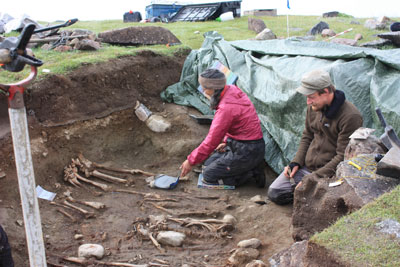
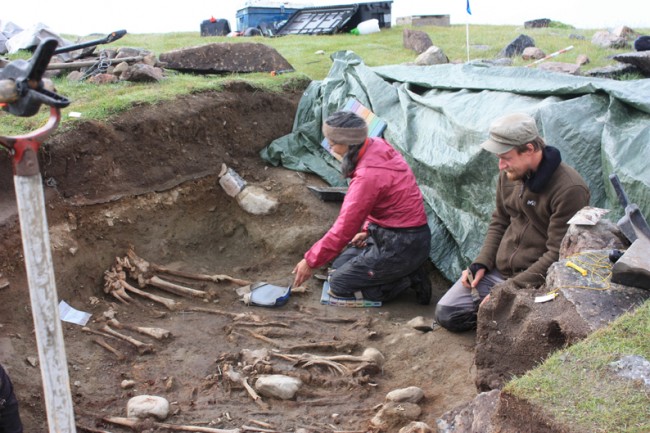
Archaeologists dig up skeletons of Norse settlers in 2010 at the Norse farm Ø64,
Igaliku Fjord, Østerbygden, Greenland. Photo: Jette Arneborg
UNSOLVED MYSTERY
Greenland's viking settlers, the Norse, disappeared suddenly and mysteriously from Greenland about 500 years ago. Natural disasters, climate change and the inability to adapt have all been proposed as theories to explain their disappearance. But now a Danish-Canadian research team has demonstrated the Norse society did not die out due to an inability to adapt to the Greenlandic diet: an isotopic analysis of their bones shows they ate plenty of seals.“Our analysis shows that the Norse in Greenland ate lots of food from the sea, especially seals,” says Jan Heinemeier, Institute of Physics and Astronomy, Aarhus University.
“Even though the Norse are traditionally thought of as farmers, they adapted quickly to the Arctic environment and the unique hunting opportunities. During the period they were in Greenland, the Norse ate gradually more seals. By the 14th century, seals made up between 50 and 80 per cent of their diet.”
Read the rest of this article...
Subscribe to:
Posts (Atom)