Wednesday, 21 March 2012
Norway's pilgrim trail
Reaching into its medieval past, Norway has revived an old pilgrim path as a challenging long-distance walking trail with possible spiritual vibes.
Called St. Olav’s Way after the country’s patron saint, it follows the footsteps of pilgrims to Trondheim, called Nidaros in the Middle Ages, and the earthly remains of St. Olav buried under its great cathedral.
In life, the saint was King Olav Haraldsson, credited with sealing Norway’s conversion to Christianity with a martyr’s death in battle in 1030. He was rushed into sainthood a year later. His spreading fame made Nidaros a major destination for European pilgrams, along with Jerusalem, Rome and Santiago de Compostela in Spain. Pilgrims trod St. Olav’s Way until Lutheranism reached Norway in 1537, shutting down saint worship.
Read the rest of this article...


Vikings 'carried mice to colonies'
Mice hitched a ride with Vikings to mount their own invasions in the 10th century, research has shown.
A genetic study shows that Viking longboats carried the weeny Norse warriors to colonies in Iceland and Greenland.
Scientists compared modern mouse DNA with ancient samples from mouse bones found at archaeological sites.
The analysis showed that the house mouse, Mus musculus domesticus, hitched lifts with Vikings in the early 10th century from either Norway or the northern British Isles.
Descendants of these stowaways can still be found in Iceland where DNA samples were collected from nine sites.
Read the rest of this article...
Tuesday, 20 March 2012
Unique pagan temple unearthed in Norway
A fascinating discovery is shedding light upon pre-Christian Scandinavian religion and early Christian inroads into Norway. In the Norwegian press, this highly important find is being called "unparalleled," "first of its kind" and "unique," said to have been "deliberately and carefully hidden" - from invading and destructive Christians.
 |
| The excavated temple [Credit: Preben Rønne, Science Museum/NTNU] |
Pre-Christian Temple Discovered in Norway
Excavations for house foundations at Ranheim, Norway, have uncovered a small "gudehovet" or "god temple," a structure used by pre-Christian Pagan peoples. Used from around the eighth or ninth centuries BCE until the 10th century AD/CE, the site is well preserved because it was covered over by its worshippers with a thick layer of peat, apparently in order to protect it from marauding Christians. It is surmised that the site's inhabitants fled Christian invaders, who were known to slaughter the natives and destroy their sacred sites. The covering over of the site coincides with an exodus recorded in ancient Norse sources, around the time of the first Norwegian king, Harald Fairhair (872-930). These Norse writings were later composed in Iceland, relating that some 40 people had come there from the area of Trøndelag, Norway.
Regarding this discovery at Ranheim, head archaeologist Preben Rønne of the Science Museum/University of Trondheim remarked, "Indications are that the people who deliberately covered up the god temple at Ranheim took the posts from the stave house/pole building, in addition to the soil from the altar, to the place where they settled down and raised a new god temple. Because our findings and the Norse sources work well together, the sources may be more reliable than many scientists believed."
Regarding this discovery at Ranheim, head archaeologist Preben Rønne of the Science Museum/University of Trondheim remarked, "Indications are that the people who deliberately covered up the god temple at Ranheim took the posts from the stave house/pole building, in addition to the soil from the altar, to the place where they settled down and raised a new god temple. Because our findings and the Norse sources work well together, the sources may be more reliable than many scientists believed."
The Viking Journey of mice and men
New research carried out at the University of York and published in BMC Evolutionary Biology has used evolutionary techniques on modern day and ancestral mouse mitochondrial DNA to show that the timeline of mouse colonisation matches that of Viking invasion.
House mice (Mus musculus) happily live wherever there are humans. When populations of humans migrate the mice often travel with them.Human settlement history over the last 1000 years is reflected in the genetic sequence of mouse mitochondrial DNA
During the Viking age (late 8th to mid 10th century) Vikings from Norway established colonies across Scotland, the Scottish islands, Ireland, and Isle of Man. They also explored the north Atlantic, settling in the Faroe Islands, Iceland, Newfoundland and Greenland. While they intentionally took with them domestic animals such as horses, sheep, goats and chickens they also inadvertently carried pest species, including mice.
A multinational team of researchers from the UK, USA, Iceland, Denmark and Sweden used techniques designed to characterize genetic similarity, and hence the relatedness of one population, or one individual, with another, to determine a mouse colonisation timeline.
Friday, 16 March 2012
New TV drama – “Vikings” – to be filmed in Ireland and Northern Europe
The History Channel in the US and History Television in Canada have announced they will be airing a scripted drama series, Vikings. The series will chronicle the extraordinary and ferocious world of the mighty Norsemen who raided, traded and explored during medieval times. Set to premiere in 2013, the series will be filmed in Ireland and throughout picturesque locations in Northern Europe. Shaw Media will be the broadcast partner in Canada, airing the show on HISTORY Television in Canada. The announcement was made by Nancy Dubuc,
“This is an amazing crossroads for HISTORY embarking on our first scripted series,” said Nancy Dubuc, President and General Manager of History. “People think they know about the Vikings – we see references to them all the time in our popular culture from TV commercials to football teams – but the reality is so much more fascinating and complex, more vivid, visceral and powerful than popular legend. We will explore the mysteries of the Vikings – the adventures they took and the people who led them. And we will start to understand a past that is very much part of our collective DNA today.”
Read the rest of this article...
Thursday, 15 March 2012
Professor Ray Page (1924 - 2012)
The Department of Anglo-Saxon, Norse & Celtic is sad to announce the death on 10 March 2012 of Professor Raymond Page, Emeritus Elrington and Bosworth Professor of Anglo-Saxon in the University of Cambridge, and Fellow and former Librarian of Corpus Christi College.
Born in 1924, Professor Page was an undergraduate at the University of Nottingham, and came to Cambridge in the 1960s. He became Fellow and Librarian of Corpus Christi College, and was for many years Lecturer and then Reader in Old Norse language and literature in the Department of ASNC.
From 1984 until his retirement in 1991 he was Elrington and Bosworth Professor of Anglo-Saxon. He will be fondly remembered by many for his teaching of Old Norse and of Scandinavian history in the Viking Age, and as the ‘silver-haired librarian’ of Corpus. His funeral will take place in the chapel of Corpus Christi College on Thursday 22 March at 2 p.m.
Read the rest of this article...
New viking village discovered
Norwegian archeologists have discovered the foundations of at least 15 buildings, an 80-meter long street and a harbour near Gokstadhaugen burial mound in Sandefjord.
So far, the ground hasn’t even been broken into. The remains that could potentially be part of an entire village have been located by using ground penetrating radar and magnetometer.
Archeologists from the Cultural and Historic museum in Oslo, the Norwegian Institute for Cultural Heritage Research (NIKU) and Vestfold County made the discovery at Gokstadhaugen, where the famous Gokstad viking ship and burial ground were also discovered in 1880.
Read the rest of this article...
Wednesday, 14 March 2012
New Norway Viking settlement discovered
Experts have found a hitherto unknown Viking area with the aid of
modern science and no shovels, reports say.

Gokstad's grave mound can be seen in the backgroundScientists using a magnetometer in Gokstad
Photo: Norwegian Institute for Cultural heritage
Using a ground-penetrating radar (GPR) and magnetometer, surveys have revealed the settlement in Sandefjord in Gokstadhaugen, eastern Norway, has 15 buildings, an 80-metre long street and a port.
Archaeologists from Oslo’s Museum of Cultural History and the Norwegian Institute for Cultural heritage Research (NIKU) were among those that made the discovery, in cooperation with Vestfold County.
Work in Gokstadhaugen began in 2011 with drilling there, as well as experts making geophysical surveys from the sea a northwards in what is called Gokstad Valley (Gokstaddalen).
Read the rest of this article...
Thursday, 8 March 2012
Scots and English universities to share Viking knowledge
Scottish and English universities are
to work together in an effort to expand knowledge of Viking culture.
The project will include seven-day field trips for students to Viking sites on Orkney.
It will conclude with public exhibitions showcasing information gathered by the students.
Dr Heather O'Donoghue, reader in Old Norse at Oxford University and project leader, said the project would be an opportunity to share knowledge on the Vikings.
Read the rest of this article...
Sunday, 26 February 2012
Unique runestone included in UNESCO list
A unique runestone that is the first to mention Norway as a country and that
documents the establishment of Christianity there, has been placed on a list of
world heritage documents of international importance.

The Kuli Stone. Image: NTNU Museum of Natural History
of Archaeology
The text on the Kuli Stone is the first known occurrence and use of the term “Nóregi” – “Norway” – in the country it names. The stone has additional importance as it also dates to the establishment of Christianity in the country in a phrase that is often transcribed as:
“… twelve winters Christianity had been in Norway”.
Read the rest of this article...
Norse settlement may help us adapt to global changes
limate scientists have been examining the past environments and archaeological remains of Norse Greenland, Iceland and North Atlantic Islands for several years. They have been particularly interested in the end period of the settlements in the early part of the Little Ice Age (1300-1870 CE) and have been able to analyse how well the Norse responded to changes in economy, trade, politics and technology, against a backdrop of changing climate.
They found that Norse societies fared best by keeping their options open when managing their long-term sustainability, adapting their trade links, turning their backs on some economic options and acquiring food from a variety of wild and farmed sources. Researchers say their findings could help inform decisions on how modern society responds to global challenges but also warns of inherent instabilities that do not directly link to climate.
In the middle ages, people in Iceland embraced economic changes sweeping Europe, developed trading in fish and wool and endured hard times to build a flourishing sustainable society. In Greenland, however, medieval communities maintained traditional Viking trade in prestige goods such as walrus ivory.
Read the rest of this article...
Wednesday, 15 February 2012
Well-Red Vikings sail in for festival
YORK’S annual Viking invasion has created a combination between Norse history and a traditional fairy story.
A key event in this year’s Jorvik Viking festival saw youth and experience come together when Phillip Sherman, of Booster Cushion Theatre, and several young helpers performed Eric the Red Riding Hood at the Early Music Centre, in Walmgate, York.
The play involves the heroine of the story encountering a myriad of characters in a humorous retelling of Little Red Riding Hood.
Read the rest of this article...
Monday, 13 February 2012
Roar talent at Viking festival
THE annual Jorvik Viking Festival swung into action with a skirmish in York city centre.
Viking characters wearing battle attire took over Coppergate to help start the popular festival, which is expected to attract 40,000 people.
This year marks the 27th festival and will feature more than 80 events culminating in a ferocious battle before the Festival Of Fire climax featuring fire jugglers, a firework display and the burning of a 60ft-longship on Bustardthorpe Field at York Racecourse on Saturday.
Read the rest of this article...
Friday, 10 February 2012
Time Team: Mary-Ann Ochota quits Channel 4 archaeological show
Time Team has been thrown into disarray after Mary-Ann Ochota became the second presenter to leave the Channel 4 archaeological programme.
Mary-Ann Ochota, 30, who holds a master’s degree in archaeology and
anthropology from Cambridge University, has left the show after a row with
Prof Mick Aston, the archaeologist.
Her leaving the show comes after Prof Aston, 65, also
quit the show after producers hired Ms Ochota, a former model, as
the programme’s co-presenter with Tony Robinson.
Prof Ashton, who has been on the show for 19 years, said he had been left
“really angry” by changes which led to the introduction of co-presenter and
some archaeologists being axed.
Read the rest of this article...
Thursday, 9 February 2012
Reply to my complaint to Channel 4 concerning Time Team Changes
As expected, a wishy-washy response - but the more people who write in, the better!
"Dear Mr Beard,
Thank you for contacting Channel 4 Viewer Enquiries regarding TIME TEAM.
We are sorry to hear that you are unhappy with the new format of the show and that Prof. Mick Aston has decided to leave. We are saddened by Mick 's decision to leave, he has been a fantastic member of the Time Team team and we wish him well in the future.
Please be assured your complaint has been logged and noted for the information of those responsible for our programming.
Thank you again for taking the time to contact us. We appreciate all feedback from our viewers; complimentary or otherwise.
Regards,
Doug Masterson
Channel 4 Viewer Enquiries"
Please take the time to send your own comments to Channel 4. Use the link here...
See the original story " Mick Aston quits Time Team after producers hire former model co-presenter"...
Wednesday, 8 February 2012
Mick Aston quits Time Team after producers hire former model co-presenter
Mick Aston, the archeologist, has quit Time Team after producers hired a former model as the programme’s co-presenter.
The 65-year-old, who has been on the show for 19 years, said he had been left
“really angry” by changes which led to the introduction of co-presenter
Mary-Ann Ochota and some archaeologists being axed.
In an interview with the magazine British Archaeology, Prof Aston, the show’s
former site director, said: “The time had come to leave. I never made any
money out of it, but a lot of my soul went into it. I feel really, really
angry about it.”
He was responding to changes first proposed by producers at Channel 4 in late
2010, which included a new presenter to join Tony Robinson and decisions to
“cut down the informative stuff about the archaeology”.
Read the rest of this article...
Click here to contact Channel 4 to tell them what you think of their decision.
Monday, 6 February 2012
Viking barley in Greenland
The Vikings are both famous and notorious for their liking of beer and mead and archaeologists have discussed for years whether Eric the Red (ca 950-1010) and his followers had to make do without the golden drink when they settled in Greenland around the year 1,000: The climate was mild when they landed, but was it warm enough for growing barley?
Researchers from the National Museum in Copenhagen say the answer to the question is ‘yes’. In a unique find, they uncovered tiny fragments of charred barley grains in a Viking midden on Greenland.
The find is final proof that the first Vikings to live in Greenland did grow barley – the most important ingredient in making a form of porridge, baking bread and of course in brewing beer, traditionally seen as the staple foods in the Vikings’ diet.
Read the rest of this article...
Viking axe find in Slimbridge discounted by archaeologists
An axe head found in a
garden in Gloucestershire, which was claimed to be of Viking origin, is
an 18th Century woodworking tool, experts have said.
Slimbridge Local History Society who said last week it was Viking have now renamed it the "Slimbridge axe head".
A meeting about the find is taking place in Slimbridge on 21 February.
Read the rest of this article...
Thursday, 2 February 2012
Wirral’s history from the Bronze Age to the Vikings to be laid bare at lecture
KEEN historians can learn more about the latest local archaeological excavations in Wirral at a talk being held next week.
The Friends of Greasby Library will host a lecture by local historian Rob Philpott who will describe how finds in a garden in Irby shed new light on settlements in the area from the Bronze Age to the arrival of the Vikings.
Roman pottery was discovered by chance, providing new evidence to link the earliest inhabitants of Wirral with later Scandinavian settlers.
And the beginnings of human settlement in Wirral have been dated to the Mesolithic period, following finds in the early 1990’s at Greasby.
Read the rest of this article...
Viking axe head discovery is 'evidence of battle'

Archaeologists think the axe
head could be evidence of a battle in 894 AD
A Viking axe head found in a Gloucestershire village could
be evidence of a battle more than 1,100 years ago, according to
archaeologists.
Historians say a band of Vikings sailed up the River Severn and fought against the Anglo-Saxons in 894 AD.
Archaeologists say where the axe head was found is where they could have tied up their ships.
Read the rest of this article...
Sunday, 29 January 2012
Friday, 27 January 2012
Archaeology Courses at the Oxford Experience 2012
The Oxford Experience Summer School
1 July to 11 August 2012
The Oxford Experience is a residential summer school held at the college of Christ Church, University of Oxford.
The programme consists of 6 weeks of courses and participants attend for one or more weeks.
It offers a choice of twelve seminars each week over a period of five weeks. Participants do not need any formal qualifications to take part, just an interest in their chosen subject and a desire to meet like-minded people.
You can also find details of
the various archaeology courses offered at Oxford Experience here...
Thursday, 26 January 2012
Mass grave belonged to Viking mercenaries
The burial site, containing the bodies of 54 young men, was unearthed at
Ridgeway Hill near Weymouth in 2009 ahead of the construction of a new road, but
the identity of the bodies within has mystified experts.
Because the men's severed heads were piled up on one side of the pit, it was
assumed they had been the unfortunate victims of a mass execution.
Radiocarbon dating showed that the men had been killed some time around the
year 1000, and isotope testing on their teeth found that they were from
Scandinavia, suggesting they may have been Viking invaders.
Now an archaeologist from Cambridge University has put forward a theory that
the men were a gang of Viking mercenaries who were murdered on the order of the
English king Aethelred II.
Read the rest of this article...
The Viking death squads who got a taste of their own medicine: Mass grave shows how the Anglo-Saxons hit back at invaders
A mass grave found in Dorset contains the bodies of an elite ‘hit squad’ of invading Viking warriors, experts claim.
All decapitated and buried alongside their severed heads, the 54 skeletons were discovered in 2009 by workmen digging a road.
Archaeologists dated their bones to around the year 1,000 but had few other clues as to the identities of the men who met such a sticky end.
Now a researcher at Cambridge University claims to have pieced the story together in a documentary to be screened tonight.
Read the rest of this article...
Viking mass grave linked to elite killers of the medieval world
A crew of Viking mercenaries – some of the fiercest and most feared killers in the medieval world – could be the occupants of a mysterious mass grave in the south of England, according to a new theory.
The intriguing hypothesis is being put forward in a documentary, Viking Apocalypse, which will premiere on National Geographic UK on Wednesday, 25 January, and attempts to piece together the identities of a group of men who were apparently the victims of a horrific mass execution around the turn of the 11th century.
Their burial pit, at Ridgeway Hill, Dorset, was found in 2009 while archaeologists were working in the area ahead of the construction of a new road. In it, researchers made the gruesome discovery of the decapitated bodies of 54 young men. All had been dumped in the shallow grave, and their heads had been piled up on the far side.
Read the rest of this article...
Skeletons found in Dorset mass grave 'were mercenaries'
A mass grave in Dorset
containing 54 decapitated skeletons was a burial ground for violent
Viking mercenaries, according to a Cambridge archaeologist.
Archaeologists found the bodies of 54 men who had all been decapitated and placed in shallow graves with their heads piled up to one side.
Carbon dating and isotype tests revealed the bodies were Scandinavian and dated from the 11th Century.
Read the rest of this article...
Wednesday, 25 January 2012
Archaeologists dig spot where hoard was found
ARCHAEOLOGISTS have examined the secret Furness site where a hoard of silver Viking booty was unearthed by a metal detectorist.
The hoard, dated to around 955, was officially declared treasure in September.
It has been described as “the missing link” by experts, who say it is the long-awaited evidence of a material culture of the 9th and 10th Century Vikings who settled in the Furness peninsula.
Read the rest of this article...
Outreach and widening participation
Applications are now open for our annual Sutton Trust Summer School in Anglo-Saxon, Norse & Celtic, which will take place on 13th-17th August. The Sutton Trust is an organisation which seeks to promote social mobility through education, and each year participants in our Summer School are given the opportunity to experience life as a Cambridge undergraduate: staying in a College, attending lectures and seminars, and receiving one-to-one or small group 'supervisions' on the languages, literatures, and history of medieval Britain, Ireland and Scandinavia. More information on how to apply is available via the University's webpages.
Read the rest of this article...
Monday, 23 January 2012
Researchers collect DNA from men with possible links to York’s Viking past
MEN with Viking surnames filled the meeting room of New Earswick Folk Hall and queued to help research into the ethnic origins of the British people.
Academics were collecting DNA from men with Viking names to see if they are directly descended from the Scandanavian traders and seaman who once ruled York and Yorkshire.
It was the first of four gatherings across northern England and followed a public appeal for people with Viking surnames to come forward.
Read the rest of this article...
Viking king discovery claims
AN amateur historian from Yorkshire claims to have discovered a new Viking king of York.
Musician and poet Damian Bullen has developed a theory after reading about the Silverdale Haul, a collection of coins and jewellery found in Lancashire in September, of similar designs to coins from about 900AD.
One of the Medieval coins has a design which has never been seen before, and carried the name Airdeconut, believed to be a derivation of Harthacnut, an early king of England and Denmark.
Read the rest of this article...
Monday, 9 January 2012
Archaeologists hunt for Viking heritage in Sherwood Forest
The land surrounding a
mysterious ancient monument in Sherwood Forest is to be researched after
a local history group received a £50,000 lottery grant.
Experts surveyed the site this year and suggested the wider area be looked at.
The Friends of Thynghowe now plan to search for further evidence of Vikings including a "court circle".
Read the rest of this article...
Tuesday, 20 December 2011
Was St Edmund killed by the Vikings in Essex?
The story of Edmund, king and martyr, has become a kind of foundation myth for the county of Suffolk, but contains at least one element of truth – in 869 there was a battle between the East Anglians and the Vikings; Edmund was captured and later killed.
However, the site of the battle (recorded as Hægelisdun) was forgotten, and different modern historians have suggested that it was at Hoxne in Suffolk, Hellesdon in Norfolk, or at Bradfield St Clare near Bury. The new proposal by Dr Briggs is unusual in that it is based on a detailed analysis of the linguistic structure of the various place-names involved. UWE Bristol has several experts among its staff in the study of both place-names and personal names from the viewpoint of historical linguistics. The use of place-names has long been recognized as an essential input into the broad study of settlement and migration, but the current work is an intriguing example of a precise conclusion about one historical event being drawn purely from place-name research.
Read the rest of this article...
Mysterious Viking-era Graves Found With Treasure
Sword at his side, the so-called Young Warrior (left) is among the thousand-year-old discoveries in a newfound cemetery in Poland, a new study says.
The burial ground holds not only a hoard of precious objects but also hints of human sacrifice—and several dozen graves of a mysterious people with links to both the Vikings and the rulers of the founding states of eastern Europe.
(Related: "'Thor's Hammer' Found in Viking Grave.")
Researchers are especially intrigued by the Young Warrior, who died a violent death in his 20s. The man's jaw is fractured, his skull laced with cut marks. The sword provides further evidence of a martial life.
Read the rest of this article...
Monday, 19 December 2011
Silverdale Viking Hoard stars in Treasure and Portable Antiquities Scheme reports
The British Museum is delighted with the continuing success of the Treasure Act and the Portable Antiquities Scheme, and they have every right to be.
The reports, launched last week, detail 90,099 finds and 860 Treasure cases in 2010 alone; since the Scheme started there have been 750,000 "finds" across England and Wales, all listed on the website www.finds.org.uk.
The highlight of the press launch was a selection of finds from the Silverdale Viking Hoard, discovered in North Lancashire in September 2011 by local metal-detectorist Darren Webster.
Read the rest of this article...
Saturday, 17 December 2011
University of Oxford Online Archaeology Courses
Enrolment is now open for the following University of Oxford online courses in archaeology:
Archaeology of the Bible Lands (Online)
Exploring Roman Britain (Online)
Greek Mythology (Online)
Origins of Human Behaviour (Online)
Ritual and Religion in Prehistory (Online)
Vikings: Raiders, Traders and Settlers (Online)
Silverdale silver Viking hoard declared treasure
A hoard of Viking silver found in
Lancashire has been declared as treasure by a coroner.
It was declared treasure by Lancashire deputy coroner Simon Jones at a hearing in Lancaster.
Lancashire Finds Liaison Officer Dot Boughton said the hoard was "very significant".
Lancaster City Museum has said it would attempt to keep the hoard in the area once it received an official valuation early in the new year.
Read the rest of this article...
Friday, 16 December 2011
Researchers puzzled as grave did not hold remains of medieval Swedish king
Earlier this year, researchers in Sweden excavated what they believe was the tomb of King Magnus Ladulås (1240-1290) at Riddarholmen Church in Stockholm, hoping to learn more about the medieval Swedish ruler and his family. But DNA tests have revealed that the bodies of nine people buried in the tomb actually died sometime between 1430 and 1520.
Records show that the King Magnus wished to have his remains buried in the church, and in 1573 the Swedish King, Johan III erected a sarcophagus with an effigy on top of what he believed was the location of the tomb.
The researchers said on their blog: “It is a fantastic story that is rolled up in front of our eyes. Johan II had the impressive tomb put up above the wrong grave and this historical hoax has been unchallenged for 400 years! On good grounds we believe instead that Magnus Ladulås was placed in the southern tomb in front of the choir, i.e. the tomb in which King Karl Knutsson placed himself in the 15th century. With the knowledge we have today it is obvious that we have only done half the job. In order to make further progress in this project we need to open also the southern part of the choir-tombs (the tomb of Karl Knutsson) and investigate all individuals there.”
Read the rest of this article...
Viking Hoard discovered in England
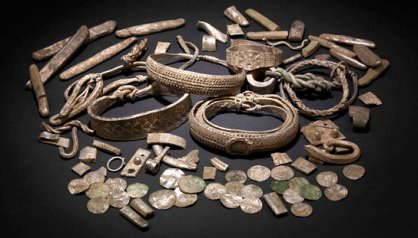
In what is being described as a “very exciting find” over 200 items dating back to around the year 900 have been discovered near Silverdale, in north Lancashire. Now known as the Silverdale Viking Hoard, the collection cotnains a total of 201 silver objects and a well preserved lead container. Of particular interest is the fact that the hoard contains a previously unrecorded coin type, probably carrying the name of an otherwise unknown Viking ruler in northern England.
Researchers are interested in the single coin that shows a previously unknown Viking ruler. One side of the coin has the words DNS (Dominus) REX, arranged in the form of a cross, reflecting the fact that many Vikings had converted to Christianity within a generation of settling in Britain. The other side has the enigmatic inscription. AIRDECONUT, which appears to be an attempt to represent the Scandinavian name Harthacnut. The design of the coin relates to known coins of the kings Siefredus and Cnut, who ruled the Viking kingdom of Northumbria around AD 900, but Harthacnut is otherwise unrecorded.
Read the rest of this article...
Thursday, 15 December 2011
Evidence for unknown Viking king Airdeconut found in Lancashire
201-piece silver hoard from AD900 discovered by a metal detectorist in Silverdale, Lancashire
Evidence of a previously unknown Viking king has been discovered in a hoard of silver found by a metal detectorist, stashed in a lead box in a field in Lancashire.
The 201 pieces of silver including beautiful arm rings, worn by Viking warriors, were found on the outskirts of Silverdale, a village near the coast in north Lancashire, by Darren Webster, using the metal detector his wife gave him as a Christmas present. It adds up to more than 1kg of silver, probably stashed for safe keeping around AD900 at a time of wars and power struggles among the Vikings of northern England, and never recovered.
Read the rest of this article...
Wednesday, 14 December 2011
Silverdale Viking hoard examined by British Museum
A hoard of Viking coins and jewellery
found buried in north Lancashire is being examined by experts at the British
Museum.
The hoard, which was in a lead box, includes a coin thought to refer to a previously unknown Viking ruler.
A coroner will decide this week if the hoard qualifies as treasure trove.
Read the rest of this article...
Incredible Viking hoard from days of Alfred the Great could 'fill in the blanks' about a murky period in British history
A man who found a hoard of Viking silver that had lain undetected for hundreds of years has described his discovery as ‘lucky’.
Darren Webster got his metal detector out in a field near his home when he had an hour to spare one day, and 20 minutes later was digging up a hoard of hidden silver coins and jewellery.
The 39-year-old stone mason from Lancashire made the discovery in September on land around Silverdale in north Lancashire. The artifacts date back to the ninth century and the rule of Alfred the Great.
Read the rest of this article...
Viking hoard provides new clues to 'previously unknown ruler'
One of the most important hoards of Viking silver ever found in Britain contains valuable coins bearing the identity of a previously unknown ruler, it emerged yesterday.
The “hugely significant” hoard of 1,000-year-old artefacts includes more than
200 coins, ingots and pieces of silver jewellery that was found buried
underground in north Lancashire.
Experts at the British Museum are currently examining the hoard after it was
discovered in a lead pot by a metal detector enthusiast. A coroner will decide
later this week whether it qualifies as treasure.
The hoard was placed in a lead box and buried underground at a time when the
Anglo-Saxons were attempting to wrest control of the north of the country from
the Vikings.
Read the rest of this article...
Evidence for unknown Viking king Airdeconut found in Lancashire
201-piece silver hoard from AD900 discovered by a metal detectorist in Silverdale, Lancashire
Evidence of a previously unknown Viking king has been discovered in a hoard of silver found by a metal detectorist, stashed in a lead box in a field in Lancashire.
The 201 pieces of silver including beautiful arm rings, worn by Viking warriors, were found on the outskirts of Silverdale, a village near the coast in north Lancashire, by Darren Webster, using the metal detector his wife gave him as a Christmas present. It adds up to more than 1kg of silver, probably stashed for safe keeping around AD900 at a time of wars and power struggles among the Vikings of northern England, and never recovered.
Airdeconut – thought to be the Anglo Saxon coin maker's struggle to get to grips with the Viking name Harthacnut – was found on one of the coins in the hoard.
Read the rest of this article...
Sunday, 11 December 2011
Archaeologists Return to Investigate Viking Period Site in Gotland
he world’s largest silver hoard was discovered in an agricultural field on an island in Scandinavia. The hoard weighed about 67 kilos, consisting of two caches about 3 meters apart. Dated to the 9th century AD, the hoard boasted a pure silver cache of more than 14,200 coins and nearly 500 silver arm rings and other objects, placed in wooden boxes beneath the floor of a Viking Age house structure. Related to this discovery was another find of bronze objects, weighing as much as 20 kilos, also placed in a wooden box.
The island, known as Gotland, is a part of Sweden and situated in the middle of the Baltic Sea. It sports a rich heritage when it comes to the Early Middle Ages and the time of the Vikings. In terms of trade, it occupied a uniquely strategic trading position for the flow of goods east and west between Scandinavia and other parts of Europe, enriching its inhabitants with luxury goods that otherwise would have eluded their reach. To the Vikings, it was a place of settlement. No place in Scandinavia can compare to the massive amount of Viking artifacts that have been discovered here over the last 200 years. And no region has yielded as many silver hoards as Gotland. In fact, more then 700 hundred hoards, with more than 150,000 silver coins from countries as far away as the Arabic world, have testified to the significance of this island during the Viking Age.
Read the rest of this article...
Thursday, 8 December 2011
Viking Quiz
What do you know about the Vikings?
Try this online quiz. It loads 10 randomly selected questions from a large database, so each time that you return to the site you get a different set of questions.
You can find the Viking Quiz here…Viking Quiz
How Scandinavian is Scotland?
The Scottish government is exploring closer links with Nordic nations in the event of independence, reports have suggested. But just how similar is Scotland to its northern neighbours?
They don't make bridies in Bergen or Tunnock's Tea Cakes in Torsby.
Nor is Hakkebøf half as popular in Hamilton or Helensburgh as it is in Hvidovre.
But the North Sea which separates Scotland from Scandinavia could become slightly less of a divide if political leaders in Edinburgh have their way.
Read the rest of this article...
Friday, 2 December 2011
Archeological Discovery Indicates Human Sacrifice
Archeological research of pagan graves in the valley Þegjandadalur in Suður-Þingeyjasýsla county in northeast Iceland support the theory that ritual human sacrifice was practiced during paganism in Iceland.
An L-shaped turf wall was discovered in Þegjandadalur, which is believed to have been constructed before Icelanders converted to Christianity in 1000 AD, Morgunblaðið reports.
In a large hole in the wall fractions of a human skull were found, a jawbone of a cat and various other animal bones, including a sheep jawbone and a several cattle bones.
In a small grave up against the turf wall bones of a newborn baby in their original resting place were discovered.
Read the rest of this article...
New Icelandic volcano eruption could have global impact
Hundreds of metres under
one of Iceland's largest glaciers there are signs of an imminent
volcanic eruption that could be one of the most powerful the country has
seen in almost a century.
"There has been a great deal of seismic activity," says Ford Cochran, the National Geographic's expert on Iceland.
Read the rest of this article...
Subscribe to:
Posts (Atom)